
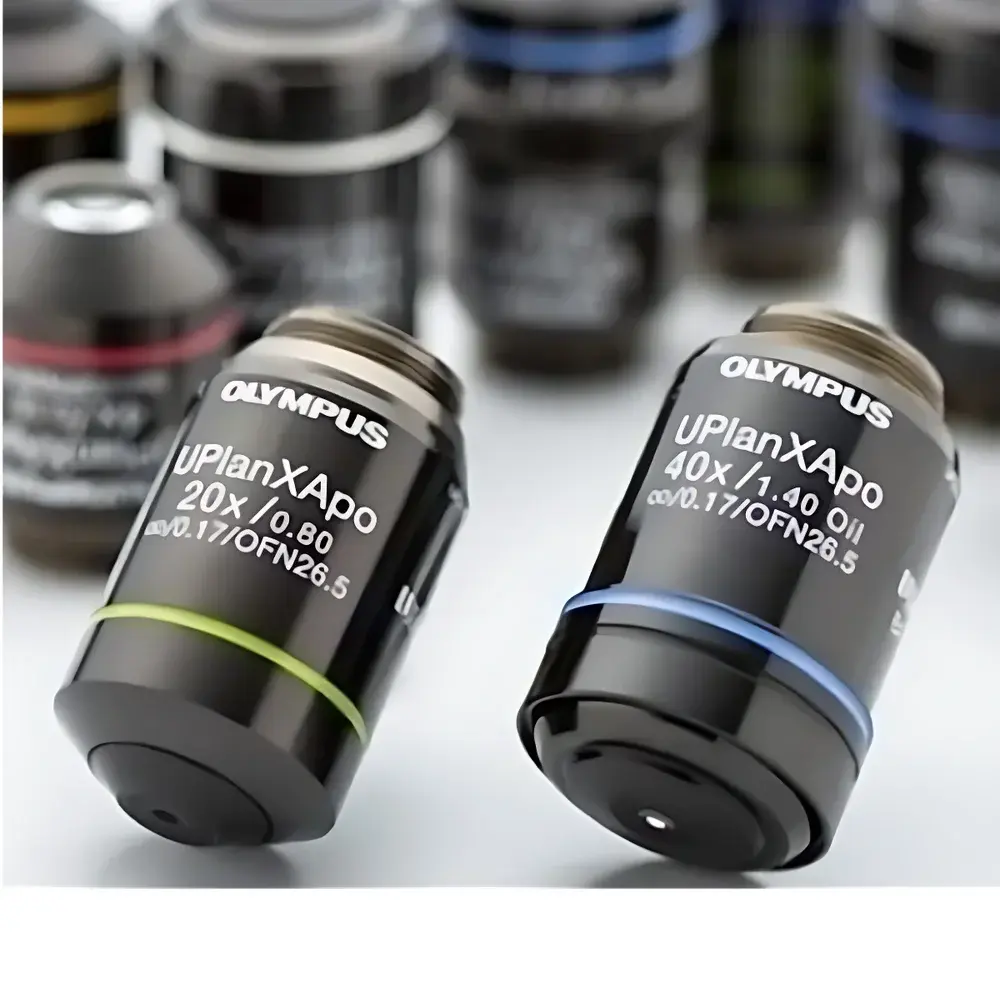
Olympus UIS2 Microscope Objective Lens
| Brand | Olympus |
|---|---|
| Origin | Japan |
| Manufacturer Type | Authorized Distributor |
| Product Category | Imported Optical Component |
| Model | UIS2 |
| Component Type | Optical Element |
Overview
The Olympus UIS2 Microscope Objective Lens is a precision-engineered optical component designed for integration into high-performance upright, inverted, and modular optical systems. Built upon Olympus’ century-long legacy in optical science, the UIS2 objective series implements an infinite-conjugate optical design (focal length ∞) with a standardized 45 mm parfocal distance—ensuring seamless interchangeability across the UIS2-compatible microscope platform. These objectives utilize advanced multi-layer anti-reflection coatings optimized for high transmission across the visible spectrum (400–700 nm), with extended performance into the near-infrared (up to 900 nm) for specialized applications such as fluorescence lifetime imaging (FLIM) and infrared contrast microscopy. The mechanical design emphasizes thermal stability, minimal axial drift, and robust chromatic and spherical aberration correction—critical for quantitative imaging, digital pathology, and metrology-grade surface profiling.
Key Features
- Infinite-conjugate optical architecture compatible with all UIS2-standard microscope bodies and beam-splitting modules
- 45 mm parfocal length ensures consistent focus position when switching between objectives of varying magnifications
- Lightweight aluminum alloy housing with precision-machined brass internal lens mounts for dimensional stability under repeated thermal cycling
- Multi-band anti-reflective coatings delivering >98% average transmission from 400–700 nm and >92% at 850 nm
- Optimized for use with standard #1.5 cover glasses (0.17 mm thickness); select models include adjustable correction collars for variable cover glass thickness (0.11–0.23 mm)
- Available in dry, water-immersion, glycerol-immersion, and oil-immersion configurations to support diverse specimen mounting protocols
- Compliant with ISO 8578:2017 (Microscopes — Objectives — Marking and designation) for unambiguous identification and traceability
Sample Compatibility & Compliance
UIS2 objectives are validated for use with standard histological preparations (paraffin-embedded, frozen, and resin sections), live-cell cultures in glass-bottom dishes, and industrial specimens including polished metallographic samples and semiconductor wafers. Dry objectives support working distances ranging from 0.5 mm (100×) to 8.5 mm (5×); long-working-distance (LWD) variants extend this to 20 mm for manipulation under objective clearance. Immersion objectives meet ISO 8578 requirements for nominal immersion medium refractive index tolerance (±0.002) and are calibrated per Olympus internal SOP-MIC-012 for numerical aperture (NA) verification using interferometric reference standards. All UIS2 lenses comply with RoHS 2011/65/EU and REACH Annex XVII restrictions on hazardous substances.
Software & Data Management
While UIS2 objectives are passive optical components, their performance is fully leveraged within Olympus cellSens™ Digital Imaging Software and third-party platforms (e.g., MicroManager, HALCON) via standardized metadata tagging. Objective parameters—including magnification, NA, working distance, immersion type, and correction collar setting—are automatically read through the microscope’s encoded nosepiece interface (where equipped) and embedded in TIFF/OME-TIFF headers. This enables automated calibration of pixel size, depth-of-field estimation, and compliance-ready audit trails for GLP/GMP environments. For FDA-regulated workflows, objective change logs and usage history can be exported in CSV format supporting 21 CFR Part 11-compliant electronic records when integrated with validated LIMS or ELN systems.
Applications
- High-resolution brightfield and phase contrast imaging in clinical cytology and hematology
- Confocal and widefield fluorescence microscopy requiring precise chromatic fidelity across multicolor probes (e.g., DAPI/FITC/TRITC/Cy5)
- White-light interferometry for non-contact surface topography measurement in MEMS and micro-optics fabrication
- In-line quality control of printed circuit board (PCB) solder joints and wire bond integrity
- Time-lapse imaging of organoids and 3D tissue cultures requiring stable focus maintenance over multi-hour acquisitions
- Materials science analysis of grain boundaries, phase distributions, and coating uniformity in metallurgical and ceramic samples
FAQ
Are UIS2 objectives compatible with non-Olympus microscope frames?
Yes—provided the host system supports infinity-corrected optics and uses a tube lens focal length of 180 mm, which matches the UIS2 optical design specification.
Do UIS2 objectives support DIC (Differential Interference Contrast)?
All UIS2 objectives rated for ≥20× magnification are DIC-compatible and feature strain-free optical paths verified per ISO 10934-1.
What is the maximum permissible temperature range for continuous operation?
Standard UIS2 objectives are rated for ambient operation between 10°C and 40°C; extended-range versions (marked “E”) operate stably from 5°C to 45°C.
Can UIS2 objectives be used with automated focus drift correction systems?
Yes—their mechanical stability and repeatable parfocality make them suitable for integration with hardware-based focus stabilization modules (e.g., Olympus ZDC, Nikon PFS) when mounted on compatible microscope stands.
Is there documentation available for ISO/IEC 17025 traceable calibration of UIS2 objectives?
Olympus provides factory calibration certificates (traceable to NMI-Japan) for NA and effective focal length upon request for specific serial-numbered units; these are issued per ISO/IEC 17025:2017 Clause 7.7.



