
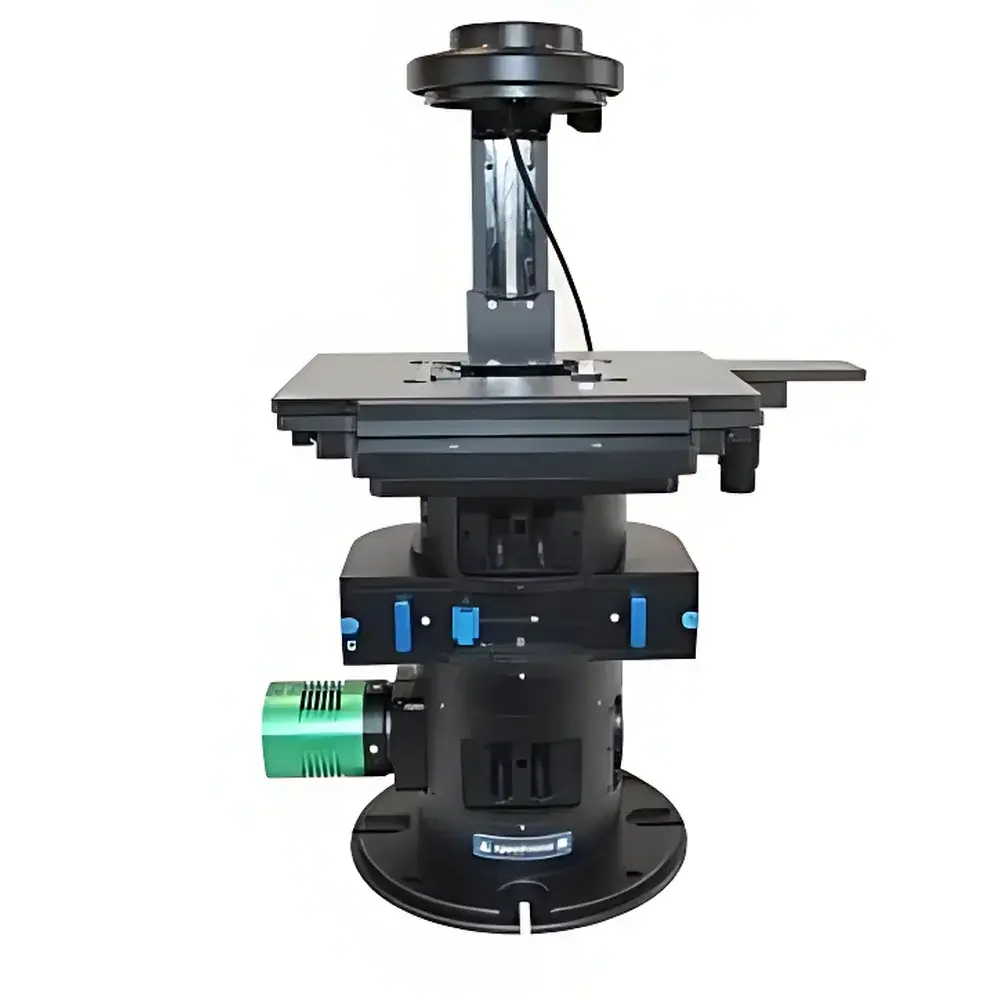
Cairn OPENFRAME Open-Source Modular Microscopy Platform
| Brand | Cairn |
|---|---|
| Origin | United Kingdom |
| Model | OPENFRAME |
| Category | Fluorescence Stereo Microscope |
| Compatibility | Nikon & Olympus Infinity-Corrected Objectives |
| Control Software | Micro-Manager (Open Source) |
| Structural Architecture | Industrial-Grade Rack-and-Pinion Mounts on All Ports |
| Optical Access | Direct, Unobstructed Path to Objective Back Focal Plane |
| Serviceability | Field-Serviceable by Trained Microscopists |
| Calibration Kit | Integrated Laser Pointer Test Suite for Optical Alignment Verification |
| Expandability | Component-Level Procurement (No Bundling Required) |
| Interoperability | Compatible with Third-Party Light Sources, sCMOS/EMCCD Cameras, Motorized Stages, Filter Wheels, Tube Lenses, and Dichroics |
Overview
The Cairn OPENFRAME is an open-source, modular microscopy platform engineered for reproducible optical performance, rapid prototyping, and long-term serviceability in academic, core facility, and translational research environments. Designed from first principles at the Photonics Group, Imperial College London—and commercially developed and supported by Cairn Research Ltd.—the system implements a rigid, compact mechanical architecture based on industrial-grade rack-and-pinion kinematics across all optical ports. Unlike conventional commercial microscopes constrained by proprietary optomechanical interfaces, OPENFRAME decouples optical function from hardware vendor lock-in. Its core principle is *mechanical and software interoperability*: every port—objective, illumination, camera, and auxiliary—features standardized M32×0.75 or SM1 threading, enabling direct integration of lenses, filters, fiber couplers, and detectors from Thorlabs, Edmund Optics, ASI, or custom-built modules. The platform is fundamentally optimized around the back focal plane (BFP) of the selected objective, ensuring minimal vignetting, high numerical aperture preservation, and unobstructed access for adaptive optics, spatial light modulators, or photostimulation optics. This design enables quantitative widefield fluorescence, transmitted-light contrast modalities (brightfield, darkfield, phase contrast), ratiometric ion imaging (e.g., Ca²⁺, voltage-sensitive dyes), and hybrid configurations such as light-sheet illumination or confocal scanning when paired with appropriate scan engines and detection paths.
Key Features
- Modular, open-hardware architecture with full bill-of-materials (BOM) and CAD documentation publicly available under CERN-OHL v2 license
- Rigid aluminum frame with precision-machined dovetail rails and anti-backlash rack-and-pinion adjustment on all optical axes (X/Y/Z focus, lateral translation, tilt)
- Native compatibility with Nikon CFI60 and Olympus UIS2 infinity-corrected objective families—including 4×–100× dry, water, and oil immersion objectives
- Direct BFP access via removable top plate; accommodates relay optics, pupil-plane masks, wavefront sensors, or holographic elements without beam clipping
- Full support for Micro-Manager 2.0+ with device adapters for common cameras (Hamamatsu ORCA, Photometrics Prime, Andor Zyla), LED illuminators (Lumencor Sola, CoolLED pE-4000), and motorized stages (ASI MS-2000, Prior ProScan)
- Integrated laser pointer alignment suite for in-situ verification of Köhler illumination, epi-fluorescence path collimation, and objective telecentricity
- No proprietary firmware or closed drivers—every actuator and sensor communicates via standard USB CDC, TTL, or RS-232 protocols
Sample Compatibility & Compliance
OPENFRAME supports live specimen imaging across model organisms including C. elegans, zebrafish embryos, mouse brain slices, organoids, and cultured mammalian cells. Its low-vibration baseplate and passive thermal stabilization enable stable time-lapse acquisition over multi-hour sessions. The platform complies with ISO 10934-1 (microscope terminology), ISO 8578 (optical component mounting interface standards), and meets mechanical safety requirements per EN 61000-6-2 (immunity) and EN 61000-6-3 (emissions). While not certified as a medical device, its design adheres to GLP-aligned documentation practices—including version-controlled assembly logs, calibration traceability records, and user-modification audit trails—facilitating internal validation for preclinical imaging workflows.
Software & Data Management
Micro-Manager serves as the primary acquisition engine, offering scriptable acquisition sequences, multi-dimensional timelapse control (Z-stack + time + channel + position), and real-time histogram-based exposure optimization. All configuration files (.cfg), metadata (OME-TIFF headers), and plugin definitions are human-readable text. Integration with Python (via pymmcore) and MATLAB (via MMCoreJ) enables custom analysis pipelines. For regulatory environments, optional add-ons provide 21 CFR Part 11-compliant electronic signatures, audit trail logging, and role-based access control when deployed with secure network-attached storage (NAS) backends.
Applications
- High-content screening using multi-channel widefield fluorescence with automated focus drift correction
- Electrophysiology-correlated imaging: simultaneous patch-clamp recording and voltage-sensitive dye imaging via dual-path epi/transmitted illumination
- Light-sheet fluorescence microscopy (LSFM) development using custom scanned or static illumination geometries
- Single-molecule localization microscopy (SMLM) requiring precise pupil-plane modulation and high-stability drift compensation
- Educational platforms for teaching optical design, microscope alignment, and open-hardware development
- Field-deployable imaging systems where modularity, low weight (<12 kg fully assembled), and tool-free disassembly are critical
FAQ
Is OPENFRAME compatible with commercial confocal scanners?
Yes—its standardized optical train geometry and accessible intermediate image planes allow integration with Yokogawa CSU-X1, Andor Dragonfly, or custom galvo-resonant scanners when mounted via C-mount or SM1-threaded adapters.
Can I use non-Cairn objectives or custom-made optics?
Absolutely—the platform accepts any infinity-corrected objective with standard tube lens spacing (200 mm for Nikon, 180 mm for Olympus); third-party tube lenses and correction collars are fully supported.
Does OPENFRAME include factory calibration certificates?
No—calibration is user-performed using the included laser pointer test kit and documented procedures; however, NIST-traceable reference standards (e.g., USAF 1951 target, fluorescent microbeads) can be integrated into routine QC workflows.
What level of technical support does Cairn provide?
Cairn offers email-based engineering support for mechanical assembly, optical alignment troubleshooting, and Micro-Manager integration—alongside public GitHub repositories containing schematics, firmware binaries, and community-contributed modules.
Is the software stack auditable for regulated environments?
Yes—Micro-Manager’s source code is publicly available under BSD-3-Clause; users may compile, modify, and validate binaries internally, maintaining full chain-of-custody for software qualification under GxP frameworks.
Related Products





