
Mightex Polygon Spatial Light Modulator for Optogenetics and Photostimulation
| Brand | Mightex |
|---|---|
| Origin | USA |
| Model | Polygon |
| Light Source Compatibility | Xenon, Mercury, LED, and Other Broadband or Monochromatic Sources |
| Core Technology | Digital Micromirror Device (DMD)-Based Spatial Light Modulation |
| Max Pattern Switching Rate | ≥1 kHz |
| Spatial Resolution | Subcellular (≤1 µm at 100× objective) |
| Field of View Coverage | Full microscope FOV (up to 2.5 mm × 2.5 mm at intermediate image plane) |
| Multi-ROI Capability | Simultaneous independent illumination of ≥100 user-defined regions |
| Wavelength Flexibility | 350–750 nm (dependent on illumination source and optical path) |
| Synchronization Interface | TTL input/output, USB 2.0, and optional Ethernet for precise hardware triggering |
| Microscope Compatibility | Universal (integrated via C-mount, infinity-corrected tube lens, or epifluorescence port on upright/inverted systems) |
| Compliance | CE, RoHS, FDA-compliant design for research use only (not for clinical diagnostics) |
Overview
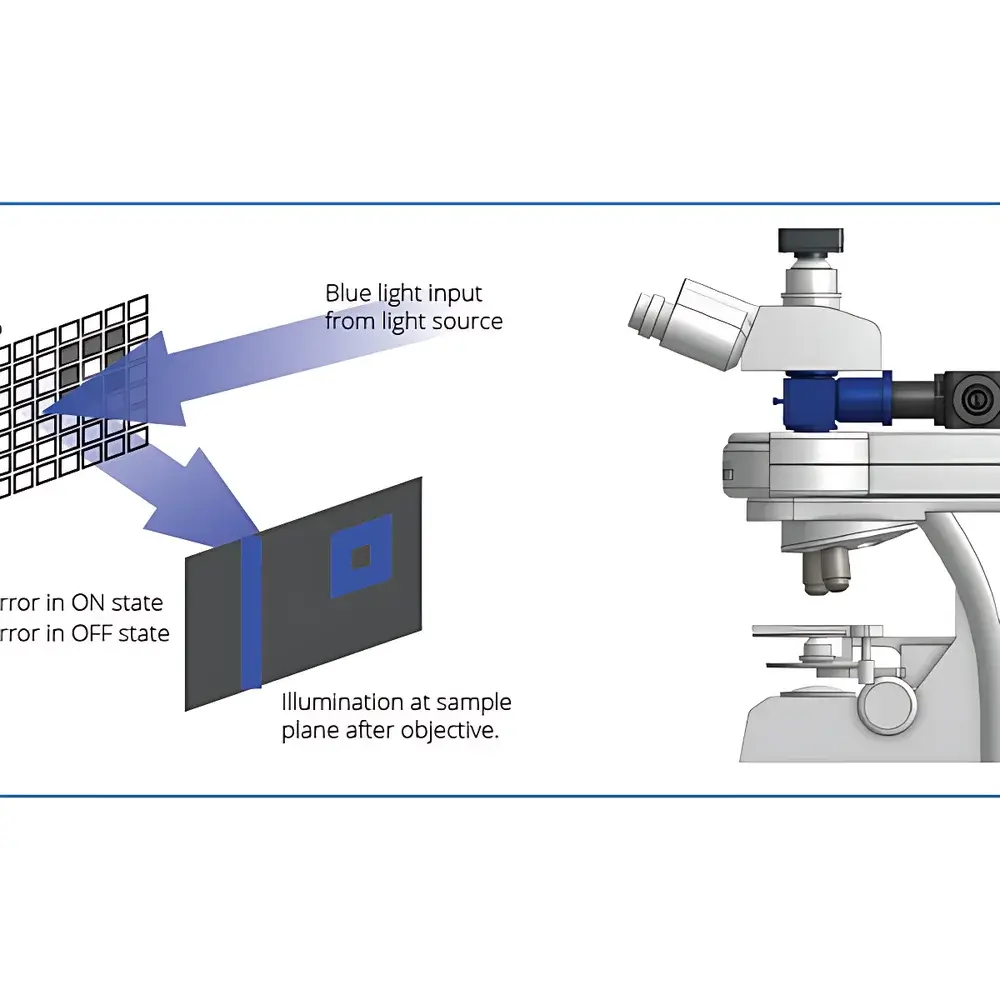
The Mightex Polygon Spatial Light Modulator is an engineered optical instrumentation platform designed for high-precision, spatiotemporally resolved photostimulation in live-cell and intact-tissue neuroscience and cell biology experiments. At its core, the system employs a Texas Instruments Digital Micromirror Device (DMD) — a solid-state, programmable spatial light modulator composed of over 1 million individually addressable aluminum micro-mirrors (each ~13.7 µm square). Unlike conventional laser-scanning or mask-based illumination approaches, the Polygon leverages DMD architecture to project arbitrary binary light patterns onto the sample plane with diffraction-limited fidelity and microsecond-scale switching latency. This enables true subcellular-resolution photomanipulation — including optogenetic activation, photoconversion, photocaging uncaging, and patterned photolysis — across large fields of view without mechanical movement or optical reconfiguration. The system operates as a modular add-on to standard widefield, confocal, or two-photon microscopy platforms, preserving native optical paths while introducing dynamic, software-defined illumination control.
Key Features
- DMD-based spatial light modulation delivering submicron pattern resolution at full-field coverage (up to 2.5 mm × 2.5 mm at the intermediate image plane)
- Real-time pattern generation with sustained switching rates exceeding 1 kHz for rapid temporal encoding of light stimuli
- Simultaneous multi-region-of-interest (multi-ROI) targeting: define and independently control ≥100 non-overlapping ROIs per frame, each with unique shape, size, intensity, and timing profile
- Wavelength-agnostic optical design: compatible with xenon arc lamps, mercury vapor lamps, high-power LEDs, and tunable laser sources (350–750 nm range)
- Hardware-level synchronization via TTL triggers (input and output) for deterministic alignment with electrophysiology acquisition systems (e.g., patch-clamp amplifiers), high-speed cameras, and scanning mirrors
- USB 2.0 interface with low-latency driver stack and cross-platform SDK (C/C++, Python, MATLAB, LabVIEW) supporting custom stimulus protocol development
- Zero-drift thermal management and rigid aluminum housing ensuring long-term optical stability during extended time-lapse or chronic stimulation experiments
Sample Compatibility & Compliance
The Polygon integrates seamlessly with both upright and inverted research-grade microscopes — including Zeiss Axio, Nikon Eclipse, Olympus IX/XV, and Leica DM series — via standardized C-mount adapters or infinity-corrected relay optics. It supports live specimens ranging from cultured neurons and organoids to acute brain slices and in vivo preparations (e.g., cranial window imaging in head-fixed or freely moving rodents). All optical components are selected for minimal autofluorescence, high transmission (>92% in visible range), and UV-stability. The system conforms to CE marking requirements for laboratory equipment and complies with RoHS Directive 2011/65/EU. While not intended for diagnostic or therapeutic use, its architecture aligns with GLP-aligned experimental documentation practices; full audit trails of pattern sequences, timestamps, and TTL event logs can be exported for regulatory traceability in preclinical neuroscience studies.
Software & Data Management
Control is managed through Mightex’s Polygon Studio software — a dedicated GUI built on Qt and optimized for low-latency rendering and deterministic stimulus delivery. The software supports vector-based ROI drawing, scriptable pattern sequencing (via Python API), and real-time preview of projected illumination geometry. All stimulation protocols are saved in HDF5 format, embedding metadata such as timestamp, objective magnification, camera exposure sync status, and DMD bitplane configuration. Integration with third-party acquisition suites (e.g., MetaMorph, Micro-Manager, ScanImage) is achieved via shared memory buffers or TTL handshake protocols. For labs operating under 21 CFR Part 11 requirements, optional software modules provide electronic signatures, role-based access control, and immutable log archiving — enabling compliance-ready workflows in contract research organizations and academic cores serving pharmaceutical partners.
Applications
- Optogenetics: Cell-type-specific photostimulation with single-spike temporal precision across cortical layers or hippocampal subfields
- Subcellular photomanipulation: Localized activation of opsins or caged compounds at dendritic spines, axon initial segments, or mitochondrial subdomains
- Multi-site network interrogation: Simultaneous excitation/inhibition of distributed neuronal ensembles to map functional connectivity
- Photoactivation kinetics: High-throughput screening of light-sensitive ion channels or G-protein coupled receptors under controlled irradiance profiles
- Patterned photolysis: Spatially defined release of neurotransmitters (e.g., glutamate, GABA) or second messengers (e.g., Ca²⁺, IP₃) in 2D tissue maps
- Behavioral optogenetics: Integration with locomotion tracking systems for closed-loop light delivery during freely moving assays
FAQ
What types of light sources are compatible with the Polygon system?
The Polygon accepts collimated broadband (xenon, mercury) or monochromatic (LED, laser) illumination via standard microscope ports; spectral performance depends on source output and filter selection.
Can the Polygon be used with two-photon microscopy?
Yes — when paired with a non-descanned detection path and appropriate relay optics, the DMD can modulate the excitation beam prior to the scan unit, enabling patterned two-photon photostimulation.
Is calibration required before each experiment?
No routine recalibration is needed; factory-applied geometric mapping ensures pixel-to-sample correspondence across magnifications. Optional drift-compensation routines are available for ultra-long-term experiments.
How is synchronization achieved with electrophysiology hardware?
Via bidirectional TTL signaling: external triggers initiate pattern display, while internal strobes mark frame onset for post-hoc alignment of voltage/current traces.
Does the system support grayscale or analog intensity modulation?
Binary (on/off) mirror control is native; analog intensity is emulated via pulse-width modulation (PWM) at kHz rates, achieving >8-bit effective dynamic range.





