
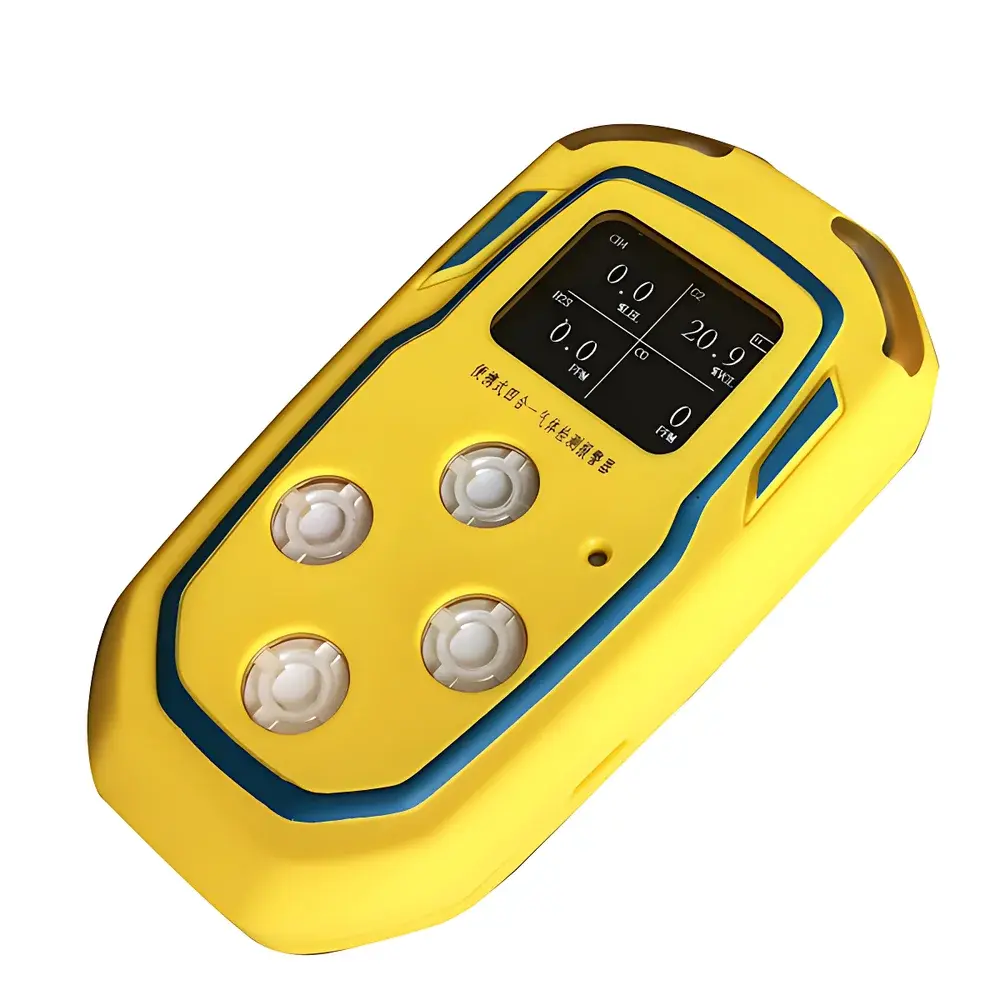
PERIC GAP X4 Portable 4-Gas Detector with Dual-Sensor Technology (Catalytic Combustion & Electrochemical)
| Brand | PERIC |
|---|---|
| Model | GAP X4 |
| Gas Detection Channels | CH₄ (0–100% LEL), O₂ (0–30.0% vol), CO (0–500 ppm), H₂S (0–100 ppm) |
| Detection Principles | Catalytic combustion (CH₄), electrochemical (O₂, CO, H₂S) |
| Sampling Method | Diffusion |
| Response Time (T₉₀) | ≤60 s for all gases |
| Accuracy | ±5% FS (CH₄), ±3% FS (O₂), ±10% relative (CO, H₂S) |
| Display Resolution | 1% LEL / 0.1% vol / 1 ppm / 1 ppm |
| Alarm Thresholds (Configurable) | CH₄: 25% LEL |
| O₂ | Low 19.5% vol, High 23.5% vol |
| CO | 24 ppm |
| H₂S | 18 ppm |
| Power | Rechargeable 3.7 V Li-ion battery (103450 type) |
| Operating Temp | −10 °C to +55 °C |
| Operating Humidity | 0–95% RH (non-condensing) |
| Ingress Protection | IP65 |
| Explosion Protection | Ex ib IIB T3 Gb per GB 3836.1–2010 & GB 3836.4–2010 |
Overview
The PERIC GAP X4 Portable 4-Gas Detector is an intrinsically safe, multi-sensor instrument engineered for real-time monitoring of four critical atmospheric hazards in industrial and confined-space environments. It integrates catalytic combustion sensing for combustible gas (calibrated to methane, CH₄) and electrochemical sensing for oxygen (O₂), carbon monoxide (CO), and hydrogen sulfide (H₂S). Designed in strict compliance with Chinese national explosion-protection standards GB 3836.1–2010 and GB 3836.4–2010, the device carries the Ex ib IIB T3 Gb marking—certifying its suitability for use in Zone 1 and Zone 2 hazardous locations where flammable gas mixtures classified as Group II A through II C and temperature classes T1 to T3 may be present. Its diffusion-based sampling architecture eliminates the need for pumps or external tubing, ensuring low-maintenance operation and rapid deployment in shipyard maintenance, petrochemical turnaround zones, wastewater treatment facilities, and underground utility workspaces.
Key Features
- Intrinsically safe design validated to GB 3836.4–2010, enabling reliable operation in potentially explosive atmospheres without risk of ignition.
- Dual-sensor architecture: catalytic bead sensor for CH₄ (0–100% LEL) and electrochemical cells for O₂ (0–30.0% vol), CO (0–500 ppm), and H₂S (0–100 ppm), each optimized for long-term stability and cross-interference resistance.
- Triple-alarm activation: simultaneous audible (≥75 dB @ 30 cm), visual (high-brightness dual-color LED), and tactile (vibration motor) alerts upon threshold breach—ensuring detection under high-noise or low-visibility conditions.
- User-configurable alarm setpoints for all four gases, supporting site-specific safety protocols and alignment with occupational exposure limits (e.g., OSHA PELs, ACGIH TLVs).
- Ergonomic, clip-mount form factor (weight < 220 g) with textured grip and recessed display—designed for secure attachment to belts, harnesses, or chest pockets without impeding mobility or tool access.
- Integrated 3.7 V lithium-ion battery (model 103450) delivering ≥10 hours of continuous operation in standard 4-gas monitoring mode; supports USB-C charging and battery-level indication via OLED screen.
Sample Compatibility & Compliance
The GAP X4 is intended for ambient air sampling only and is not designed for direct contact with corrosive vapors, high-velocity gas streams, or particulate-laden environments exceeding IP65 ingress thresholds. It meets the functional safety requirements for portable gas detection per GB/T 50493–2019 (Design Standard for Gas Detection and Alarm Systems in Petrochemical Enterprises). While certified to GB 3836 series standards, it does not carry ATEX, IECEx, or UL/cUL listing; users deploying in North America or EU jurisdictions must verify local regulatory acceptance prior to operational use. The instrument’s calibration protocol aligns with manufacturer-recommended span-gas verification intervals (typically every 180 days or after exposure to sensor-poisoning compounds such as silicones or leaded fuels).
Software & Data Management
Data logging is supported via internal flash memory (up to 100,000 data points) with timestamped records of gas concentration, alarm events, battery voltage, and sensor health status. Logged data is exportable in CSV format using the proprietary PERIC PC Utility software (Windows-compatible), which enables trend analysis, report generation (PDF/Excel), and audit-trail review. The software enforces user-access levels (operator, technician, administrator) and maintains immutable logs compliant with GLP-aligned documentation practices. Though not FDA 21 CFR Part 11-certified, the system supports manual electronic signature workflows for calibration and bump-test verification records.
Applications
- Confined space entry monitoring in shipyards, tank farms, and pipeline maintenance—verifying O₂ sufficiency and absence of toxic/combustible accumulation prior to worker entry.
- Hot work permit validation in refineries and chemical plants, where CH₄ and H₂S presence must be continuously verified during welding or grinding operations.
- Emergency response by HAZMAT teams requiring immediate triage of multi-gas hazards following leaks or process upsets.
- Periodic air quality verification in municipal wastewater lift stations and digesters, where CO and H₂S pose acute inhalation risks.
- Contractor safety compliance audits, where instrument traceability, calibration history, and alarm event logs serve as evidentiary documentation.
FAQ
What gases does the GAP X4 detect, and are the sensors field-replaceable?
The GAP X4 detects methane (CH₄), oxygen (O₂), carbon monoxide (CO), and hydrogen sulfide (H₂S). All four sensors are factory-installed and replaceable by authorized service centers; end users should not attempt sensor replacement due to calibration and sealing integrity requirements.
Does the device support automatic zero calibration?
No—zero calibration requires exposure to certified fresh air (20.9% O₂, <1 ppm CO/H₂S, 0% LEL CH₄) in a clean environment; automatic zero is disabled to prevent drift under variable ambient conditions.
Can the alarm thresholds be modified outside the default values?
Yes—thresholds for all four gases are fully programmable via the onboard menu or PC utility, allowing alignment with site-specific safety management systems or regional regulatory limits.
Is the GAP X4 suitable for use in sub-zero temperatures?
The specified operating range is −10 °C to +55 °C; prolonged exposure below −10 °C may reduce electrochemical sensor response time and battery capacity—thermal insulation sleeves are recommended for cold-weather deployment.
How often must the instrument undergo bump testing and full calibration?
Bump testing is required before each day’s use per OSHA 1910.146 and GB/T 50493–2019 guidelines; full calibration is recommended every 180 days or after any event that compromises sensor performance (e.g., exposure to high-concentration gas, physical shock, or condensation ingress).







