
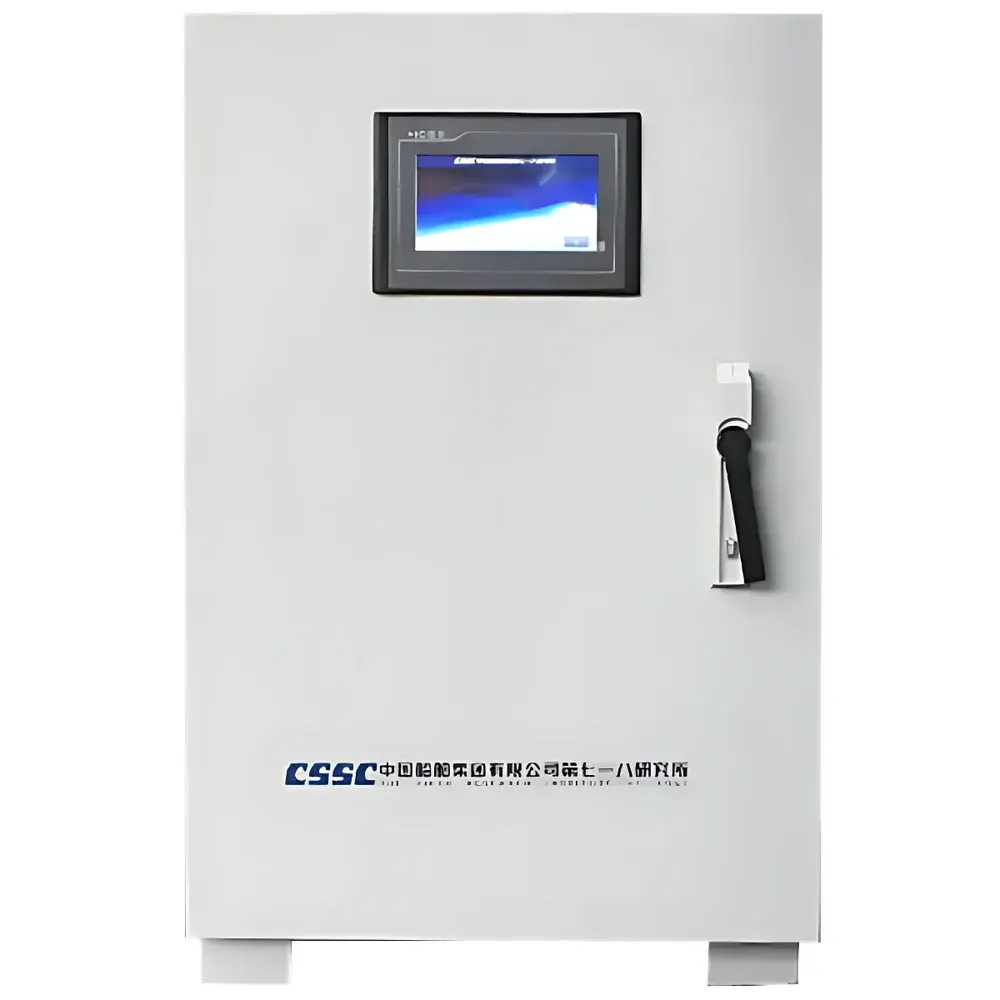
PERIC Customized Marine Greenhouse Gas Emission Online Monitoring System
| Brand | PERIC |
|---|---|
| Origin | Hebei, China |
| Manufacturer Type | Manufacturer |
| Origin Category | Domestic |
| Model | Customized 7 |
| Quotation | Upon Request |
| Repeatability | 2% F.S. |
| Resolution | 0.01% VOL |
| Response Time | ≤30 s |
| CO₂ Measurement Range | (0–10)% VOL |
| Measurement Principle | Tunable Diode Laser Absorption Spectroscopy (TDLAS) |
| Accuracy | ±2% F.S. |
| Operating Ambient Temperature | −20 °C to +55 °C |
Overview
The PERIC Customized Marine Greenhouse Gas Emission Online Monitoring System is an engineered solution designed to meet the stringent requirements of the European Union’s Monitoring, Reporting, and Verification (MRV) Regulation (EU 2015/757), as well as emerging frameworks under the International Maritime Organization’s (IMO) Initial GHG Strategy and the upcoming FuelEU Maritime regulation. This system implements direct emission measurement methodology at exhaust stacks—specifically at main engine, auxiliary engine, scrubber outlet, and boiler exhaust points—by simultaneously acquiring real-time CO₂ concentration (with optional CH₄ and N₂O extension), volumetric flow rate, temperature, pressure, and moisture content. Core measurement relies on Tunable Diode Laser Absorption Spectroscopy (TDLAS), a non-contact, interference-resistant optical technique offering high selectivity for CO₂ in complex marine exhaust matrices. Unlike extractive NDIR or electrochemical methods, TDLAS minimizes cross-sensitivity to SO₂, NOₓ, and particulate matter, ensuring stable performance under high-humidity, high-sulfur, and transient load conditions typical of marine diesel and residual fuel operation.
Key Features
- Full-stack compliance-ready architecture: Integrates certified gas analyzers, heated extractive sampling probes, temperature/pressure-compensated ultrasonic flow meters, and redundant data acquisition modules aligned with IMO MEPC.329(76) and EU MRV Annex I technical specifications.
- Robust extractive sampling design: Features fully heated sample lines (maintained at >180 °C), ceramic-filtered probe assemblies, and condensate management systems to prevent water vapor condensation, acid dew point corrosion, and particulate clogging—critical for long-term reliability in exhaust streams containing up to 15% CO₂, 1000 ppm SO₂, and >5 g/Nm³ fly ash.
- Modular hardware configuration: Separable functional units—including Sampling Unit, Gas Composition Module (CO₂ primary, expandable to CH₄/N₂O), Flow & Conditioning Module, and Communication Gateway—enable flexible installation, staged commissioning, and future regulatory upgrades without full-system replacement.
- Real-time data integrity assurance: Embedded dual-channel validation logic compares raw TDLAS absorbance signals against reference cell stability metrics; automatic zero/span drift correction triggered every 24 hours or upon operator command, traceable to NIST-traceable calibration gases.
- Environmental resilience: Enclosure rated IP66, operating range −20 °C to +55 °C, conformal-coated PCBs, and stainless-steel wetted parts (316L) ensure durability in salt-laden, vibration-prone marine environments.
Sample Compatibility & Compliance
This system is validated for continuous monitoring of exhaust gases from low-speed two-stroke and medium-speed four-stroke marine engines burning HFO, VLSFO, MGO, LNG, and bio-blended fuels. It complies with ISO 8573-1:2010 (compressed air quality), EN 15267-3:2017 (QAL1 certification framework), and supports QAL2 (Quality Assurance Level 2) field validation per EN 14181. Data output formats adhere to IMO DCS XML schema v2.0 and EU MRV EDI message structure, enabling seamless integration with shipboard data acquisition systems (e.g., Class-approved CMS platforms) and shore-based reporting gateways (e.g., THETIS-MRV, Clean Shipping Index). All firmware and data logs maintain audit trails compliant with GLP principles and support 21 CFR Part 11 electronic signature readiness when deployed in regulated flag state contexts.
Software & Data Management
The embedded Linux-based control unit runs PERIC EMS v4.2 firmware, providing local HMI via 7-inch capacitive touchscreen with multilingual UI (EN/DE/FR/ZH). Data is timestamped with GPS-synchronized UTC and stored locally (16 GB industrial-grade eMMC) for ≥90 days at 1-second resolution. Remote access is enabled via TLS 1.2-secured MQTT or OPC UA over Ethernet/Wi-Fi/LTE; all communication supports certificate-based authentication and encrypted payload transmission. Automated daily reports (PDF/CSV) include emission factor calculation per IMO Tier 3 methodology (CO₂ = Σ(Q × C × K), where Q = corrected volumetric flow, C = dry CO₂ mole fraction, K = molar mass conversion), deviation alerts, and calibration history. Optional cloud dashboard (PERIC CloudLink) offers fleet-wide KPI visualization, anomaly detection using moving-window statistical process control (SPC), and API-driven export to third-party carbon accounting platforms (e.g., CarbonChain, RightShip).
Applications
- EU MRV and IMO DCS mandatory reporting for vessels >5,000 GT operating in or calling EU ports.
- FuelEU Maritime compliance verification through onboard Well-to-Wake (WtW) GHG intensity calculation.
- Internal energy efficiency management per ISO 50001 and SEEMP Part II/III implementation.
- Post-scrubber and exhaust gas recirculation (EGR) system performance validation.
- Research and development of alternative marine fuels (ammonia, methanol, hydrogen) requiring precise stoichiometric combustion analysis.
FAQ
Does the system meet IMO DCS and EU MRV certification requirements for onboard verification?
Yes—the hardware configuration, measurement uncertainty budget (<±2% F.S. for CO₂), and data handling protocols are pre-aligned with IMO MEPC.329(76) and EU Commission Implementing Regulation (EU) 2016/2071 Annex III technical criteria.
Can CH₄ and N₂O measurement be added post-installation?
Yes—via firmware update and installation of additional TDLAS laser modules; optical path sharing enables multi-gas detection without modifying sample conditioning hardware.
Is the system compatible with Class society type approval processes?
All major Class societies (DNV, LR, ABS, BV, CCS) have reviewed PERIC’s documentation package; type approval support includes IACS UR Z17-compliant test reports, FAT/SAT protocols, and cyber security assessment (IEC 62443-3-3 SL2).
What maintenance intervals are recommended for marine operational continuity?
Quarterly filter replacement, biannual zero/span calibration with certified gas standards, and annual full system QAL2 verification—documented in onboard maintenance log per ISO 17025 traceability requirements.







