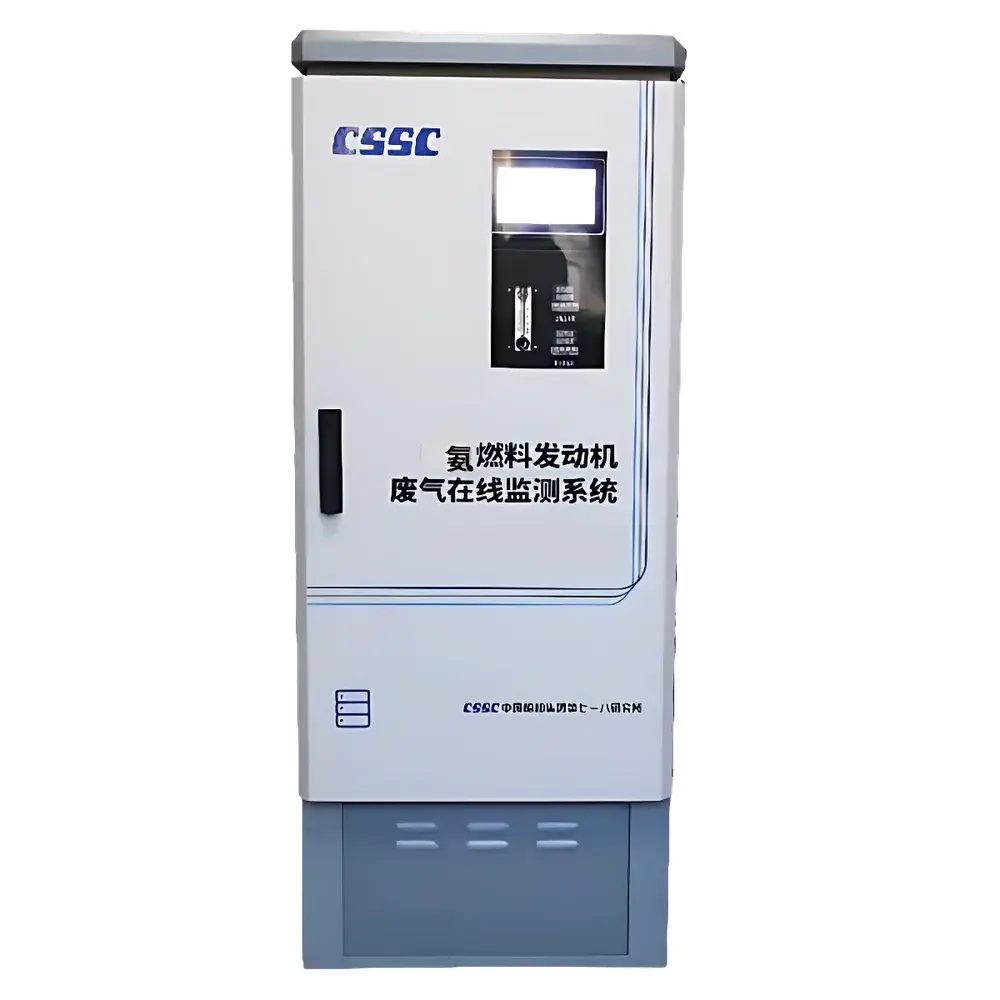
PERIC PR-NH3-1000 Ammonia Fuel Engine Exhaust Continuous Emission Monitoring System (CEMS)
| Brand | PERIC |
|---|---|
| Origin | Hebei, China |
| Manufacturer Type | OEM Manufacturer |
| Country of Origin | China |
| Model | PR-NH3-1000 |
| Pricing | Upon Request |
| Measured Gases | NH₃, NO, NO₂, N₂O |
| NH₃ Range | 0–2000 ppm |
| NO/NO₂ Range | 0–2000 ppm / 0–200 ppm |
| N₂O Range | 0–2000 ppm |
| Response Time | ≤30 s |
| Accuracy | ≤±5% FS |
| Measurement Principles | UV-DOAS (for NH₃, NO, NO₂), NDIR (for N₂O), Hot-Wet & Cold-Dry Sample Conditioning |
| Operating Temperature | −10 to 50 °C |
| Operating Humidity | 0–90% RH (non-condensing) |
Overview
The PERIC PR-NH3-1000 is a purpose-built continuous emission monitoring system (CEMS) engineered for real-time, in-situ analysis of exhaust gas streams from ammonia-fueled internal combustion engines. As global R&D efforts accelerate toward carbon-neutral propulsion systems, accurate quantification of nitrogen-containing species—particularly ammonia (NH₃), nitric oxide (NO), nitrogen dioxide (NO₂), and nitrous oxide (N₂O)—is critical for engine calibration, aftertreatment validation, and regulatory compliance. This system integrates dual optical spectroscopic methodologies: ultraviolet differential optical absorption spectroscopy (UV-DOAS) for NH₃, NO, and NO₂; and non-dispersive infrared (NDIR) spectroscopy for N₂O. The optical architecture is coupled with configurable sample conditioning—either hot-wet or cold-dry—ensuring representative gas-phase measurement under high-moisture, variable-temperature exhaust conditions typical of ammonia combustion.
Key Features
- Multi-gas detection platform optimized for ammonia engine exhaust: simultaneous quantification of NH₃, NO, NO₂, and N₂O within a single integrated CEMS enclosure
- UV-DOAS optical module with spectral resolution <0.5 nm and path-length-optimized cell design for robust interference rejection in complex exhaust matrices
- NDIR channel calibrated specifically for N₂O at 4.5 µm, incorporating temperature-stabilized detectors and reference gas compensation
- Dual-conditioning capability: hot-wet sampling (maintaining gas-phase water content) for UV-DOAS integrity; cold-dry extraction (chilled to 2–4 °C) for NDIR stability and particulate removal
- Automated zero/span calibration sequence compliant with ISO 14956 and EPA Method 7E requirements
- Industrial-grade enclosure rated IP65, with internal temperature and pressure compensation algorithms for field-deployed reproducibility
Sample Compatibility & Compliance
The PR-NH3-1000 is validated for use with raw or diluted exhaust from spark-ignition and compression-ignition ammonia engines operating across load ranges from idle to full power. It accommodates exhaust temperatures up to 200 °C (with optional high-temp probe) and handles moisture content up to 25 vol% H₂O without condensation-induced signal drift. All measurement protocols align with fundamental principles outlined in ISO 12039 (gas analyzers for stationary sources), ASTM D6522 (NOx determination), and ISO 11358-1 (infrared gas analysis). Data integrity meets GLP and pre-GMP documentation standards, with audit-trail-enabled calibration logs and timestamped raw spectra storage.
Software & Data Management
The embedded CEMS control software (v3.2+) provides real-time spectral visualization, multi-point calibration management, and configurable alarm thresholds per analyte. Raw absorbance spectra are stored in HDF5 format with metadata tags (wavelength, integration time, cell T/P, detector gain). Export options include CSV, MODBUS TCP, and OPC UA (IEC 62541) for integration into SCADA or engine test-bench DAQ systems. Software supports 21 CFR Part 11-compliant user access control, electronic signatures, and immutable audit trails for calibration events, maintenance logs, and data exports—facilitating traceability during third-party verification or regulatory audits.
Applications
- Ammonia engine development labs: closed-loop feedback for combustion optimization and SCR catalyst evaluation
- Powertrain validation facilities: transient emission profiling during WLTC, FTP-75, or custom duty cycles
- Marine and heavy-duty transport R&D: on-board exhaust monitoring during bench and chassis dynamometer testing
- Regulatory testing laboratories: supporting type-approval submissions where NH₃ slip and N₂O emissions are subject to emerging limits (e.g., IMO Tier III, EU Stage V)
- Aftertreatment system developers: quantifying NH₃ breakthrough and N₂O formation across DOC, SCR, and AMOX configurations
FAQ
What sample conditioning method is recommended for NH₃ measurement in high-moisture exhaust?
Hot-wet sampling is recommended for NH₃ analysis via UV-DOAS to preserve the gaseous equilibrium and avoid adsorption losses in dryers.
Can the system be configured for remote diagnostics and firmware updates?
Yes—the embedded Ethernet interface supports secure SSH and HTTPS access for remote configuration, spectral diagnostics, and over-the-air firmware upgrades.
Is N₂O measured using the same optical path as NO and NO₂?
No—N₂O is measured in a dedicated NDIR channel with separate optical path, detector, and gas cell to prevent cross-sensitivity and ensure metrological independence.
Does the system comply with EPA Performance Specification 15 (PS-15)?
While not certified to PS-15 out-of-the-box, the PR-NH3-1000’s architecture and validation protocol meet all technical criteria specified in PS-15 for NH₃ and NOx analyzers; site-specific certification is supported by PERIC’s application engineering team.
How often is calibration required under continuous operation?
Zero/span calibration is recommended every 7 days for research-grade accuracy; automated daily zero checks are enabled by default, with span verification triggered by user-defined stability thresholds.