
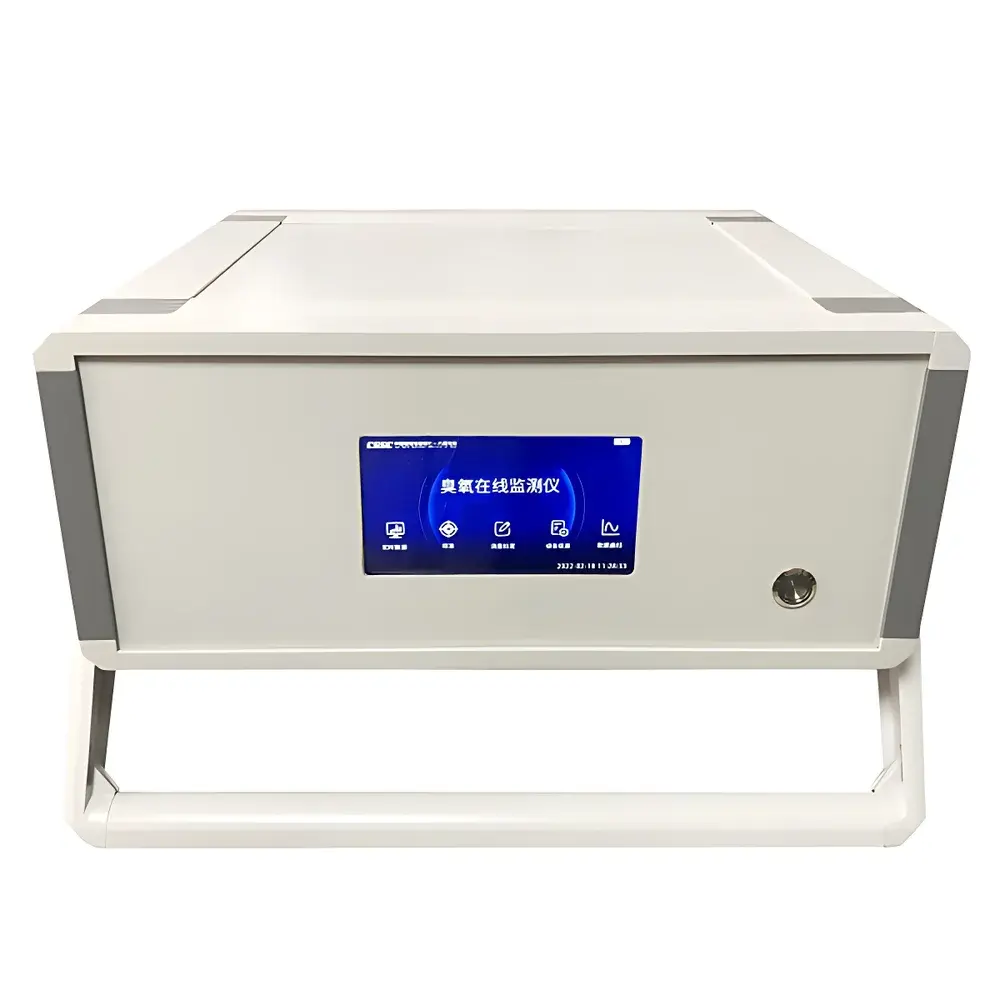
PERIC GAP-O3 Online Ozone Analyzer
| Brand | PERIC |
|---|---|
| Model | GAP-O3 |
| Measurement Principle | UV Absorption (254 nm) |
| Detection Range | 0–1000 nmol/mol |
| Detection Limit | ≤1 nmol/mol |
| Accuracy | ±3% FS |
| Repeatability | ≤1% |
| Response Time (T90) | ≤20 s |
| Zero Drift (4 h) | ±2 nmol/mol |
| Span Drift (4 h) | ±4 nmol/mol |
| Operating Temperature | 5–40 °C |
| Relative Humidity | ≤85% RH |
| Display | 5-inch capacitive touchscreen |
| Power Supply | DC 12 V (with internal rechargeable Li-ion battery) |
| Compliance | Designed for continuous ambient and industrial process monitoring per ISO 13964, ASTM D5012, and EPA Reference Method EQOA-01 |
Overview
The PERIC GAP-O3 Online Ozone Analyzer is a fixed-installation, real-time gas analyzer engineered for continuous, high-fidelity measurement of ozone (O₃) concentration in ambient air and industrial process streams. It operates on the fundamental principle of ultraviolet (UV) absorption photometry at 254 nm — a wavelength strongly absorbed by ozone molecules in accordance with the Beer-Lambert law. The instrument employs a dual-beam, time-multiplexed optical path design: one beam passes through a sample stream that has been pre-treated by an ozone scrubber (catalytic or chemical), while the other traverses untreated sample gas. The differential absorbance between these two paths eliminates interference from background UV-absorbing species (e.g., SO₂, NO₂, hydrocarbons) and compensates for lamp intensity drift and optical fouling, thereby delivering robust, zero-baseline-stable ozone quantification. This methodology ensures traceable accuracy without reliance on frequent external calibration gases under routine operation.
Key Features
- Integrated dual-channel UV photometric detection with automatic ozone scrubber switching for true differential absorbance calculation
- 5-inch high-resolution capacitive touchscreen interface with intuitive Chinese/English bilingual menu navigation and real-time trend visualization
- Modular hardware architecture enabling field-replaceable optical cells, scrubber cartridges, and power modules — minimizing downtime during maintenance
- Comprehensive self-diagnostic suite including optical path integrity check, lamp output stability monitoring, flow sensor validation, and scrubber efficiency verification
- Onboard DC 12 V rechargeable lithium-ion battery supporting ≥8 hours of uninterrupted operation during power outages or mobile deployment scenarios
- Embedded environmental compensation algorithms correcting for temperature- and humidity-induced signal drift within specified operating ranges (5–40 °C, ≤85% RH)
Sample Compatibility & Compliance
The GAP-O3 is validated for use with clean, dry, particle-free gas streams typical of ambient air monitoring networks, stack emissions sampling points, and controlled industrial environments (e.g., water treatment off-gas, semiconductor cleanroom purge lines, pharmaceutical sterilization chambers). It meets mechanical and electrical safety requirements per IEC 61000-6-2 (immunity) and IEC 61000-6-3 (emissions). While not certified as a U.S. EPA Federal Reference Method (FRM) device, its optical methodology aligns with the performance criteria outlined in EPA EQOA-01 for ozone analyzers used in supplemental monitoring networks. It supports GLP-compliant data logging and is compatible with third-party SCADA systems via RS-485 Modbus RTU and optional 4–20 mA analog output. All firmware operations maintain audit-trail-capable event logging per 21 CFR Part 11 guidelines when integrated with validated LIMS platforms.
Software & Data Management
The embedded firmware provides local data storage for up to 30 days of 1-minute averaged ozone concentration values, zero/span events, diagnostic flags, and environmental metadata (temperature, pressure, flow rate if equipped). Data export is supported via USB flash drive in CSV format, preserving timestamped, column-labeled records with units and uncertainty annotations. Remote configuration and real-time telemetry are enabled through optional Ethernet/Wi-Fi modules using HTTP RESTful API endpoints. Calibration history, user access logs, and system uptime metrics are retained with tamper-evident timestamps. Firmware updates are performed via signed binary packages to ensure integrity and version traceability across fleet deployments.
Applications
- Ambient air quality monitoring stations (AQMS) for regulatory compliance reporting under national ozone standards (e.g., China’s GB 3095-2012, EU Directive 2008/50/EC)
- Process control in municipal and industrial water treatment facilities utilizing ozone disinfection
- Off-gas monitoring in pharmaceutical cleanrooms where ozone is employed for surface decontamination
- Emissions verification at pulp & paper bleaching lines and petrochemical oxidation reactors
- Indoor air quality assessment in laboratories, printing facilities, and HVAC systems where ozone generation may occur unintentionally
- Research-grade ozone exposure studies requiring stable, low-drift baseline measurements over extended durations
FAQ
How does the GAP-O3 eliminate interference from other UV-absorbing gases?
It uses time-synchronized dual-path absorption: one path measures total UV absorbance; the other measures absorbance after catalytic removal of ozone. The difference yields ozone-specific concentration, inherently rejecting cross-sensitivity.
Is external zero gas required for daily operation?
No — the built-in ozone scrubber enables automatic zero referencing without external gas cylinders. Manual zero calibration is optional and recommended only after filter replacement or extended downtime.
Can the analyzer operate unattended for extended periods?
Yes — with its internal battery, self-diagnostics, and non-consumable optical design, it supports >6 months of continuous operation between scheduled maintenance intervals.
What communication protocols are supported for integration into existing monitoring networks?
Standard RS-485 Modbus RTU is included; optional modules add Ethernet TCP/IP, Wi-Fi, and 4–20 mA analog output with HART protocol support.
Does the instrument comply with ISO or ASTM standards for ozone measurement?
Its optical method conforms to the physical principles and performance thresholds defined in ISO 13964 (ambient ozone analysis) and ASTM D5012 (ozone generator output testing), though formal certification requires third-party verification per site-specific QA/QC protocols.
Related Products







