
PERIC Custom Deep-Ultraviolet Laser Raman Remote Sensing System
| Brand | PERIC |
|---|---|
| Origin | Hebei, China |
| Manufacturer Type | Original Equipment Manufacturer (OEM) |
| Regional Classification | Domestic (China) |
| Model | Custom 2 |
| Pricing | Available Upon Request |
Overview
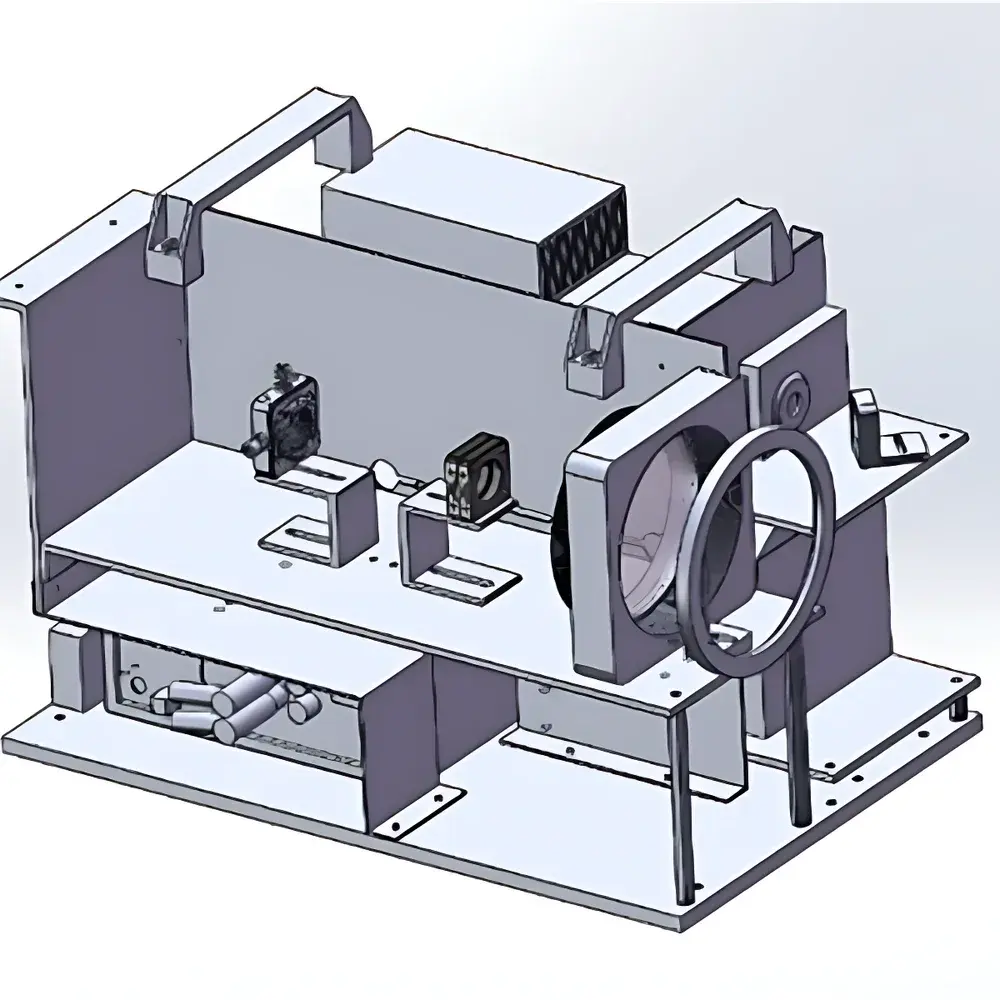
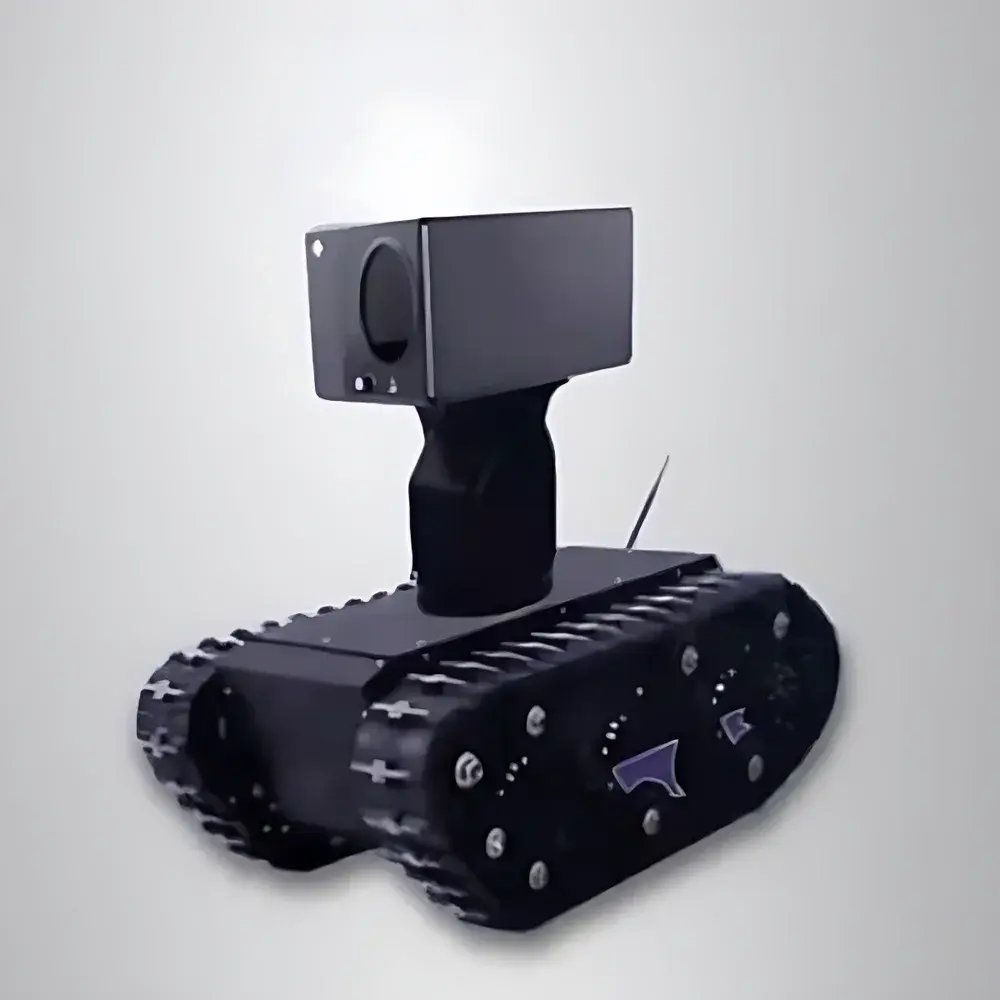
The PERIC Custom Deep-Ultraviolet Laser Raman Remote Sensing System is a purpose-engineered spectroscopic instrument designed for standoff detection and quantitative analysis of hazardous gaseous species—particularly hydrogen—in nuclear power plant environments. It operates on the fundamental principle of deep-UV resonance-enhanced Raman scattering: a high-stability, narrow-linewidth deep-ultraviolet laser (typically 244 nm or 266 nm) illuminates a remote target volume (e.g., flange joints, valve stems, or pipe welds), inducing inelastic scattering from molecular vibrational modes. Unlike visible or near-IR Raman systems, deep-UV excitation provides intrinsic resonance enhancement for diatomic gases such as H₂ and suppresses fluorescence and broadband ambient background—enabling daytime operation without optical shielding or dark-room constraints. The system delivers non-contact, real-time spectral acquisition at standoff distances ranging from 1 m to 30 m, with full spectral resolution sufficient to resolve rotational–vibrational Raman bands unique to target analytes.
Key Features
- Deep-UV laser excitation (244 nm or 266 nm) for fluorescence suppression and enhanced Raman cross-section of H₂ and other small molecules
- Co-aligned telescope-optics architecture enabling diffraction-limited beam delivery and efficient backscattered photon collection
- Dual-channel detection: high-quantum-efficiency CCD spectrometer for full-spectrum acquisition (200–400 cm⁻¹ Raman shift range) and fast-gated photomultiplier tube (PMT) for time-resolved, low-noise intensity monitoring
- Hardened optical train with thermally stabilized mounts and anti-vibration isolation—engineered for industrial deployment in high-radiation, high-humidity, and temperature-fluctuating nuclear auxiliary buildings
- Real-time spectral processing firmware supporting automated baseline correction, cosmic-ray rejection, and peak-fitting algorithms compliant with ASTM E1840-22 (Standard Practice for Raman Spectroscopy Data Analysis)
Sample Compatibility & Compliance
The system is optimized for gaseous-phase detection in open-path or semi-confined industrial settings. It detects H₂, CH₄, CO, NH₃, and other symmetric diatomic or polyatomic gases with strong Raman-active modes in the deep-UV accessible range. No sample extraction, dilution, or pre-concentration is required—eliminating cross-contamination risk and preserving process integrity. The optical design conforms to IEC 61000-6-2 (EMC immunity) and IEC 61000-6-4 (EMC emission) standards. All embedded firmware supports audit-trail logging and user-access controls aligned with GLP/GMP documentation requirements. While not FDA-cleared, the spectral data output format (NIST-compatible .jdx and .spc) ensures traceability for internal QA/QC reporting and regulatory review under IAEA Safety Standards Series No. SSG-30.
Software & Data Management
The proprietary PERIC RamanView™ software suite runs on Windows 10/11 (64-bit) and provides full instrument control, spectral visualization, and quantitative concentration inversion via multivariate calibration models (PLS-R, PCR). Raw spectra are timestamped, geotagged (when integrated with optional GNSS module), and stored in an encrypted SQLite database with SHA-256 hash verification. Data export supports CSV, PDF report generation, and direct integration into enterprise LIMS platforms via OPC UA or RESTful API. Software validation documentation—including IQ/OQ protocols and 21 CFR Part 11-compliant electronic signature modules—is available upon request for regulated nuclear facility deployment.
Applications
- Hydrogen leak surveillance at pressurized coolant system flanges and valve packings in PWR/BWR containment buildings
- Post-maintenance verification of seal integrity prior to reactor restart
- Continuous monitoring of spent fuel pool ventilation exhaust streams for trace H₂ accumulation
- Remote screening of decommissioning site piping networks where access is restricted or radiological dose minimization is critical
- Method development support for ISO 20816-4 (vibration-based mechanical integrity correlation with gas leakage signatures)
FAQ
What is the minimum detectable concentration for hydrogen using this system?
Typical limit of detection (LOD) for H₂ is ≤50 ppm·m (parts-per-million × meter pathlength) under ambient daylight conditions, validated per ISO 10423 Annex G procedures.
Can the system distinguish hydrogen from methane or water vapor interference?
Yes—the 244 nm excitation selectively enhances the Q-branch Raman band of H₂ at ~4155 cm⁻¹ while suppressing H₂O rotational Raman features; spectral deconvolution uses constrained non-negative least squares (NNLS) fitting against reference libraries.
Is operator training or radiation safety certification required for field use?
No laser radiation hazard beyond Class 3B (IEC 60825-1); operators require standard industrial laser safety training (ANSI Z136.1), but no radiological worker credentials—optical path remains external to containment boundaries.
Does the system support ATEX or IECEx certification for Zone 1 deployment?
The base unit is rated IP54; explosion-proof enclosure variants (ATEX II 2G Ex db IIB T4 Gb) are available as OEM options—contact PERIC Engineering for zone-specific configuration documentation.





