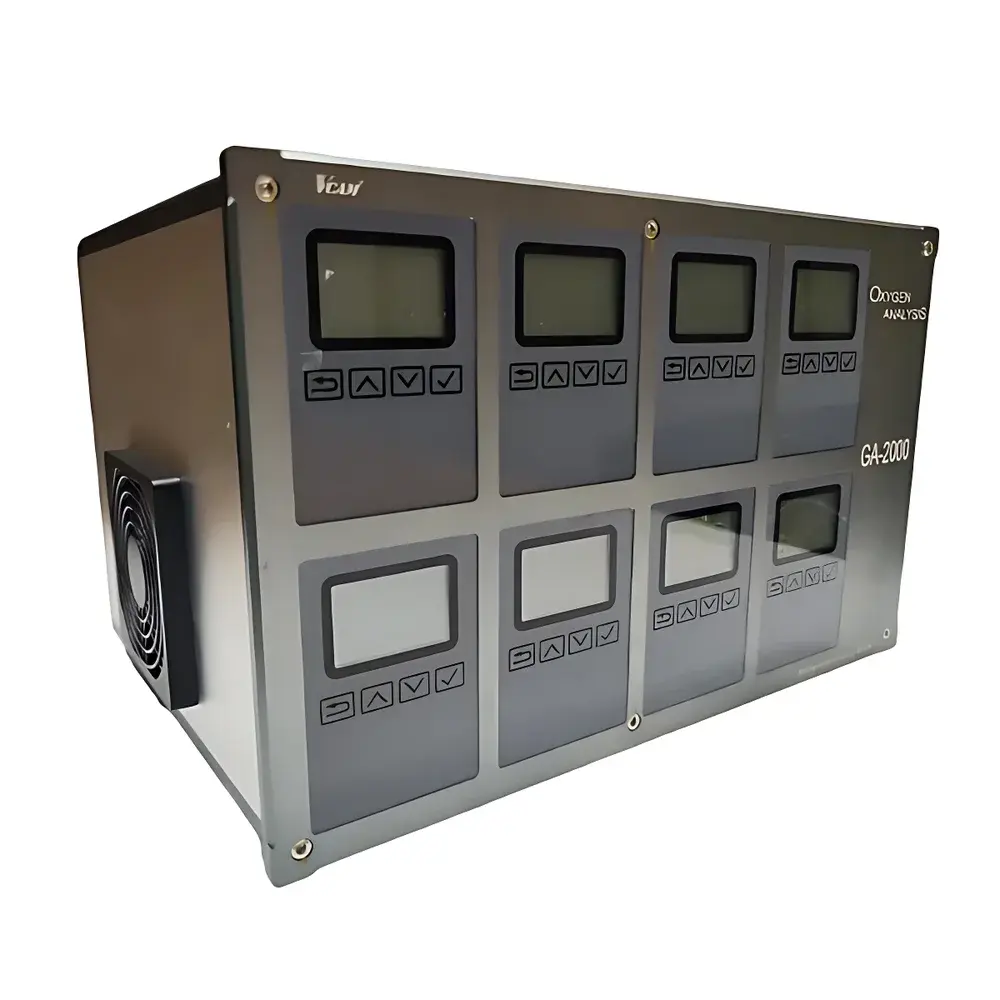
PERIC Custom Model 8 Online Volatile Organic Amine (VOA) Gas Analyzer
| Brand | PERIC |
|---|---|
| Origin | Hebei, China |
| Manufacturer Type | Manufacturer |
| Country of Origin | Domestic (China) |
| Model | Custom Model 8 |
| Quotation | Upon Request |
| Response Time | ≤60 s |
| Measurement Principle | UV Differential Optical Absorption Spectroscopy (UV-DOAS) with Hot-Wet Sampling |
| Detection Target | Monoethanolamine (MEA), Diethanolamine (DEA), and related alkanolamines |
| Range | 0–20 ppm |
| LOD | 200 ppb |
| Accuracy | ≤±5% FS |
| Sample Flow Rate | ≥2 L/min |
| Optical Path Length | ≥7 m |
| Operating Temperature | −5 to 40 °C |
| Operating Humidity | 15–85% RH |
| Preconditioning | Heated Wet Sampling + Multi-Stage Filtration |
| Compliance | Designed for marine GLP-aligned operation |
Overview
The PERIC Custom Model 8 Online Volatile Organic Amine (VOA) Gas Analyzer is an industrial-grade, real-time monitoring system engineered for continuous measurement of volatile alkanolamine species—primarily monoethanolamine (MEA) and diethanolamine (DEA)—in exhaust streams from carbon capture, utilization, and storage (CCUS) systems deployed on maritime platforms. It operates on the physical principle of ultraviolet differential optical absorption spectroscopy (UV-DOAS), leveraging characteristic electronic absorption transitions of amine molecules in the 200–400 nm spectral window. Unlike extractive NDIR or electrochemical sensors, UV-DOAS enables direct, interference-resistant quantification without chemical conversion or consumables. The analyzer employs a hot-wet sampling architecture: gas is drawn at process temperature and humidity, minimizing condensation-induced bias and preserving thermodynamic equilibrium of volatile amine species. This design is critical for accurate measurement in shipboard CCUS applications where ambient temperature fluctuations, salt-laden air, and space constraints demand robustness and metrological integrity.
Key Features
- Hot-wet sampling pathway with integrated multi-stage particulate and aerosol filtration, eliminating condensation artifacts and ensuring representative vapor-phase composition.
- High-stability deuterium-halogen UV light source with >12,000-hour operational lifetime; modular optical head design allows field-replaceable components without recalibration.
- Optical path length ≥7 meters achieved via folded-path White cell configuration, enhancing sensitivity to sub-ppm amine concentrations while maintaining compact footprint (W × D × H: 480 × 420 × 220 mm).
- Dedicated spectral inversion algorithm applying constrained least-squares fitting with reference spectra libraries for MEA, DEA, H2O vapor, NO2, SO2, and O3, effectively decoupling overlapping absorptions in humid marine exhaust.
- Self-diagnostic firmware with real-time signal-to-noise ratio (SNR) monitoring, lamp intensity tracking, and optical alignment verification—generating audit-ready logs per GLP/GMP-aligned data governance protocols.
Sample Compatibility & Compliance
The analyzer is validated for use with wet, particulate-laden, and moderately corrosive gas matrices typical of marine CCUS slipstream ducts (e.g., post-absorber stripper off-gas, regenerator vent lines). It meets mechanical and environmental requirements per IEC 60945 (marine electronic equipment), IP54 ingress protection, and EMC compliance per EN 61000-6-2/6-4. While not certified to ATEX or IECEx, its non-intrusive optical design eliminates ignition risk. Data output supports MODBUS RTU/TCP and analog 4–20 mA interfaces, enabling integration into DCS/SCADA platforms compliant with ISA-84 and IEC 61511 for safety instrumented functions. System validation reports include traceability to NIST-traceable gas standards and uncertainty budgets per ISO/IEC 17025 principles.
Software & Data Management
Embedded firmware provides local data logging (≥30 days at 1-min intervals) with timestamped raw spectra, processed concentration values, diagnostic flags, and calibration history. Optional PERIC Analytical Suite software enables remote configuration, spectral review, multi-point calibration management, and automated report generation (PDF/CSV) aligned with FDA 21 CFR Part 11 requirements—including electronic signatures, audit trails, and role-based access control. All calibration events and parameter changes are immutably logged with user ID, timestamp, and pre/post-change values.
Applications
- Real-time monitoring of amine slip in marine CCUS systems to ensure regulatory compliance with IMO GHG Strategy and flag-state emission limits.
- Leak detection and alarm triggering in enclosed spaces (engine rooms, CO2 compression skids, amine storage areas) to support occupational exposure limit (OEL) adherence per ACGIH TLV® guidelines.
- Performance validation of amine regeneration efficiency during commissioning and routine operation of onboard carbon capture plants.
- Supporting technology qualification for classification society approvals (e.g., DNV, LR, CCS) requiring documented amine loss quantification.
- Adaptation to terrestrial applications including biogas upgrading, coal-fired flue gas scrubbing, and pharmaceutical solvent recovery units.
FAQ
What amine species does the analyzer detect?
It is calibrated and validated for monoethanolamine (MEA) and diethanolamine (DEA); cross-sensitivity to other low-molecular-weight alkanolamines (e.g., MDEA) can be characterized upon request.
Is zero/span calibration required on-site?
Yes—bi-weekly span checks using certified MEA permeation tubes or dynamic dilution standards are recommended; automatic zero compensation is performed daily using synthetic air purge.
Can the system operate continuously in high-humidity marine environments?
Yes—the heated sample line (maintained at 60–80 °C), Peltier-cooled detector housing, and hydrophobic filter media ensure stable performance across 15–85% RH without condensation-induced drift.
Does the analyzer meet cybersecurity requirements for shipboard IT networks?
Firmware supports TLS 1.2 encrypted communications, configurable firewall rules, and disabled unused ports—aligned with IMO MSC-FAL.1/Circ.3 guidance on maritime cyber risk management.
What maintenance intervals are specified?
Optical window cleaning every 3 months; lamp replacement every 12–18 months; full system verification annually per ISO/IEC 17025 internal audit schedule.
Related Products