
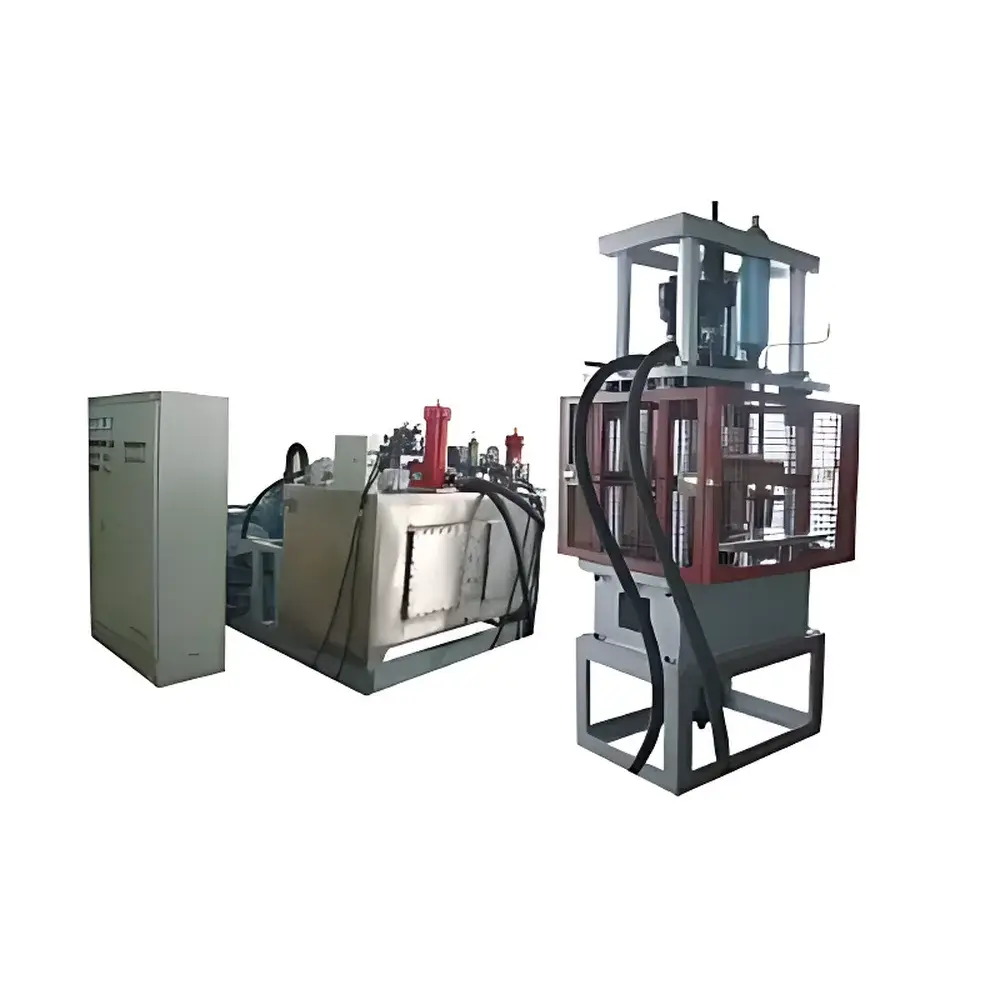
PQH-80KN Computer-Controlled Pneumatic Spring Fatigue Testing Machine
| Key | Max Test Load: 80 kN |
|---|---|
| Test Frequency Range | 0–5 Hz |
| Frequency Accuracy | ±1% |
| Stroke Amplitude | 0–160 mm |
| Static Load Accuracy | ±0.5% |
| Position Resolution | ±0.1 mm |
| Cylinder Thrust Range | 0–8,000 kgf |
| Speed Range | 0.2–200 mm/min |
| Max Specimen OD | 600 mm |
| Max Specimen Height | 500 mm |
| Power Supply | AC 380 V, 100 kW |
| Waveform Options | Sine, Ramp, Square |
| Compliance Standard | GB/T 13061 |
Overview
The PQH-80KN Computer-Controlled Pneumatic Spring Fatigue Testing Machine is an electro-hydraulic servo-driven dynamic testing system engineered for high-reliability, long-duration fatigue evaluation of automotive air suspension springs. It operates on the principle of controlled cyclic compression and extension using a precision MOOG electro-hydraulic servo valve and a high-stiffness hydraulic actuator, enabling repeatable sinusoidal, ramp, or square-wave loading profiles. Designed to meet the mechanical validation requirements defined in GB/T 13061—“Rubber Air Bellows for Automotive Suspension Systems”—the system delivers stable 80 kN maximum force output at frequencies up to 5 Hz, with programmable amplitude (0–160 mm) and stroke control. Its architecture supports both dynamic fatigue cycling (e.g., 3 million cycles at 3 Hz) and quasi-static characterization modes—including static load-deflection, internal pressure vs. displacement, effective area mapping, and pneumatic integrity verification—making it suitable for R&D validation, production QA, and durability certification workflows in Tier-1 automotive suppliers and OEM test labs.
Key Features
- MOOG electro-hydraulic servo valve integrated with high-bandwidth hydraulic actuator for precise force and position control
- Dual-mode operation: fully programmable dynamic fatigue testing (up to 5 Hz) and high-resolution static mechanical characterization
- Automated cycle counting with pre-set termination logic—supports automatic shutdown upon target cycle completion or specimen failure detection
- Integrated real-time monitoring of axial displacement, applied load, internal air pressure, and circumferential diameter (via proprietary in-situ girth measurement module)
- Computer-controlled test sequencing with full data logging: time-stamped force-displacement-pressure-position datasets synchronized at ≥1 kHz sampling rate
- Robust mechanical frame with reinforced crosshead guidance and low-hysteresis load cell (ISO 7500-1 Class 0.5 compliant)
- Configurable waveform generation: sine, triangular (ramp), and square waveforms with independent amplitude, frequency, and offset control
- Thermal management system ensuring continuous 30-day unattended operation under nominal 3 Hz/±80 mm duty cycles
- Modular software interface supporting ASTM E466, ISO 1099, and GB/T 13061-compliant test method templates
Sample Compatibility & Compliance
The PQH-80KN accommodates air springs with outer diameters up to 600 mm and compressed heights up to 500 mm, covering standard commercial vehicle, passenger car, and rail suspension geometries. Fixture adaptability supports both free-standing and constrained-mount configurations. All test protocols are traceable to GB/T 13061 and align with internationally recognized fatigue testing frameworks—including ISO 1099 (metallic materials), ASTM E466 (force-controlled axial fatigue), and ISO 27889 (pneumatic component endurance). Data acquisition meets GLP audit requirements: full electronic signature support, user-access logs, and immutable test record archiving. Optional 21 CFR Part 11 compliance package available for regulated automotive safety-critical validation environments.
Software & Data Management
The system runs on a real-time Windows-based control platform with deterministic I/O scheduling. Test definition, execution, and post-processing occur within a unified GUI supporting scriptable test sequences, multi-channel calibration, and live curve overlay (load vs. displacement, pressure vs. stroke, girth vs. compression). Raw data exports to .csv and .tdms formats; analysis modules include hysteresis loop quantification, stiffness degradation trending, cycle-to-failure statistics, and Weibull life distribution fitting. All datasets are timestamped, version-controlled, and linked to operator ID, environmental conditions (optional ambient sensor integration), and calibration certificate metadata. Audit trails comply with ISO/IEC 17025 documentation standards.
Applications
- Endurance validation of rubber diaphragm air springs per GB/T 13061, including 3-million-cycle benchmarking at 3 Hz and 50% of rated compression stroke
- Static characterization: load-deflection curves, effective area calculation, internal pressure–deformation relationships
- Pneumatic seal integrity assessment under static and dynamic loading conditions
- Comparative lifecycle analysis across material batches, curing processes, or design iterations
- Root cause analysis of premature failure modes (e.g., rubber cracking, fabric delamination, mounting interface wear)
- Support for homologation testing required by OEM technical specifications (e.g., VW TL 52303, Ford WSS-M99P1111-A)
FAQ
What standards does the PQH-80KN comply with for air spring qualification?
It is explicitly designed to satisfy GB/T 13061 and supports methodology alignment with ISO 1099, ASTM E466, and OEM-specific durability protocols.
Can the system perform both fatigue and static tests without hardware reconfiguration?
Yes—the dual-mode electro-hydraulic architecture and unified software environment enable seamless switching between dynamic cycling and static load/pressure mapping without fixture or controller changes.
Is real-time circumferential diameter measurement included as standard equipment?
Yes, the system integrates a non-contact optical girth measurement module that operates synchronously with load and displacement channels during all test phases.
What is the maximum continuous runtime capability under rated fatigue conditions?
The thermal and hydraulic design enables uninterrupted operation for ≥720 hours (30 days) at 3 Hz, ±80 mm stroke, with automated fluid temperature regulation and predictive maintenance alerts.
Does the software support export to third-party analysis platforms such as MATLAB or Python?
Yes—raw time-series data exports in ASCII (.csv) and NI TDMS formats, both natively readable in MATLAB, Python (via pandas/h5py), and Minitab for advanced statistical modeling.



