
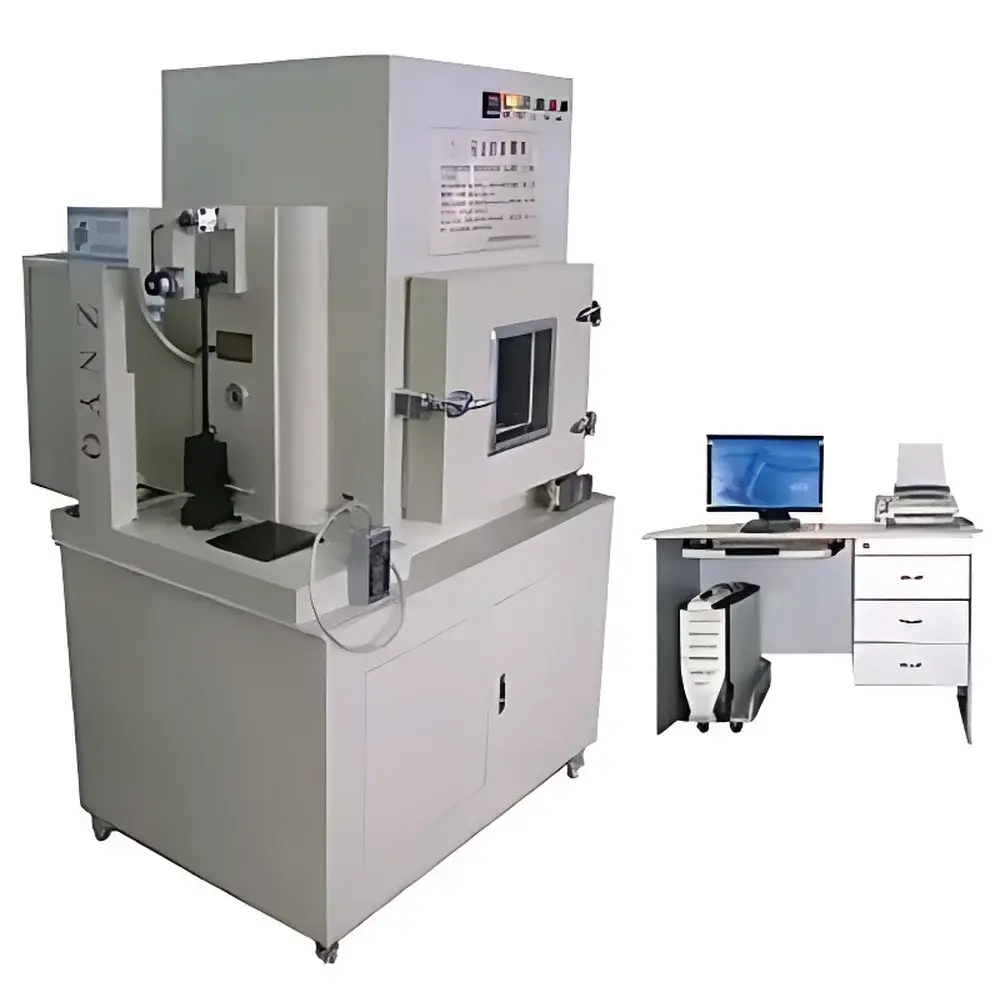
English Product Name
| Changchun Intelligent JJ-20 Cryogenic Impact Testing Machine (Dual-Mode | Charpy & Izod) |
|---|---|
| Origin | Jilin, China |
| Manufacturer Type | Authorized Distributor |
| Country of Origin | China |
| Model | JJ-20 |
| Pricing | Available Upon Request |
| Max Impact Energy | 4 J (Charpy), 5.5 J (Izod) |
| Sampling Rate | 1.2 µs |
| A/D Resolution | 1/65536 |
| Load Range Selection | ×1, ×2, ×4, ×8 |
| Load Measurement Accuracy | ≤1% FS |
| Charpy Span Options | 40 mm, 60 mm, 62 mm |
| Charpy Specimen Dimensions | 4×6×50 mm, 4×10×80 mm |
| Izod Specimen Dimensions | 4×10×80 mm |
| Charpy Pendulum Velocity | 2.9 m/s |
| Izod Pendulum Velocity | 3.50 m/s |
| Temperature Range | –40 °C to ambient |
| Temperature Stability | ±0.5 °C |
| Temperature Uniformity | ±2 °C |
| Sample Handling | Semi-automatic feed, manual positioning |
Overview
The Changchun Intelligent JJ-20 Cryogenic Impact Testing Machine is a dual-mode, microsecond-resolution impact tester engineered for high-fidelity mechanical characterization of polymeric and composite materials under controlled thermal conditions. It operates on the fundamental principles of pendulum-based impact mechanics—specifically adhering to both Charpy (simply supported beam) and Izod (cantilever beam) configurations—as standardized in ISO 179-1:2002, ISO 180:2002, GB/T 1043–2008, and GB/T 1843–2008. Unlike conventional impact testers, the JJ-20 integrates synchronized high-speed angular displacement monitoring and calibrated load-cell sensing, enabling real-time acquisition of force–time (F–t) and energy–time (J–t) profiles during fracture events. Its cryogenic chamber maintains stable sub-zero environments down to –40 °C, supporting evaluation of temperature-dependent brittle-to-ductile transitions in engineering thermoplastics—including automotive bumpers, interior trim, and structural composites—under rigorously reproducible test conditions.
Key Features
- Dual-test capability: Interchangeable fixtures and pendulums support both ISO/GB-compliant Charpy (4 J max) and Izod (5.5 J max) impact modes without hardware reconfiguration
- Cryogenic thermal control system: Integrated refrigerated chamber with PID-controlled cooling, ±0.5 °C temperature stability and ±2 °C uniformity across specimen zone
- High-fidelity data acquisition: 1.2 µs sampling interval, 16-bit A/D resolution (1/65536), and low-noise signal conditioning for precise dynamic load capture
- Real-time curve generation: Simultaneous acquisition and display of N–t (force vs. time) and J–t (energy vs. time) curves during impact event
- Modular mechanical architecture: Precision-machined pendulum shaft, hardened anvil surfaces, and traceable calibration components (including span gauges, centering jigs, and leveling shims)
- Compliance-ready design: Supports audit trails, user-access controls, and raw-data export formats compatible with GLP/GMP documentation workflows
Sample Compatibility & Compliance
The JJ-20 accommodates standard ISO and GB-compliant specimens—including notched and unnotched bars measuring 4×6×50 mm (Charpy) and 4×10×80 mm (Charpy/Izod)—with adjustable span lengths (40 mm, 60 mm, 62 mm) and repeatable notch alignment via dedicated centering fixtures. All mechanical and thermal performance parameters meet or exceed requirements specified in ISO 179-1:2002 (Charpy), ISO 180:2002 (Izod), GB/T 1043–2008, and GB/T 1843–2008. The system’s measurement uncertainty for impact energy is validated per ISO/IEC 17025 guidelines, with load cell calibration traceable to national metrology institutes. Thermal validation includes mapping reports confirming spatial uniformity and temporal stability per ASTM E2203 for low-temperature testing apparatus.
Software & Data Management
The bundled ZNS2008 test software (lifetime free updates) provides full control over test configuration, real-time waveform visualization, automated parameter calculation (e.g., absorbed energy, peak load, time-to-fracture), and customizable reporting. Data files are stored in open binary + XML metadata format, enabling integration with LIMS platforms and third-party analysis tools (e.g., MATLAB, Python pandas). Software features include electronic signature support, configurable user roles (operator, supervisor, administrator), audit-log generation (per FDA 21 CFR Part 11 requirements), and PDF/Excel report export with embedded calibration certificates and environmental logs. All raw sensor traces—including synchronized analog inputs from load and angular encoders—are retained without compression.
Applications
- Automotive R&D: Formulation screening of PP/EPDM, PC/ABS, and TPO blends for bumper systems, door panels, and crash-absorbing structures
- Academic polymer physics: Quantification of ductile-brittle transition temperature (DBTT) shifts in filled thermoplastics and fiber-reinforced composites
- Quality assurance labs: Routine verification of incoming resin lots against supplier specifications under controlled low-temperature conditions
- Standards laboratories: Reference testing for inter-laboratory round-robin studies aligned with ISO/IEC 17025 accreditation scope
- Failure analysis: Correlation of impact fracture morphology (via post-test SEM/FTIR) with dynamic loading signatures captured by the JJ-20
FAQ
Does the JJ-20 comply with ISO/IEC 17025 requirements for accredited testing laboratories?
Yes—the mechanical subsystem, thermal chamber, and data acquisition chain are designed for traceable calibration and documented uncertainty budgets; full validation packages including temperature mapping and load-cell linearity reports are available upon request.
Can the system perform tests at temperatures below –40 °C?
No—the certified operational range is –40 °C to ambient; extension beyond this requires custom chamber redesign and is not covered under standard warranty or compliance certification.
Is remote operation or network integration supported?
The ZNS2008 software supports TCP/IP-based remote monitoring and scheduled test execution via local area network; however, direct cloud upload or IoT telemetry is not implemented to preserve data integrity and regulatory compliance.
What maintenance intervals are recommended for the pendulum bearing and load cell?
Annual recalibration of the load cell and angular encoder is advised; pendulum pivot bearings require lubrication every 500 tests or biannually—whichever occurs first—using ISO VG 32 synthetic oil.
Are ISO-standard reference specimens available for performance verification?
Yes—certified Charpy and Izod reference bars (with NIST-traceable fracture energy values) are offered as optional accessories, fully compatible with JJ-20 fixture geometry and alignment protocols.



