
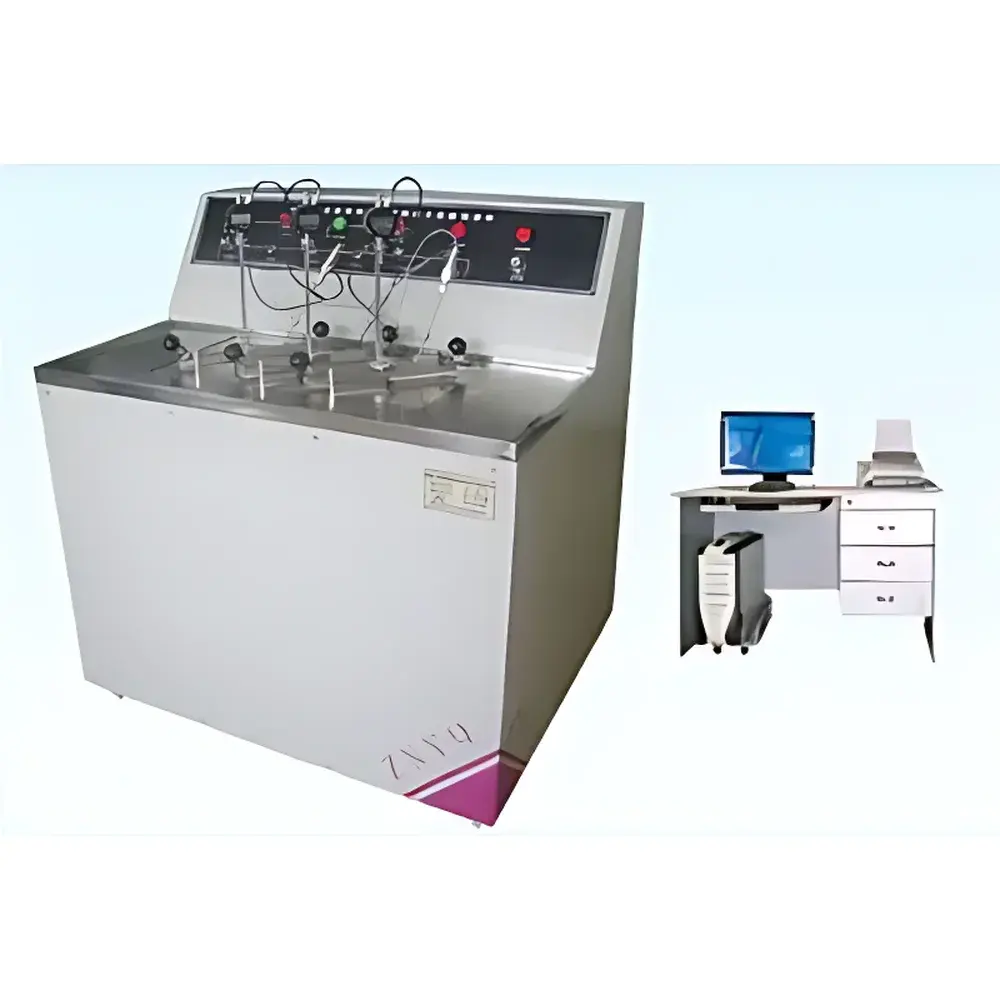
WKW-300 Heat Deflection Temperature (HDT) and Vicat Softening Temperature (VST) Tester
| Origin | Jilin, China |
|---|---|
| Manufacturer Type | Distributor |
| Origin Category | Domestic |
| Model | WKW-300 |
| Quotation | Upon Request |
| Temperature Range | Ambient to 300 °C |
| Temperature Accuracy | ±0.5 °C |
| Heating Rates | 5 ±0.5 °C/6 min (Method A), 12 ±1.0 °C/6 min (Method B) |
| HDT Deformation Range | 0–0.5 mm |
| VST Penetration Range | 0–1 mm |
| Dial Indicator Resolution | ±0.005 mm |
| Max HDT Load | 5 kgf |
| Max VST Loads | GA = 10 N ±0.2 N, GB = 50 N ±1 N |
| Max Heating Power | ≤4000 W |
| Power Supply | 220 V, 50 Hz, 30 A |
| Cooling Modes | Natural convection & water cooling |
| Over-Temperature Protection | Configurable upper limit |
Overview
The WKW-300 Heat Deflection Temperature (HDT) and Vicat Softening Temperature (VST) Tester is a precision-controlled thermal-mechanical testing system engineered for standardized evaluation of thermoplastic and thermosetting polymers under defined load and heating conditions. It operates in accordance with internationally recognized test standards—including ASTM D648 (HDT), ASTM D1525 (VST), ISO 75-1/2/3 (HDT), and ISO 306 (VST)—to quantify the temperature at which polymeric specimens undergo specified deformation under flexural stress (HDT) or needle penetration under axial load (VST). The instrument employs a dual-mode heating bath—typically filled with silicone oil or transformer oil—where temperature is regulated via PID-controlled resistive heating elements and monitored continuously by calibrated platinum resistance thermometers (PRTs). Specimen deflection or needle penetration is measured in real time using a high-resolution digital dial indicator, ensuring traceable, repeatable results suitable for quality control, material qualification, and regulatory documentation.
Key Features
- Microprocessor-based closed-loop temperature control with programmable ramp rates compliant with ASTM and ISO Method A (5 °C/6 min) and Method B (12 °C/6 min)
- Dual-load capability: supports both HDT configurations (1.80 MPa and 0.45 MPa stress levels) and VST loads per GA (10 N) and GB (50 N) specifications
- Integrated overflow oil recovery system to mitigate thermal expansion risks during prolonged high-temperature operation (up to 300 °C)
- Configurable over-temperature protection with user-defined upper limit thresholds to prevent thermal runaway and safeguard specimen integrity
- Multi-mode cooling options: passive natural convection for low-power operation or active water-cooling for rapid thermal cycling between tests
- Real-time data acquisition with CRT-based graphical display of temperature vs. deformation curves, enabling immediate visual verification of transition onset
- Onboard data storage, curve plotting, and report generation with customizable templates compliant with internal QA/QC documentation requirements
Sample Compatibility & Compliance
The WKW-300 accommodates standard rectangular bars (ASTM D648: 127 × 13 × 3 mm; ISO 75: 80 × 10 × 4 mm) and cylindrical VST specimens (ISO 306: Ø10 mm × ≥10 mm height). It is validated for use with rigid and semi-crystalline thermoplastics (e.g., ABS, PC, PP, PA6/66), thermosets (e.g., epoxy, phenolic), and elastomeric composites including halogen-free cable compounds. All mechanical loading components—including cantilever support fixtures, bending spindles, and VST needles—are manufactured to dimensional tolerances specified in ASTM E220 and ISO 6892-1. The system meets general electrical safety requirements per IEC 61010-1 and supports laboratory adherence to GLP principles through audit-ready test logs, operator ID tagging, and timestamped result exports.
Software & Data Management
Embedded firmware enables full test sequence automation—from initial temperature stabilization and load application to endpoint detection and pass/fail classification based on user-defined deformation thresholds. Raw sensor data (temperature, displacement, time) are logged at ≥1 Hz resolution and stored in non-volatile memory. Export formats include CSV for statistical analysis in JMP or Minitab, and PDF reports containing test parameters, annotated curves, and compliance statements referencing applicable ASTM/ISO clauses. While the system does not implement FDA 21 CFR Part 11 electronic signature controls natively, its data export architecture facilitates integration into validated LIMS or ELN platforms where electronic records, audit trails, and role-based access are centrally managed.
Applications
- Quality assurance of incoming polymer resins and compounded granules in automotive, electronics, and wire & cable manufacturing
- Comparative thermal stability assessment during polymer formulation development (e.g., filler effects, plasticizer migration, flame-retardant interactions)
- Regulatory submission support for UL 746B, IEC 60695-10-2, and EN 60695-10-2 flammability-related mechanical performance criteria
- Educational laboratories conducting standardized polymer characterization per ASTM D4000 classification systems
- Failure analysis of heat-distorted components in root cause investigations involving service temperature exceedance
FAQ
What standards does the WKW-300 fully support for HDT and VST testing?
It is configured to execute ASTM D648, ASTM D1525, ISO 75-1/2/3, and ISO 306 without hardware modification. Calibration certificates reference NIST-traceable PRTs and certified weights.
Can the instrument perform both HDT and VST tests without manual reconfiguration?
Yes—the fixture carriage and load application mechanism are designed for rapid tooling changeover between HDT bending jigs and VST penetration assemblies, typically completed in under 90 seconds.
Is water cooling mandatory for operation above 250 °C?
Water cooling is recommended—not required—for sustained operation near 300 °C to maintain thermal gradient stability and extend bath fluid service life; natural convection remains viable for shorter-duration tests.
How is measurement traceability ensured for the digital dial indicator?
The indicator is factory-calibrated against ISO 13029-compliant reference gauges, with calibration interval guidance provided in the maintenance manual and documented in the instrument’s calibration log file.
Does the system support multi-user environments with access control?
User profiles are stored locally with password protection for parameter editing and report generation; however, centralized authentication (e.g., LDAP) requires external middleware integration via serial or Ethernet API commands.



