
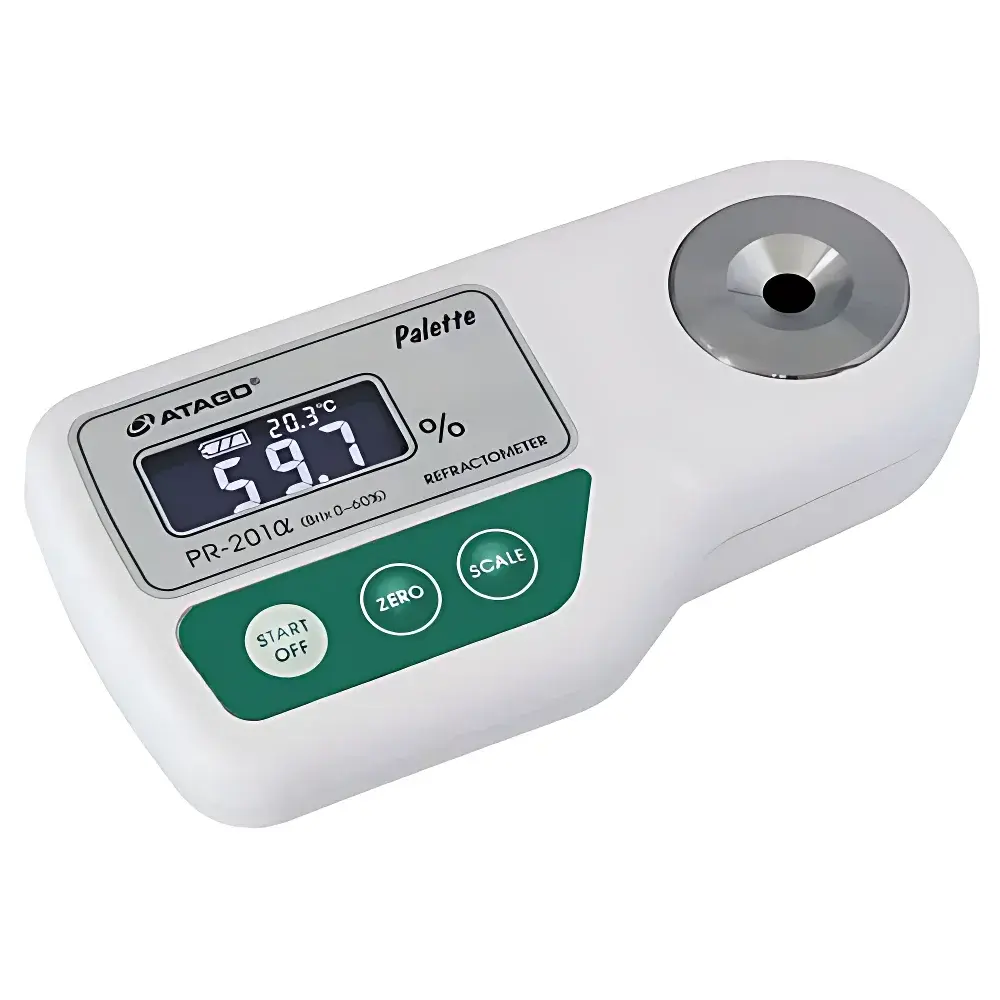
ATAGO PR-201α Portable Digital Refractometer for Juice and High-Range Brix Measurement
| Brand | ATAGO |
|---|---|
| Origin | Japan |
| Model | PR-201α (Wide-Range Digital) |
| Measurement Range | 0.0–60.0% Brix |
| Accuracy | ±0.1% Brix |
| Temperature Compensation | Automatic (ATC), 10–40°C |
| Resolution | 0.1% Brix |
| Operating Ambient Temperature | 10–40°C |
| Power Supply | 9V Alkaline Battery (006P) |
| IP Rating | IP64 |
| Dimensions & Weight | 17 × 9 × 4 cm, 300 g (main unit only) |
Overview
The ATAGO PR-201α is a portable, high-precision digital refractometer engineered for rapid, field-deployable measurement of soluble solids concentration—expressed as % Brix—in liquid and semi-viscous food and industrial samples. Based on the optical principle of critical angle refraction, the instrument determines Brix by measuring the refractive index of a sample placed on its sapphire-coated prism surface. Light passes through the prism-sample interface, and the resulting critical angle shift is converted into a digital Brix value via an integrated photodiode array and temperature-compensated microprocessor. Its wide 0.0–60.0% Brix range accommodates not only standard fruit juices and soft drinks but also highly concentrated products such as fruit concentrates, jams, syrups, and viscous industrial fluids—including water-soluble cutting oils, cleaning solutions, and antifreeze coolants. Built-in Automatic Temperature Compensation (ATC) ensures measurement stability across ambient conditions from 10°C to 40°C, eliminating manual correction and supporting consistent QC in non-climate-controlled environments.
Key Features
- Wide-range Brix measurement (0.0–60.0%) optimized for both low-dilution beverages and high-solids formulations
- ELI (Enhanced Light Immunity) optical system minimizes interference from ambient light—enabling reliable outdoor or production-floor use without shading or enclosures
- User-definable scale conversion: supports up to three custom scales (Scale 2, 3, 4) with programmable linear coefficients (e.g., Concentration = Brix × K), enabling direct readout of industry-specific units (e.g., % citric acid, % glycol, or proprietary formulation indices)
- IP64-rated enclosure ensures dust resistance and protection against water splashes—suitable for humid processing areas and mobile field inspection
- One-touch START/OFF operation with 3-second stabilization and auto-hold function; results displayed after triple-digit flash confirmation
- Factory-calibrated with traceable NIST-traceable sucrose standards; zero calibration using distilled water performed in <15 seconds
- Low-power design powered by a single 9V alkaline battery (006P), delivering >5,000 measurements per charge
Sample Compatibility & Compliance
The PR-201α is validated for use with aqueous solutions containing dissolved sugars, organic acids, salts, and glycols—provided they are optically clear or mildly turbid (non-scattering). It reliably measures clarified fruit juices (e.g., apple, orange, grape), nectars, dairy-based beverages, pharmaceutical syrups, and industrial coolants. For viscous or particulate-laden samples (e.g., pulpy juice, jam), users must apply thin, uniform films to the prism and verify homogeneity prior to measurement. While the device itself is not certified under ISO/IEC 17025, its measurement methodology aligns with ASTM D115, AOAC Official Method 932.12, and ICUMSA Method GS4/3-12 for refractometric Brix determination. Data integrity is supported by GLP-compliant operation: all calibrations are manually initiated and timestamped via user action; no electronic audit trail is embedded, making it suitable for routine QC where full 21 CFR Part 11 compliance is not mandated.
Software & Data Management
The PR-201α operates as a standalone, embedded-system instrument with no onboard memory, Bluetooth, or USB connectivity. All measurement data remain local and unrecorded unless manually transcribed. This architecture eliminates firmware updates, cybersecurity vulnerabilities, and validation overhead—making it ideal for regulated environments where device simplicity and operational transparency are prioritized over digital integration. Calibration logs, coefficient settings, and measurement history must be maintained externally in paper-based or LIMS-linked records. The instrument’s user-configurable scales and coefficient storage (retained after battery replacement) support repeatable method execution across shifts and operators without software dependency.
Applications
- Quality control of incoming raw materials (e.g., fruit concentrate Brix verification prior to blending)
- In-process monitoring during juice pasteurization, evaporation, and dilution stages
- Final product release testing for soft drinks, sports beverages, and ready-to-drink teas
- Concentration verification of pharmaceutical oral solutions and excipient mixtures
- Maintenance of industrial fluid concentrations in CNC machining (cutting oil), parts washing (detergent strength), and HVAC systems (glycol antifreeze)
- R&D screening of new formulations where rapid, non-destructive Brix estimation supports iterative development
FAQ
How often should I calibrate the PR-201α?
Zero calibration with distilled water is required before first use each day, after significant ambient temperature shifts (>5°C), and following battery replacement.
Can the PR-201α measure opaque or pulpy samples?
It is designed for optically transparent or low-turbidity liquids. For pulpy juices or jams, centrifuge or filter the sample to obtain a clear supernatant prior to measurement.
What does the “ELI” feature do?
ELI (Enhanced Light Immunity) dynamically adjusts the photodetector gain to suppress saturation from ambient light sources—enabling stable readings under direct sunlight or factory lighting without external shielding.
How is temperature compensation implemented?
An internal thermistor continuously monitors prism temperature and applies real-time correction based on the sucrose/water refractive index vs. temperature curve per ICUMSA guidelines.
Is the PR-201α compliant with FDA or EU food safety regulations?
As a Class I general-purpose measuring device, it meets CE marking requirements for electrical safety (EN 61010-1) and carries ATAGO’s Declaration of Conformity. Its measurement principle and accuracy are accepted under Codex Alimentarius and national food standards for Brix-based quality assessment.






