
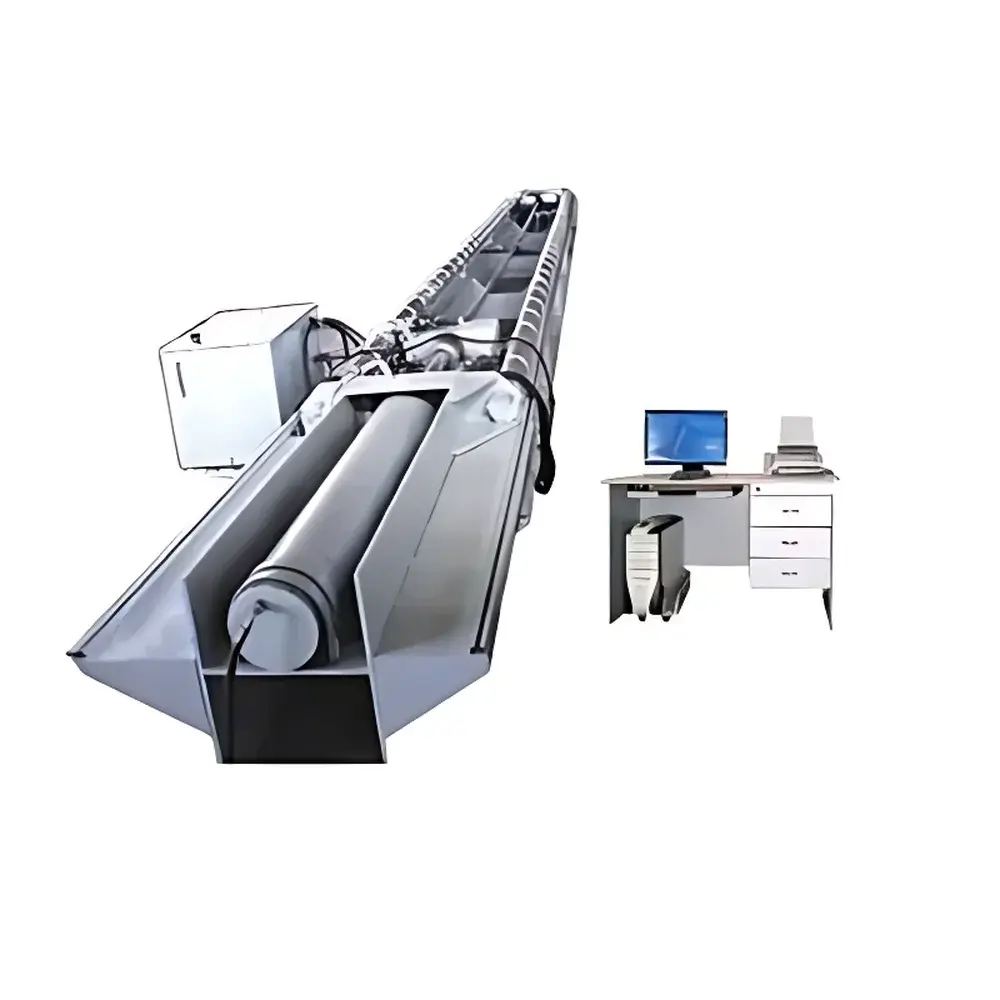
LY-150 Horizontal Universal Testing Machine
| Origin | Jilin, China |
|---|---|
| Manufacturer Type | Authorized Distributor |
| Origin Category | Domestic (China) |
| Model | LY-150 |
| Quotation | Upon Request |
| Max Load Capacity | 2000 kN |
| Load Measurement Accuracy | ±1% FS |
| Maximum Test Length | 14,000 mm |
| Adjustable Crosshead Travel | 10,000 mm |
| Test Speed Range | 1–100 mm/min |
| Rapid Positioning Speed | 200 mm/min |
| Extensometer Gauge Length Range | 0–15,000 mm |
| Elongation Measurement Accuracy | ±0.2% FS ±1 mm |
| Displacement Measurement Range | 0–15,000 mm |
| Displacement Accuracy | ±0.5% FS ±1 mm |
| Hydraulic Cylinder Stroke | 1200 mm |
| Motor Power | 5.5 kW, 3-phase 380 V AC |
| Overall Dimensions (L×W×H) | 8000 × 8000 × 25,000 mm |
Overview
The LY-150 Horizontal Universal Testing Machine is a heavy-duty, floor-mounted static tensile testing system engineered for ultra-long specimen evaluation under high-load conditions—specifically designed for structural validation of cables, conductors, composite tendons, geosynthetic reinforcements, and large-scale polymer or metallic rods up to 14 meters in length. Unlike conventional vertical configurations, its horizontal architecture eliminates gravitational sag effects during extended-duration tests and enables seamless integration into purpose-built test bays with reinforced foundations. The system operates on a closed-loop servo-hydraulic control principle, utilizing imported high-response proportional valves, precision pressure transducers, and temperature-compensated load cells to ensure traceable force measurement per ISO 7500-1 Class 1 requirements. It supports sustained load testing at up to 2000 kN for durations exceeding 200 hours—critical for creep, stress relaxation, and long-term durability assessment in aerospace, power transmission, and civil infrastructure applications.
Key Features
- Structural frame engineered for installation in a dedicated 10 m × 10 m × 5 m test chamber with reinforced concrete pit (4 m × 4 m × 3 m), including wind-stabilizing diagonal bracing and lightning protection system.
- Integrated 15-meter specimen lifting mechanism with synchronized dual-point hoisting for safe handling of elongated samples.
- Automated hydraulic grip actuation with programmable clamping force and jaw alignment verification—compatible with flat, round, and threaded specimens.
- Dedicated maintenance access via motorized personnel lift platform (CE-compliant, 2.5 m max height).
- High-resolution digital long-travel displacement measurement system (U.S.-sourced optical encoder-based extensometer) covering 0–15,000 mm with resolution ≤0.01 mm.
- Real-time load–displacement, stress–strain, and time-based curve acquisition with multi-channel synchronization (load, extension, crosshead position, temperature if equipped).
- Modular software architecture supporting ASTM E8/E21, ISO 6892-1, GB/T 228.1, and JIS Z 2241 standard-compliant test sequences.
Sample Compatibility & Compliance
The LY-150 accommodates specimens with diameters from 6 mm to 120 mm and lengths up to 14,000 mm—including stranded conductors, pre-stressed concrete tendons, fiber-reinforced polymer (FRP) bars, steel cables, and high-modulus polyethylene (HMPE) ropes. Grip systems are configurable with serrated, wedge-type, or custom-machined jaws to prevent slippage during high-force ramping or hold phases. All mechanical and electrical subsystems conform to IEC 61000-6-2/6-4 immunity and emission standards. Force calibration is traceable to national metrology institutes (e.g., NIM China) and validated annually per ISO/IEC 17025 requirements. Data integrity complies with FDA 21 CFR Part 11 when audit trail and electronic signature modules are enabled.
Software & Data Management
The embedded Windows-based control and analysis suite provides full GLP/GMP-aligned data governance: automatic timestamped storage of raw sensor streams, test parameters, operator ID, environmental logs (optional), and digital signatures. Users define custom test protocols—including multi-step loading profiles (ramp-hold-ramp), cyclic tension, and relaxation sequences—with real-time pass/fail flagging against preset limits. Curve analysis includes region-of-interest zoom, overlay comparison across batches, tangent modulus calculation, yield point detection (0.2% offset), and fracture energy integration. Export formats include CSV, XML, PDF, and native .tdms; direct export to Microsoft Excel or Word templates enables rapid report generation compliant with internal QA documentation workflows.
Applications
This system serves as a primary validation tool for materials and components requiring dimensional stability and mechanical integrity under prolonged axial loading. Key use cases include: qualification testing of submarine power cables per IEC 62044; fatigue life assessment of bridge stay cables per AASHTO LRFD; tensile characterization of carbon-fiber tow bundles per ASTM D4018; creep compliance evaluation of HDPE geomembranes per GRI-GM13; and stress–strain mapping of aluminum alloy extrusions per EN 755-2. It is routinely deployed in third-party certification labs, OEM R&D centers, and national metrology institutes conducting interlaboratory comparisons under ILAC-MRA frameworks.
FAQ
What foundation specifications are required for installation?
A reinforced concrete pit measuring 4 m (L) × 4 m (W) × 3 m (D) with M35-grade concrete and anchored embed plates is mandatory. Site-level geotechnical survey and vibration isolation recommendations must be provided prior to civil works.
Is the system compatible with ASTM E2309-compliant test methods?
Yes—the control firmware and calibration documentation support all procedural requirements for high-force static tensile testing, including dynamic compensation for hydraulic lag and thermal drift correction algorithms.
Can deformation be measured directly on the specimen gauge section?
Yes—optional clip-on or non-contact video extensometers (up to 15,000 mm field of view) may be integrated to eliminate machine-frame compliance errors and meet ISO 9513 Class 1 accuracy for strain measurement.
Does the system support remote monitoring and diagnostics?
Standard Ethernet/IP interface enables secure remote access via TLS-encrypted VPN for real-time status monitoring, firmware updates, and predictive maintenance alerts based on hydraulic pressure trends and valve duty cycles.
What documentation is supplied for regulatory audits?
Factory calibration certificates, uncertainty budgets per GUM (JCGM 100), software validation reports (IQ/OQ/PQ), and a complete traceability matrix linking hardware IDs, firmware versions, and metrological references are included in the delivery package.



