
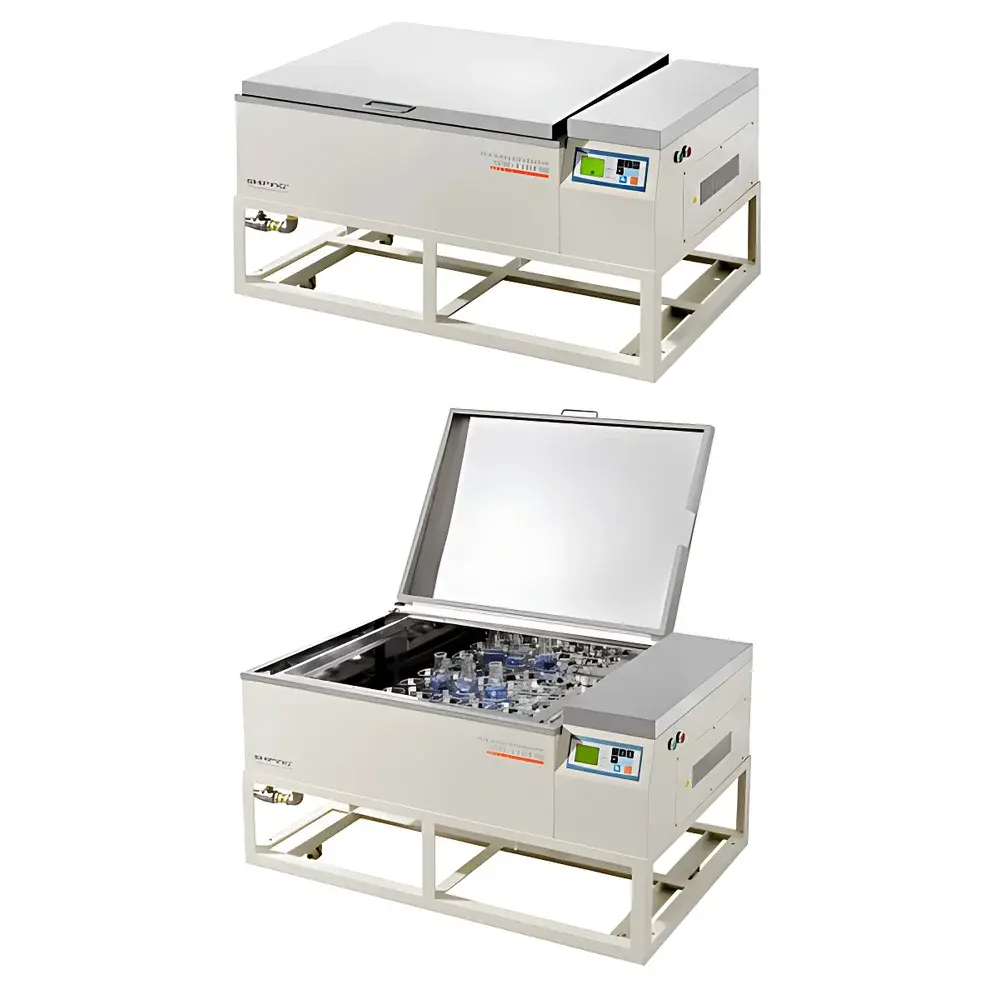
Shiping SPH-110X12 / SPH-110X24 / SPH-110X48 Reciprocal Water Bath Shaker
| Brand | Shiping |
|---|---|
| Origin | Shanghai, China |
| Model | SPH-110X12 / SPH-110X24 / SPH-110X48 |
| Timer Range | 0–500 h |
| Oscillation Frequency | 20–200 rpm |
| Frequency Accuracy | ±1 rpm |
| Stroke Amplitude | Φ25 mm |
| Temperature Range | 5°C above ambient to 99.9°C |
| Temperature Uniformity | ±0.1°C |
| Temperature Accuracy (Steady State) | ±0.2°C |
| Chamber Material | 316L stainless steel |
| Tray Dimensions | 430×320×60 mm / 590×390×80 mm / 780×586×80 mm |
| Capacity | 12×250 mL / 24×250 mL / 48×250 mL (or equivalent volumetric configurations) |
| Power | 2000 W / 2200 W / 4000 W |
| Net Weight | 45 kg / 55 kg / 80 kg |
| Drive Type | Balanced orbital drive |
| Control System | PID microprocessor with environmental scanning logic |
| Display | Dual-line LCD (setpoint & real-time values) |
| Safety Features | Dual overtemperature protection, dry-run prevention, open-door shutdown, leakage/overcurrent protection, acoustic-optical alarms |
Overview
The Shiping SPH-110X Series Reciprocal Water Bath Shaker is an engineered platform for precise temperature-controlled agitation in life science laboratories. Designed around a reciprocating oscillation principle—where the shaker tray moves along a horizontal linear path with controlled amplitude and variable frequency—the system enables uniform heat transfer and mechanical mixing within aqueous or buffer-based samples. Unlike rotary or orbital shakers, the reciprocal motion minimizes centrifugal forces while maximizing shear consistency across heterogeneous suspensions, making it particularly suitable for sensitive biological applications such as cell culture maintenance, hybridization kinetics, and antigen-antibody binding assays. The water bath enclosure ensures exceptional thermal stability and homogeneity (±0.1°C), critical for reproducible enzyme kinetics, solubility profiling, and diagnostic assay development under GLP-compliant workflows.
Key Features
- Reciprocating oscillation mechanism with adjustable frequency (20–200 rpm) and fixed stroke amplitude (Φ25 mm), delivering consistent shear profiles without vortex formation.
- 316L stainless steel water bath chamber and electropolished stainless steel tray—corrosion-resistant, non-porous, and compatible with repeated sterilization cycles using ethanol, hydrogen peroxide vapor, or autoclave-compatible protocols.
- PID-controlled microprocessor with environmental scanning logic ensures rapid thermal equilibration and minimal overshoot; temperature stability maintained at ±0.2°C under steady-state conditions.
- Dual-line LCD interface displays both setpoint and real-time temperature and speed values; supports parameter memory, power-failure recovery, and eight-segment programmable ramp-hold profiles.
- Integrated safety architecture includes dual independent overtemperature cutoffs (bath-level and sample-level), dry-run protection, automatic shutdown upon lid opening, and Class I electrical protection per IEC 61010-1.
- Front-mounted drain valve facilitates complete bath drainage for cleaning, decontamination, or coolant replacement—essential for labs maintaining ISO 13485 or CLIA-certified environments.
Sample Compatibility & Compliance
The SPH-110X Series accommodates standard laboratory vessels—including Erlenmeyer flasks (up to 1000 mL), test tubes, multi-well plates, and hybridization tubes—secured via spring-loaded clamps or optional universal platforms. Its design conforms to common regulatory expectations for benchtop incubation equipment: thermal performance aligns with ASTM E2500-13 (verification of laboratory equipment), and operational logging capabilities support traceability requirements under FDA 21 CFR Part 11 when paired with validated external data capture software. The unit operates within ambient temperature ranges of 15–30°C and meets EN 61326-1 electromagnetic compatibility standards for laboratory use.
Software & Data Management
While the SPH-110X operates as a standalone instrument with embedded firmware, its programmable timer (0–500 h), real-time parameter display, and event-triggered alarms (e.g., deviation >3°C from setpoint) generate auditable operational records. For extended compliance workflows, users may integrate external USB or RS-232 loggers to capture timestamped temperature and speed traces—enabling retrospective analysis aligned with GMP Annex 11 or ISO/IEC 17025 documentation frameworks. Calibration certificates for temperature and speed sensors can be issued by accredited third-party metrology providers upon request.
Applications
- Cell culture propagation under controlled thermal and agitation conditions (e.g., suspension CHO or HEK293 cultures).
- Solubility and dissolution testing per USP , especially for poorly water-soluble compounds requiring prolonged equilibration.
- Nucleic acid hybridization (Southern/Northern blotting), immunoprecipitation wash steps, and ELISA plate shaking protocols.
- Microbial suspension preparation, serial dilution homogenization, and staining/de-staining cycles in histology and cytology labs.
- Extraction efficiency optimization in natural product isolation, including aqueous-organic partitioning and solid-phase extraction conditioning.
FAQ
What is the difference between reciprocating and orbital motion in shakers?
Reciprocating motion provides linear back-and-forth displacement, minimizing radial acceleration and reducing foam formation—ideal for viscous or shear-sensitive samples. Orbital motion introduces centripetal force, which may cause stratification or splashing in low-volume or high-density suspensions.
Can the SPH-110X series be used for sterile applications?
Yes—the 316L stainless steel construction, smooth electropolished surfaces, and removable tray allow full autoclaving or VHP decontamination. However, the electronic control panel must remain external to sterilization chambers.
Is temperature calibration traceable to NIST standards?
Factory calibration uses reference-grade thermistors traceable to national metrology institutes. End-user verification can be performed using a calibrated PT100 probe inserted into the bath medium at multiple locations.
Does the unit support continuous operation beyond 24 hours?
Yes—the 500-hour maximum timer setting enables unattended overnight and multi-day experiments, with audible and visual alerts at endpoint and on thermal deviation events.
What maintenance is required for long-term reliability?
Routine inspection of water level, drain valve seal integrity, and tray mounting hardware is recommended every 6 months. Annual verification of PID loop response and alarm thresholds is advised for regulated environments.




