
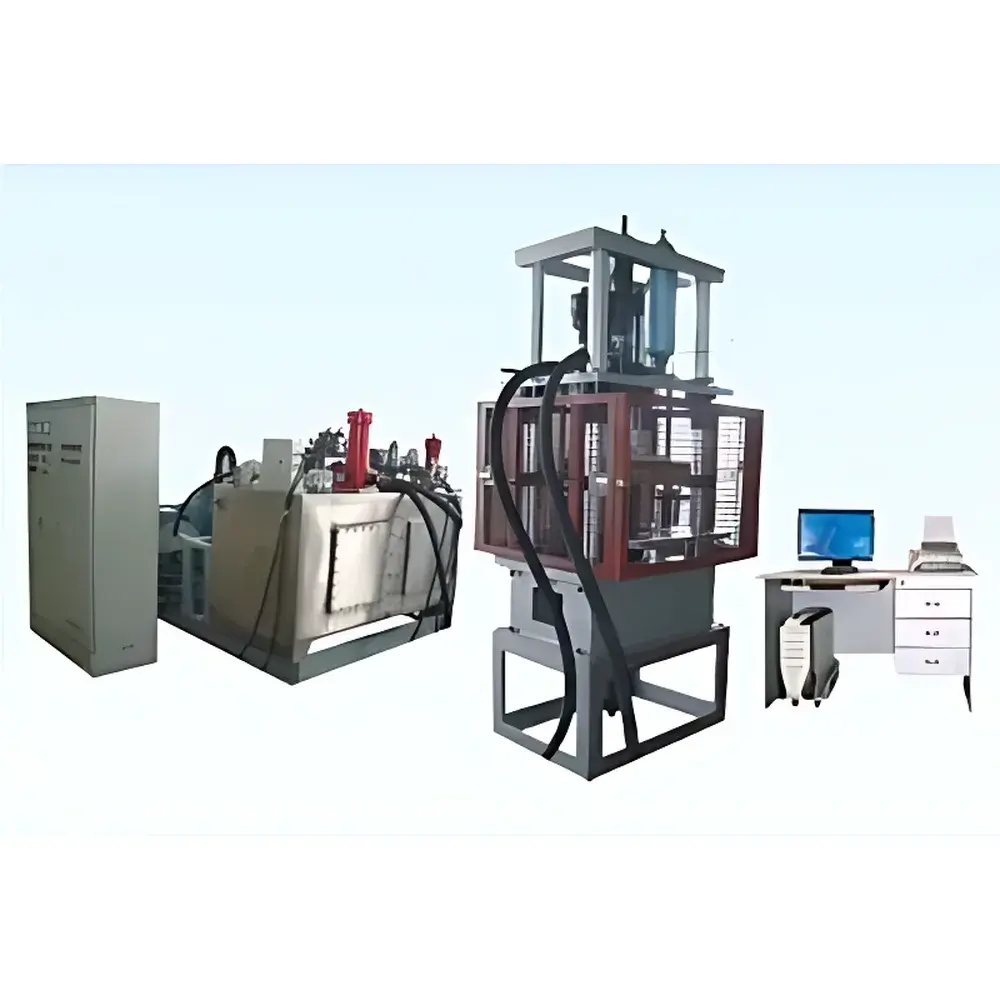
Changchun Zhineng PQH-80KN Electro-Hydraulic Servo Air Spring Fatigue Testing Machine
| Key | Max Test Load: 80 kN |
|---|---|
| Frequency Range | 0–5 Hz |
| Amplitude Range | 0–160 mm |
| Static Load Accuracy | ±0.5% |
| Frequency Accuracy | ±1% |
| Stroke Resolution | 0.1% ± 0.1 mm |
| Speed Range | 0.2–200 mm/min |
| Max Spring OD | 600 mm |
| Max Spring Height | 500 mm |
| Power Supply | AC 380 V, 100 kW |
| Waveform Options | Sine, Ramp, Square |
| Compliance | GB/T 13061 |
Overview
The Changchun Zhineng PQH-80KN Electro-Hydraulic Servo Air Spring Fatigue Testing Machine is a high-precision, computer-controlled dynamic testing system engineered for evaluating the long-term structural integrity and functional reliability of pneumatic suspension components used in automotive and rail applications. It operates on a closed-loop electro-hydraulic servo principle, integrating MOOG-series servo valves with high-bandwidth hydraulic actuators to deliver repeatable, programmable cyclic loading under controlled displacement or force conditions. The system is specifically designed to replicate real-world service conditions—such as repeated compression-extension cycles at frequencies up to 5 Hz and amplitudes up to 160 mm—enabling accelerated life-cycle validation per GB/T 13061 (“Rubber Air Bellows for Automotive Suspension Systems”). Capable of executing fatigue tests up to 3 million cycles without interruption, the machine supports continuous operation over extended periods (e.g., 720+ hours), making it suitable for durability qualification, design verification, and production lot acceptance testing in accordance with ISO 17025-aligned laboratory practices.
Key Features
- Electro-hydraulic dual-drive architecture with independent servo-controlled positioning and dynamic actuation for precise load-displacement coordination
- Integrated real-time measurement of effective diameter during test via proprietary circumferential gaging system—enabling concurrent evaluation of dimensional stability and volumetric compliance
- Multi-mode waveform generation (sine, ramp, square) with user-defined frequency sweep, dwell, and step functions
- Automated test termination triggers: preset cycle count, specimen failure detection (load drop > threshold), or abnormal displacement deviation
- Simultaneous acquisition and synchronization of force, displacement, internal pressure, and effective area data streams
- Static characterization capability: pressure-tightness verification, load-deflection mapping, pressure-deflection curves, and effective area vs. stroke analysis
- Full digital control interface with Windows-based software supporting ASTM E4, ISO 1099, and GB/T 13061-compliant test protocols
- Robust mechanical frame with reinforced crosshead guidance and low-friction linear bearings to minimize parasitic moments and ensure axial alignment fidelity
Sample Compatibility & Compliance
The PQH-80KN accommodates air springs with outer diameters up to 600 mm and heights up to 500 mm—covering passenger car, commercial vehicle, and light-rail suspension units. Its modular fixture interface supports standardized mounting configurations per OEM technical specifications. All test procedures and data reporting are structured to meet traceability requirements under GLP and GMP frameworks. The system’s static load accuracy (±0.5%) and frequency stability (±1%) comply with metrological benchmarks referenced in ISO 7500-1 (tensile testing machines) and ISO 25649 (fatigue testing of elastomeric components). Raw data files include embedded timestamps, operator ID, environmental metadata (ambient temperature, humidity), and full audit trails—supporting FDA 21 CFR Part 11 readiness when configured with electronic signature modules.
Software & Data Management
The embedded PC-based control platform runs deterministic real-time OS firmware with synchronized analog-to-digital sampling at ≥10 kHz across all channels. Test sequences are defined using hierarchical script templates, allowing rapid configuration of multi-stage profiles (e.g., preconditioning → sinusoidal fatigue → final static hold). Acquired data are stored in HDF5 format with embedded calibration coefficients and sensor identification tags. Post-processing tools enable overlay comparison of multiple test curves (force vs. displacement, pressure vs. stroke), statistical trend analysis (cycle-to-failure distribution, stiffness degradation rate), and automated report generation in PDF/Excel formats compliant with internal QA documentation standards. Export interfaces support direct integration with LIMS and PLM systems via OPC UA or RESTful API.
Applications
- Durability validation of rubber-reinforced air bellows subjected to road-induced vibrations (e.g., ISO 8608 road spectra simulation)
- Development testing of variable-rate air springs incorporating auxiliary chambers or flow restrictors
- Correlation studies between benchtop fatigue performance and field service data from fleet monitoring programs
- Material screening for new elastomer compounds and textile cord adhesion performance under cyclic strain
- Verification of seal integrity and creep behavior under sustained static pressure (up to rated working pressure)
- Supporting APQP Stage 3 (Product and Process Validation) and PPAP submission packages for Tier-1 automotive suppliers
FAQ
What standards does this system support for air spring certification?
It is fully aligned with GB/T 13061 and provides configurable test templates for ISO 1099, ASTM E466, and SAE J2477 fatigue methodologies.
Can the system perform both force-controlled and displacement-controlled fatigue tests?
Yes—the dual-loop servo architecture allows seamless switching between load-regulated and stroke-regulated modes within a single test sequence.
Is internal pressure monitoring integrated into the standard configuration?
Yes; a calibrated pressure transducer (0–2.5 MPa range, Class 0.25) is included and synchronized with displacement and load data acquisition.
How is maintenance access and hydraulic fluid conditioning managed?
The hydraulic power unit features a self-contained cooling circuit, multi-stage filtration (β₃≥1000), and real-time oil temperature/contamination monitoring with audible alerts.
Does the software support remote diagnostics and firmware updates?
Remote connectivity is enabled via secure TLS-encrypted Ethernet link; diagnostic logs and update packages are delivered through authenticated vendor portal access.



