
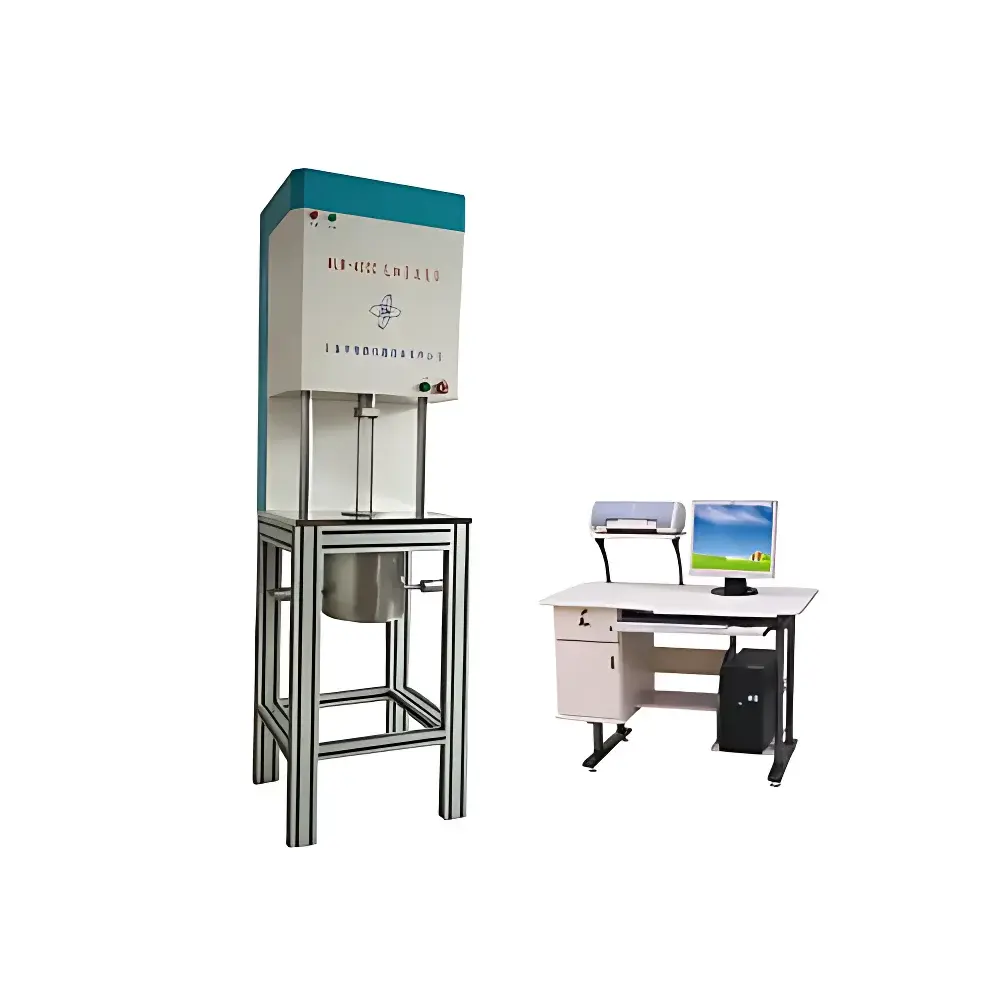
Changchun Intelligent MLW-400B Computer-Controlled Capillary Rheometer
| Brand | Changchun Intelligent |
|---|---|
| Origin | Jilin, China |
| Model | MLW-400B |
| Instrument Type | Capillary Rheometer |
| Temperature Range | Ambient to 400 °C ±1 °C |
| Heating Rate | 1–6 °C/min (adjustable) |
| Temperature Accuracy | ±0.5 °C (displayed), Resolution: 0.1 °C |
| Piston Diameter | Φ11.28 mm (−0.05 mm / −0.012 mm) |
| Piston Cross-Sectional Area | 1 cm² |
| Pressure Range | 1–50 MPa ±1% |
| Capillary Dies | Φ1 mm × 5 mm, Φ1 mm × 10 mm, Φ1 mm × 20 mm, Φ1 mm × 40 mm |
| Die Material | Tungsten Carbide |
| Power Supply | 220 V, 50 Hz, <400 W |
Overview
The Changchun Intelligent MLW-400B Computer-Controlled Capillary Rheometer is a precision-engineered instrument designed for the quantitative characterization of polymer melt rheology under controlled thermal and pressure conditions. It operates on the principle of capillary flow rheometry—measuring the volumetric extrusion rate of molten thermoplastics or thermosets through standardized dies under defined axial pressure and temperature gradients. This method enables direct calculation of apparent shear viscosity, shear stress, and shear rate using the Bagley and Rabinowitsch corrections, providing fundamental data for process design, material selection, and quality control in extrusion, injection molding, and melt spinning applications. The system integrates real-time computer-based pressure regulation, high-stability temperature ramping, and automated data acquisition to support ISO 11443, ASTM D3835, and GB/T 3682-compliant testing protocols.
Key Features
- Computer-controlled constant-pressure extrusion with closed-loop pressure regulation across 1–50 MPa (±1% accuracy), ensuring reproducible shear stress application.
- Programmable heating profile with adjustable ramp rates from 1 to 6 °C/min, enabling precise simulation of industrial thermal histories and kinetic studies of curing or degradation.
- High-precision temperature control (±0.5 °C, 0.1 °C resolution) over an operational range of ambient to 400 °C, validated by embedded Pt100 sensors and PID feedback.
- Dual-calibrated tungsten carbide capillary dies (Φ1 mm × 5, 10, 20, and 40 mm) for systematic L/D ratio analysis and die swell correction.
- Standardized piston geometry (Φ11.28 mm, nominal cross-sectional area = 1 cm²) with tight dimensional tolerance (−0.05 mm / −0.012 mm) to minimize flow non-uniformity and ensure consistent shear rate derivation.
- Integrated data acquisition software that automatically computes apparent viscosity (ηapp), true viscosity (ηtrue), flow activation energy (Ea), and constructs master curves via time–temperature superposition (TTS).
Sample Compatibility & Compliance
The MLW-400B accommodates granular, pelletized, or powdered thermoplastic polymers (e.g., PE, PP, PS, PC, PA6), thermosetting prepolymers (epoxy, phenolic resins), and filled composites (glass-, carbon-, or mineral-reinforced systems). Its design conforms to the mechanical and thermal requirements specified in ISO 11443:2014 (Plastics — Determination of the melt mass-flow rate (MFR) and melt volume-flow rate (MVR) of thermoplastics) and ASTM D3835 (Standard Test Method for Determination of Properties of Polymer Melts Using Capillary Rheometry). While not certified for GMP environments, its audit-ready data logging supports GLP-aligned workflows when configured with timestamped, user-authenticated operation logs and exportable raw datasets (CSV, XLSX).
Software & Data Management
The proprietary Windows-based control software provides synchronized acquisition of piston displacement velocity, applied pressure, and barrel temperature at configurable sampling intervals (10–100 ms). All measurements are stored with metadata including operator ID, test date/time, sample batch code, and calibration certificate references. Post-processing functions include automatic Bagley correction for entry pressure loss, Rabinowitsch correction for non-Newtonian shear thinning, and Arrhenius fitting for temperature-dependent viscosity modeling. Export options include publication-ready graphs (viscosity vs. shear rate, log η vs. 1/T), tabulated reports compliant with internal QA templates, and raw ASCII files for third-party statistical analysis (e.g., JMP, MATLAB, Python Pandas).
Applications
- Quantification of melt viscosity and shear-thinning behavior for extrusion die design and screw profile optimization.
- Evaluation of thermal stability and onset of degradation during rapid heating cycles.
- Characterization of cure kinetics in reactive thermosets via time-resolved viscosity build-up at isothermal and dynamic temperature profiles.
- Determination of softening, melting, and flow points in amorphous and semi-crystalline polymers per ASTM D1525 and ISO 306.
- Process window definition for melt spinning—including spinline stress prediction and draw resonance analysis.
- Quality assurance of polymer batches through comparative flow curve fingerprinting and activation energy mapping.
FAQ
What types of materials can be tested on the MLW-400B?
Thermoplastics (e.g., polyolefins, engineering resins), thermoset prepolymers, elastomers, and filled polymer compounds—provided they exhibit sufficient melt stability within the 400 °C upper limit and are compatible with tungsten carbide die surfaces.
Does the system support ISO or ASTM standard compliance?
Yes—the hardware configuration and measurement methodology align with ISO 11443:2014 and ASTM D3835; full compliance requires user implementation of traceable calibration procedures and documented uncertainty budgets.
Is pressure calibration traceable to national standards?
The pressure transducer is factory-calibrated; users are advised to perform periodic verification using NIST-traceable deadweight testers or certified hydraulic calibrators as part of routine maintenance.
Can the software generate 21 CFR Part 11-compliant audit trails?
The base software does not include electronic signature or role-based access control; however, it exports fully timestamped, immutable datasets suitable for integration into validated LIMS or ELN platforms supporting Part 11 requirements.
What maintenance is required for long-term accuracy?
Annual recalibration of temperature sensors and pressure transducers is recommended; routine cleaning of die channels with stainless steel brushes and solvent rinsing after each test prevents carbon buildup and ensures laminar flow integrity.



