
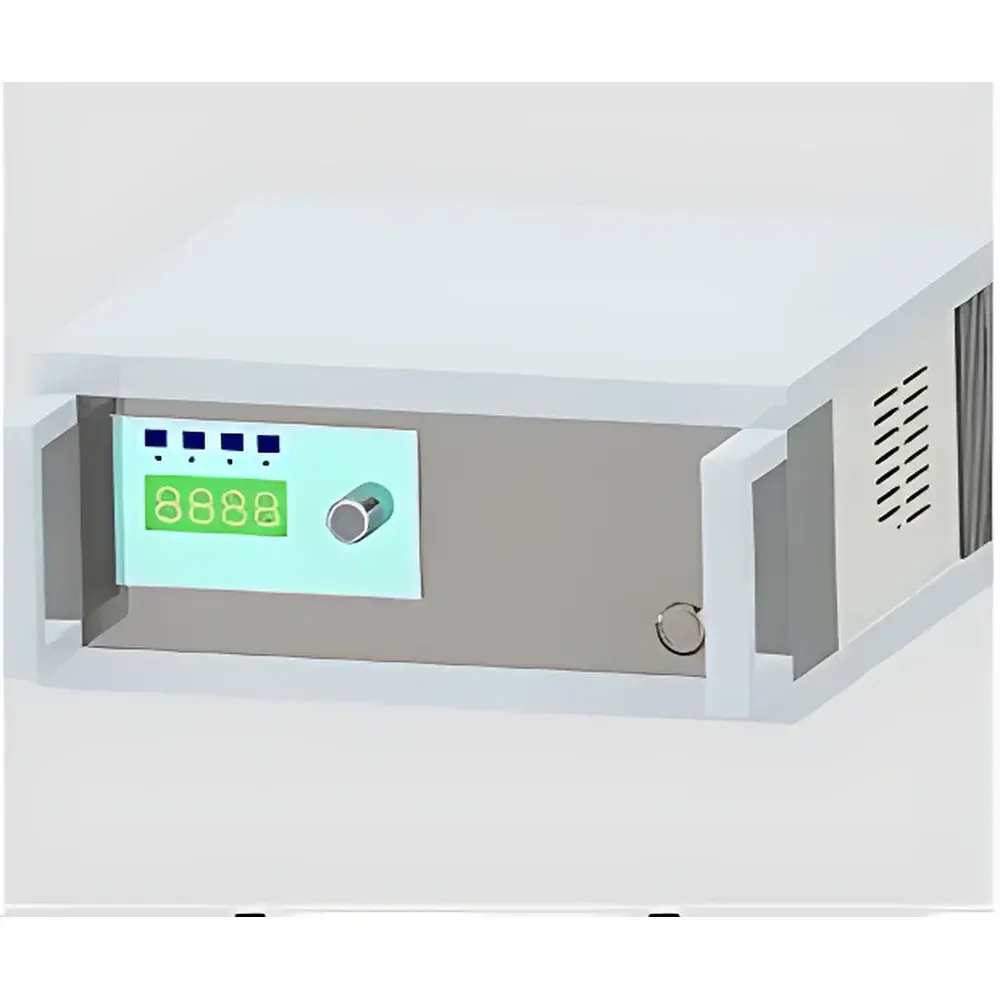
Truelab K11 Single-Channel Electrospinning Collector Controller
| Brand | Truelab |
|---|---|
| Origin | Shanghai, China |
| Model | K11 |
| Motor Type | Stepper Motor Drive |
| Speed Range | 0–1000 rpm (1 rpm resolution above 300 rpm |
| Speed Control Accuracy | ±0.1 rpm (≤300 rpm), ±1 rpm (>300 rpm) |
| Direction Control | Bidirectional toggle switch |
| Safety Features | Emergency stop button, dedicated motor grounding terminal |
| Dimensions (W×D×H) | 275 × 250 × 110 mm |
| Weight | 3.5 kg |
| Power Supply | AC 220 V, 50 Hz |
| Enclosure Rating | IP20 (indoor laboratory use) |
| Upgrade Path | Compatible with K21 dual-channel controller expansion |
Overview
The Truelab K11 Single-Channel Electrospinning Collector Controller is an engineered precision motion control unit designed exclusively for laboratory-scale electrospinning systems utilizing roller-type or mandrel-type collectors. It employs a closed-loop stepper motor drive architecture to deliver stable, repeatable rotational motion across the full operational range of 0–1000 rpm. Unlike open-loop controllers subject to torque drop or positional drift under variable load, the K11 integrates real-time feedback monitoring and microstepping logic to maintain speed fidelity—critical for achieving uniform fiber alignment, controlled mat thickness, and reproducible nanofiber morphology in polymeric and composite electrospun scaffolds. Its core function is to decouple collector dynamics from high-voltage power supply and syringe pump subsystems, enabling independent optimization of fiber deposition kinetics without cross-system interference.
Key Features
- Precision speed regulation with dual-resolution mode: 0.1 rpm resolution at low speeds (0–300 rpm) for fine-tuning of slow-deposition protocols; 1 rpm resolution at higher speeds (300–1000 rpm) for robust, noise-immune operation during high-throughput collection.
- Dedicated emergency stop circuit compliant with IEC 60204-1 safety standards—mechanically latching, hardwired to motor driver enable lines, ensuring immediate torque cutoff without software dependency.
- Integrated motor grounding terminal meeting IEC 61000-6-3 EMC requirements, minimizing common-mode current buildup and extending brushless stepper motor service life under continuous duty cycles.
- Bidirectional rotation control via momentary push-button interface with visual LED indication—eliminates need for external relay wiring or firmware reconfiguration.
- Compact benchtop form factor (275 × 250 × 110 mm) with ventilated aluminum chassis for passive thermal management—designed for integration into Class II biosafety cabinets or glovebox-mounted electrospinning rigs.
- Modular hardware architecture supporting field upgrade to the Truelab K21 dual-channel controller via daughterboard replacement and firmware reflashing—preserving investment in existing K11 installations.
Sample Compatibility & Compliance
The K11 controller interfaces seamlessly with standard NEMA 17 and NEMA 23 stepper motors used in commercial and custom-built electrospinning collectors, including rotating drums (diameter 50–200 mm), parallel wire mandrels, and rotating disk electrodes. It supports both conductive and non-conductive collector substrates (e.g., aluminum foil, stainless steel mesh, silicon wafers, PET films) without requiring electrical isolation modifications. The unit complies with CE marking requirements under the EU Machinery Directive 2006/42/EC and Electromagnetic Compatibility Directive 2014/30/EU. Its electrical insulation and creepage distances conform to EN 61010-1 for Laboratory Equipment, ensuring safe operation in environments where solvents (e.g., DMF, chloroform, HFIP) are routinely handled.
Software & Data Management
The K11 operates as a standalone analog/digital hybrid controller—no host PC or proprietary software is required for basic operation. All parameters are set via front-panel rotary encoder and push-button interface with LED numeric display. For traceable process documentation, optional RS-485 Modbus RTU communication (add-on module) enables integration into LabView, Python-based data acquisition systems, or LIMS platforms. When configured with audit-trail-enabled SCADA systems, the K11 supports ALCOA+ principles (Attributable, Legible, Contemporaneous, Original, Accurate, Complete, Consistent, Enduring, Available) for GLP-compliant nanofiber process validation per ISO/IEC 17025:2017 Annex A.
Applications
- Controlled fabrication of aligned nanofibrous mats for neural tissue engineering scaffolds, where rotational speed directly governs fiber orientation index (FOI) and tensile anisotropy.
- High-speed collection of ultrafine fibers (<100 nm diameter) from low-conductivity polymer solutions (e.g., PCL, PLGA), where precise rpm stabilization minimizes bead formation and diameter dispersion.
- Multi-layer electrospinning workflows requiring sequential collector speed ramping between deposition stages—enabled by programmable dwell time and ramp rate presets (via optional Modbus integration).
- Accelerated stability testing of collector surface coatings (e.g., hydrophobic silanes, conductive PEDOT:PSS layers) under sustained mechanical shear at defined rpm profiles.
- Educational labs performing fundamental studies on Taylor cone dynamics and jet splitting behavior, where stepwise rpm variation isolates centrifugal force effects on jet trajectory.
FAQ
Does the K11 support analog voltage input for remote speed control?
Yes—the rear panel includes a 0–10 V DC analog input port compatible with standard PLC outputs or function generators for external ramping or synchronized multi-axis control.
Is firmware update capability available?
Firmware updates are performed via USB-C bootloader interface using Truelab’s certified configuration utility (Windows/Linux); version history and checksums are published in the technical documentation portal.
Can the K11 be used with high-vacuum electrospinning chambers?
The base unit is rated for ambient pressure only; however, its motor driver output signals can be routed through vacuum feedthroughs to externally mounted stepper drivers—full system integration requires custom mechanical shielding per ASTM E1957-18 guidelines.
What maintenance is required for long-term reliability?
No scheduled maintenance is required; periodic inspection of grounding continuity (per IEC 61557-2) and encoder tactile response every 12 months is recommended for GMP-aligned operations.
Is calibration certification provided with shipment?
Each unit ships with a factory-verified speed accuracy report (traceable to NIM Shanghai metrology standards), including raw test data at 50, 150, 300, 600, and 1000 rpm points.



