
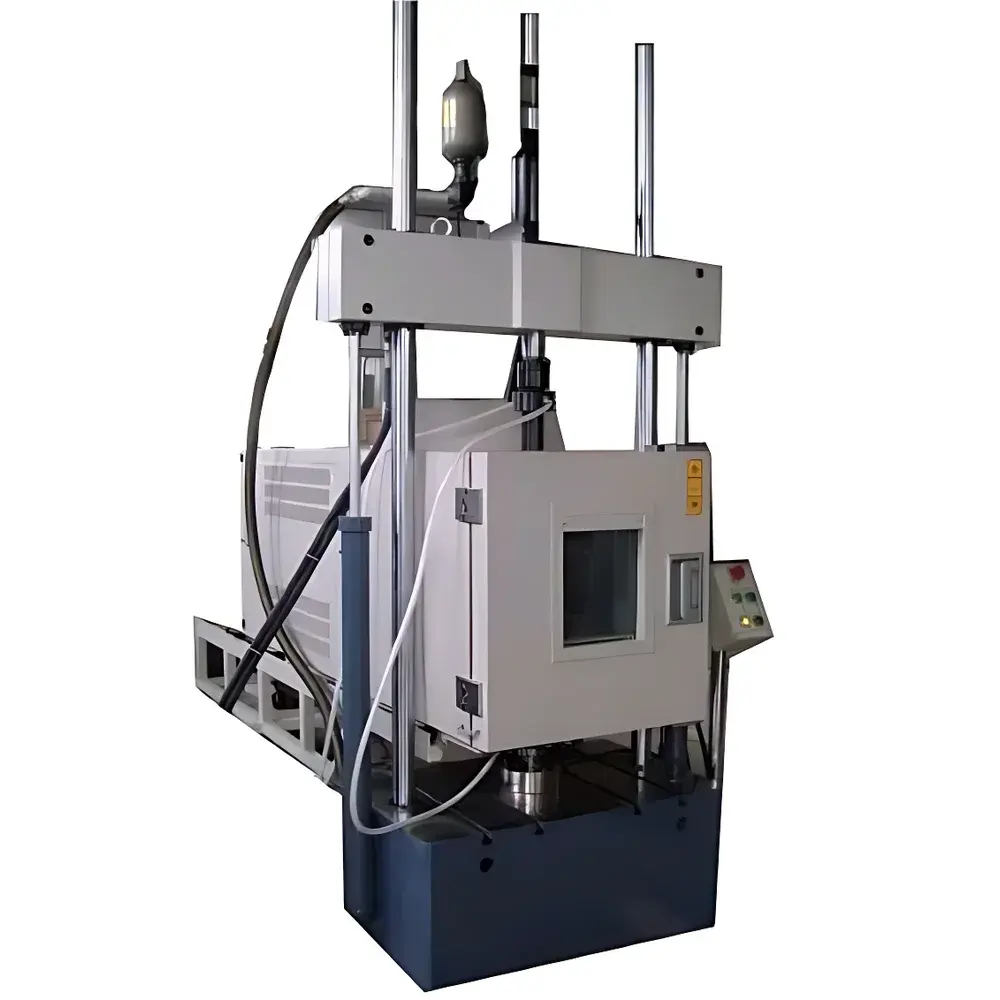
DJF-50KN Dynamic & Static Stiffness Fatigue Testing Machine
| [Origin | Jilin, China |
|---|---|
| Manufacturer Type | Authorized Distributor |
| Origin Category | Domestic (PRC) |
| Model | DJF-50KN |
| Pricing | Available Upon Request] |
Overview
The DJF-50KN Dynamic & Static Stiffness Fatigue Testing Machine is an electromechanical universal testing system engineered for precise characterization of static stiffness, dynamic stiffness, and fatigue behavior in rubber compounds, elastomeric mounts, polymer composites, and other viscoelastic materials. It operates on a servo-controlled hydraulic or high-torque electromechanical actuation platform—capable of delivering controlled uniaxial force and displacement waveforms under both quasi-static and cyclic loading conditions. The system conforms to fundamental mechanical testing principles defined in ASTM D412 (tensile properties of vulcanized rubber), ASTM D3574 (flexible cellular materials), ISO 48-4 (rubber hardness and modulus), and ISO 6982 (dynamic mechanical analysis of elastomers). Its dual-mode architecture enables seamless transition between static tensile/compression tests and dynamic sinusoidal compression fatigue protocols—critical for validating automotive bushings, railway suspension components, seismic isolators, and industrial vibration dampers under service-relevant load spectra.
Key Features
- Dual-range 100 kN bidirectional load cell with ±1% full-scale accuracy, supporting both tension and compression modes without sensor reconfiguration
- Digital encoder-based displacement measurement with 0.01 mm resolution over 0–1000 mm travel range (tension) and 0–500 mm (compression)
- Programmable dynamic excitation: frequency range 0.1–40 Hz; amplitude range 0.1–15 mm; real-time frequency–amplitude coupling compliance per ISO 10844-defined constraints
- Automatic range switching during test execution based on real-time load and deformation feedback
- Integrated strain measurement via extensometer (0–100 mm range, 0.01 mm resolution, ±1% accuracy) for true material-level deformation quantification
- Motorized crosshead with digital positioning, micro-adjustment capability, and programmable return-to-origin functionality
- Comprehensive safety architecture: overload/overpressure/undervoltage/overtemperature protection; mechanical upper/lower limit switches; automatic emergency stop on specimen rupture detection
- Real-time synchronized acquisition of force, displacement, and (optional) extensometer signals at ≥1 kHz sampling rate
Sample Compatibility & Compliance
The DJF-50KN accommodates cylindrical or prismatic specimens up to 301 mm in diameter and 300 mm in height—suitable for full-size automotive anti-vibration mounts, rail pad assemblies, and structural elastomeric bearings. Fixture interfaces comply with ISO 26203-2 (mounting provisions for dynamic testing) and ASTM E2342 (specimen alignment requirements for compressive fatigue). All static test routines support ASTM D638, D695, and ISO 37 compliance when configured with appropriate grips and alignment fixtures. Dynamic test protocols are traceable to ISO 4664-2 (rubber—determination of dynamic properties—part 2: compression mode) and SAE J2712 (vibration isolation component qualification). The system supports GLP-compliant audit trails when paired with validated software modules meeting FDA 21 CFR Part 11 requirements for electronic records and signatures.
Software & Data Management
Control and analysis are performed via a Windows-based proprietary software suite supporting IEC 61508 SIL2-compliant operation. The interface enables user-defined test method scripting (e.g., multi-step ramp-hold-fatigue sequences), real-time curve overlay of up to 16 concurrent tests, region-specific zooming, and arbitrary point interrogation for modulus, hysteresis loss, storage/loss modulus derivation, and stiffness decay trend analysis. Data export formats include CSV, XML, and PDF report templates customizable to ISO/IEC 17025 laboratory reporting standards. All calibration parameters—including load cell sensitivity, encoder scaling, and extensometer gain—are digitally stored with timestamped metadata and version control. Automatic backup of test configurations, raw data streams, and post-processed results ensures full traceability across instrument lifecycle.
Applications
- Static and dynamic stiffness mapping of rubber-metal bonded isolators used in engine mounts and chassis subsystems
- Fatigue life assessment of elastomeric bridge bearings under simulated seismic or traffic-induced cyclic loading
- Hysteresis and energy dissipation analysis of damping materials for HVAC vibration control systems
- Compression set evaluation of silicone and EPDM compounds per ASTM D395
- Creep-recovery and stress relaxation profiling under constant load or displacement boundary conditions
- Validation of finite element models (FEM) through direct correlation of experimental force–displacement loops with simulation outputs
FAQ
What is the maximum specimen size supported by the DJF-50KN?
The machine accepts specimens up to 301 mm in diameter and 300 mm in height, optimized for full-scale elastomeric components used in transportation and civil infrastructure.
Does the system meet international calibration and traceability standards?
Yes—load cells and displacement transducers are calibrated per ISO/IEC 17025-accredited procedures; calibration certificates include uncertainty budgets and NIST-traceable references.
Can the software generate reports compliant with ISO/IEC 17025 or FDA 21 CFR Part 11?
Report generation supports configurable templates aligned with ISO/IEC 17025 Section 7.8.2; optional Part 11 compliance package includes electronic signature workflows, audit trail logging, and role-based access control.
Is extensometer integration mandatory for dynamic stiffness calculation?
While crosshead displacement suffices for gross stiffness estimation, a contact-type extensometer is required for accurate dynamic modulus (E’, E”) and loss tangent (tan δ) derivation per ISO 4664-2.
How is thermal drift compensated during long-duration fatigue tests?
The system employs real-time thermal compensation algorithms applied to load cell output and includes ambient temperature monitoring inputs to adjust baseline offset dynamically.



