
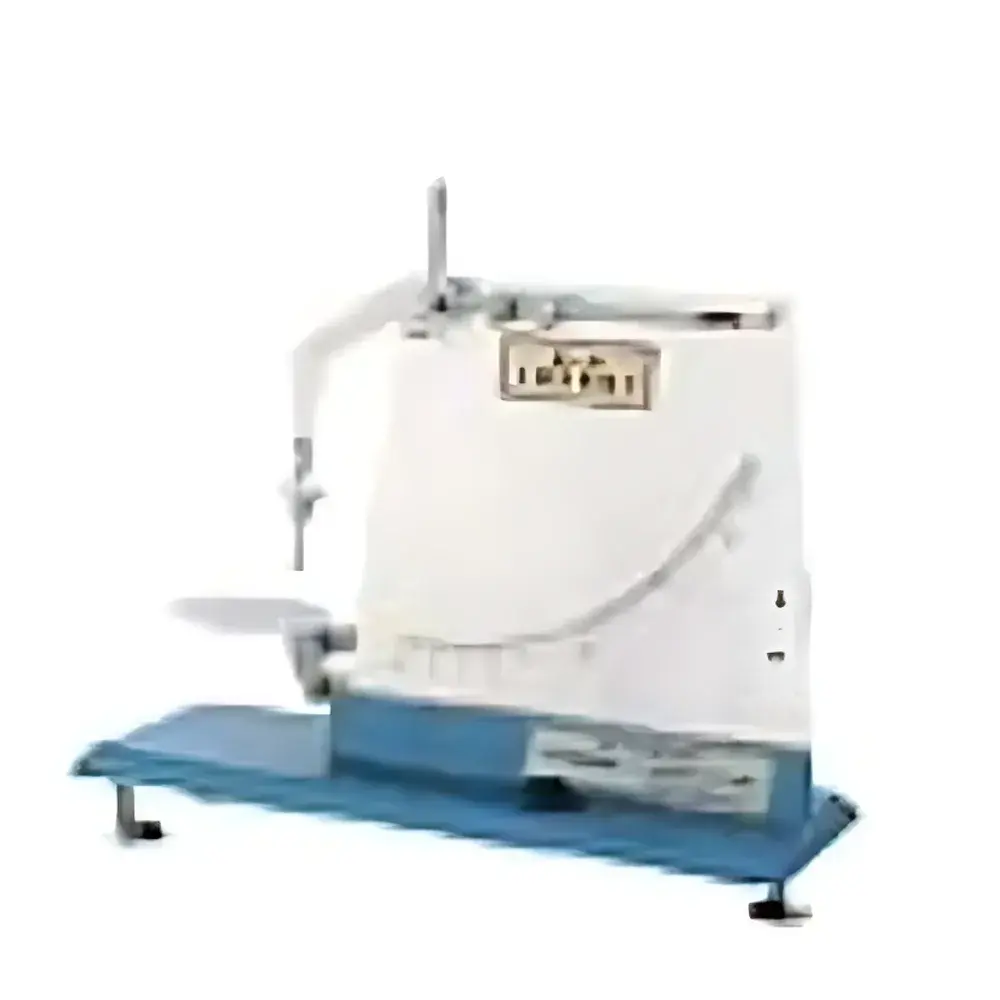
MD-J Digital Densitometer for Solid and Elastomeric Materials
| Origin | Jilin, China |
|---|---|
| Manufacturer Type | Authorized Distributor |
| Origin Category | Domestic (PRC) |
| Model | MD-J |
| Pricing | Available Upon Request |
| Measurement Range | 0.8–3.5 g/cm³ |
| Sample Mass | 5–12 g |
| Accuracy | ±1% |
| Scale Graduation | 0.01 (0.8–2.0), 0.02 (2.0–2.5), 0.05 (2.5–3.5) g/cm³ |
| Sample Requirements | Bubble-free, smooth-surfaced, oil- and contaminant-free specimens |
Overview
The MD-J Digital Densitometer is a precision mechanical buoyancy-based instrument engineered for the accurate determination of density in solid and elastomeric materials that are insoluble in water—particularly polymers such as rubber, plastics, and synthetic fibers. It operates on the fundamental principle of Archimedean displacement, where the density of a dry sample is calculated from its mass in air and its apparent mass when fully immersed in distilled water at a controlled temperature (typically 23 ± 0.5 °C). This method complies with standardized gravimetric density measurement protocols referenced in ASTM D792, ISO 1183-1, and GB/T 1033.1–2008. Unlike digital oscillating U-tube or hydrostatic weighing systems, the MD-J employs a balanced beam architecture with high-stability aluminum construction, enabling repeatable manual operation without external power or electronic transducers—making it ideal for QC laboratories requiring robust, low-maintenance instrumentation in regulated industrial environments.
Key Features
- Stainless steel three-pronged suspension needle mounted beneath a rigid lever arm, ensuring consistent sample positioning and minimal torsional error during immersion.
- Aluminum front panel with engraved dual-scale density graduation: fine-resolution 0.01 g/cm³ increments from 0.8 to 2.0, medium 0.02 g/cm³ from 2.0 to 2.5, and coarse 0.05 g/cm³ from 2.5 to 3.5—optimized for visual interpolation and operator consistency.
- Two precision ball-bearing pivot points supporting the beam assembly, minimizing friction and hysteresis across repeated measurement cycles.
- Adjustable rear pressure plate and height-calibrated tray system enabling precise vertical alignment of the water bath to ensure full, contact-free submersion of specimens up to 12 g.
- No electrical components or software dependencies—designed for operational reliability in environments with electromagnetic interference, humidity fluctuations, or limited infrastructure.
Sample Compatibility & Compliance
The MD-J is validated for use with non-porous, water-insoluble solids and elastomers—including vulcanized rubber compounds, thermoplastic pellets, polymeric films, and filament yarns—provided samples meet dimensional and surface integrity criteria: mass between 5 and 12 g, absence of surface contaminants or entrapped air voids, and geometric stability under wetting conditions. It is not suitable for porous, hygroscopic, or water-soluble materials (e.g., cellulose derivatives, certain polyurethanes, or salt-based composites). The instrument supports compliance workflows aligned with ISO/IEC 17025-accredited testing labs, and its mechanical calibration traceability enables documentation per GLP and GMP requirements. Routine verification using certified density reference standards (e.g., fused quartz or stainless-steel calibration weights) satisfies internal audit and regulatory inspection expectations.
Software & Data Management
The MD-J is a fully manual, analog-digital hybrid instrument with no embedded firmware or data logging capability. All measurements are recorded manually by the operator via direct scale reading and documented in laboratory notebooks or LIMS-integrated spreadsheets. For laboratories requiring electronic data capture, optional third-party digital calipers or USB-connected optical encoders may be integrated with custom scripts for automated transcription—though such configurations fall outside factory validation scope. The instrument’s design inherently supports 21 CFR Part 11-compliant workflows when paired with validated paper-based SOPs, handwritten logbooks with witness signatures, and periodic review of calibration logs against NIST-traceable reference artifacts.
Applications
- Quality control of polymer extrudates and injection-molded parts in chemical fiber and plastics manufacturing.
- Batch-to-batch density verification of rubber compounding formulations prior to vulcanization.
- R&D screening of filler-loaded composites (e.g., carbon black–EPDM blends) where density correlates with dispersion homogeneity.
- Educational demonstration of Archimedes’ principle and material property relationships in university polymer science laboratories.
- Field-deployable density verification in plant-floor settings where environmental resilience and minimal maintenance are prioritized over automation.
FAQ
What is the required temperature control for distilled water during measurement?
Distilled water must be maintained at 23 ± 0.5 °C; deviation beyond this range introduces systematic error due to thermal expansion of both water and the aluminum frame.
Can the MD-J measure powders directly?
No—powdered samples must first be compression-molded into solid, non-porous tablets meeting the 5–12 g mass and surface integrity requirements.
Is calibration traceable to national standards?
Yes; calibration is performed using NIST-traceable density reference standards and documented in accordance with ISO/IEC 17025 Clause 6.6.
What maintenance intervals are recommended?
Daily visual inspection of needle tip integrity and bearing smoothness; quarterly cleaning of aluminum scale panel with isopropyl alcohol; annual verification of beam balance symmetry using certified counterweights.
Does the instrument comply with ASTM D792?
Yes—the MD-J implements the core procedural requirements of ASTM D792 Method A (immersion technique), including specified water purity, temperature control, and buoyancy correction methodology.



