
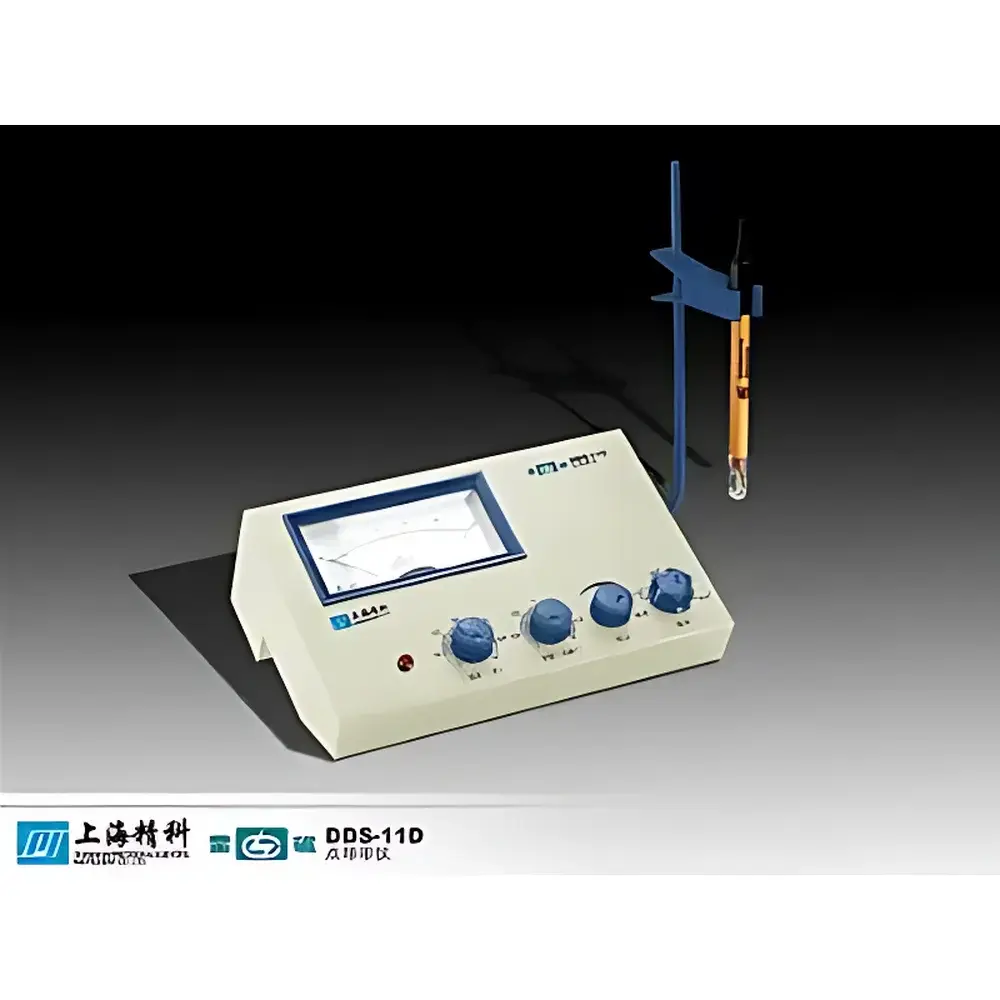
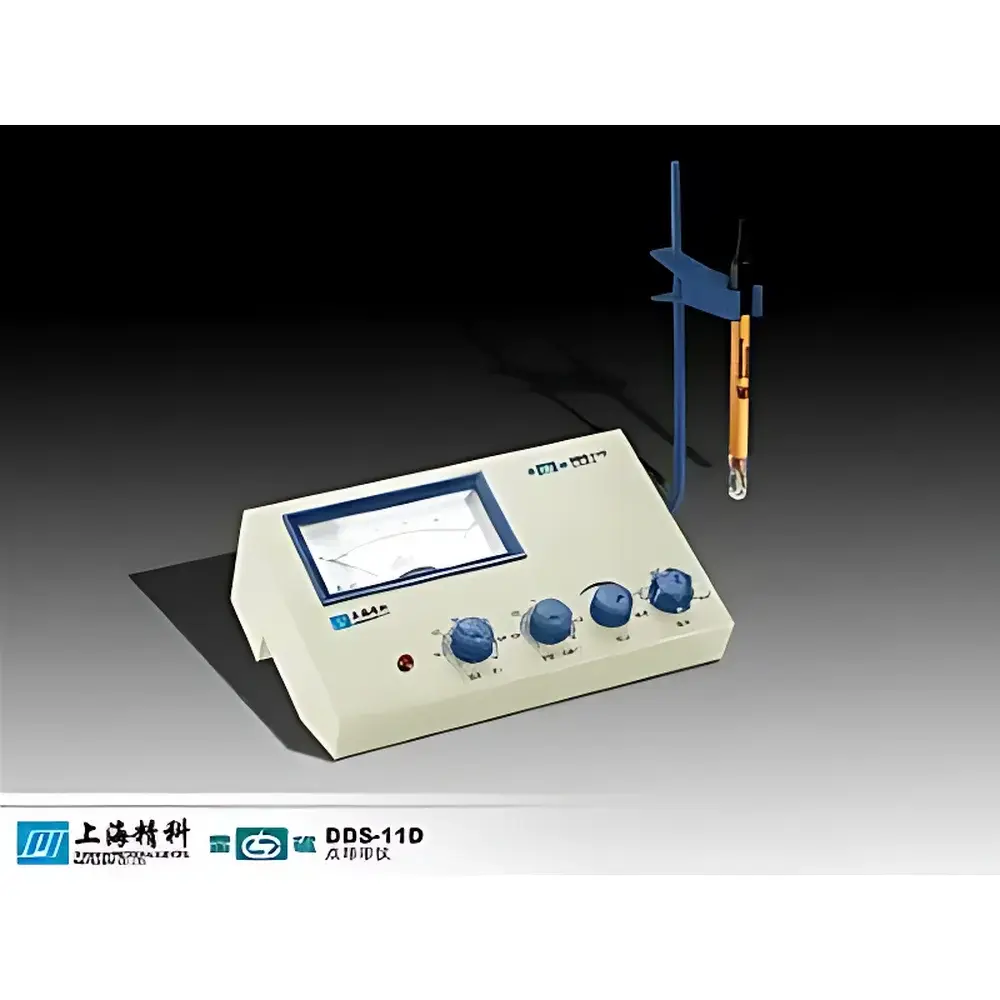
Leici DDS-11A / DDS-11C / DDS-11D Benchtop Conductivity Meters
| Brand | Leici |
|---|---|
| Origin | Shanghai, China |
| Instrument Type | Benchtop |
| Measurement Principle | Two-electrode AC conductivity measurement |
| Measurement Range | 0–1×10⁵ µS/cm |
| Accuracy | ±1.5% FS (DDS-11A & DDS-11D), ±1.0% FS (DDS-11C) |
| Resolution | 0.1 µS/cm (analog scale) |
| Calibration Standard | NIST-traceable Chinese national calibration solutions |
| Compliance | GB/T 11018–2021 (Chinese National Standard for Conductivity Meters) |
| Power Supply | AC 220 V ±10%, 50 Hz |
Overview
The Leici DDS-11A, DDS-11C, and DDS-11D series are benchtop conductivity meters engineered for routine laboratory and quality control applications in academic, municipal, and industrial water analysis settings. These instruments operate on the principle of two-electrode alternating current (AC) conductometry—applying a low-frequency AC voltage across a standardized cell to measure solution conductance while minimizing electrode polarization effects. Designed in accordance with GB/T 11018–2021, the series provides reliable, reproducible measurements across a broad dynamic range (0–1×10⁵ µS/cm), supporting conductivity assessment of deionized water, drinking water, boiler feedwater, wastewater effluents, and saline process streams. While the DDS-11A and DDS-11D utilize analog pointer displays with manual range selection (12 ranges for DDS-11A; fixed-range for DDS-11D), the DDS-11C introduces an LED digital display with improved readability and enhanced stability in ambient lighting conditions. All models employ temperature-compensated measurements using a built-in or optional Pt1000 temperature sensor (standard on DDS-11C), applying linear compensation per EN 27888 and ISO 7888 protocols.
Key Features
- Benchtop form factor with robust ABS housing suitable for stable placement in QC labs and teaching environments
- Manual range selection (DDS-11A: 12-step range switch; DDS-11C/DDS-11D: single-range or multi-range configurations)
- Temperature compensation capability (0–50 °C), configurable via front-panel adjustment or factory preset
- NIST-traceable Chinese national calibration standard compatibility—ensures metrological traceability aligned with domestic regulatory expectations
- Low-power AC operation (220 V ±10%, 50 Hz), eliminating battery dependency and drift associated with portable units
- CE-marked electrical safety design compliant with IEC 61010-1 for laboratory instrumentation
Sample Compatibility & Compliance
These meters are validated for aqueous samples with total dissolved solids (TDS) concentrations up to ~60,000 mg/L (approx. 100 mS/cm). They are routinely deployed in environmental monitoring labs conducting compliance testing per China’s HJ/T 342–2007 (water conductivity determination method) and municipal water plants referencing CJ/T 206–2005. Though not certified to FDA 21 CFR Part 11 or EU Annex 11 for regulated GMP environments, their mechanical simplicity, lack of embedded software logic, and direct analog/digital readout make them suitable for GLP-aligned routine checks where audit trails are maintained manually. The cell constant (typically 1.0 cm⁻¹) is fixed and calibrated using standard KCl solutions (e.g., 0.01 mol/L, 0.1 mol/L), with verification traceable to CNAS-accredited reference materials.
Software & Data Management
The DDS-11A/C/D series are standalone instruments with no onboard data logging, USB connectivity, or PC interface. Measurement values are recorded manually into lab notebooks or LIMS-compatible spreadsheets. For laboratories requiring electronic record retention, external documentation workflows must be implemented per ALCOA+ principles—ensuring Attributable, Legible, Contemporaneous, Original, Accurate, Complete, Consistent, Enduring, and Available records. No firmware updates or configuration files exist; calibration and range adjustments are performed exclusively via physical controls. This architecture minimizes cybersecurity exposure and eliminates validation burden associated with software-based instruments.
Applications
- Routine conductivity screening in university teaching labs (general chemistry, environmental science)
- Raw water and treated effluent monitoring in municipal water treatment facilities
- Boiler water purity verification in power generation and HVAC maintenance programs
- Process water qualification in pharmaceutical excipient manufacturing (non-GMP grade use)
- Calibration verification of higher-end meters (e.g., Leici DDSJ-318) using reference standards
- Field-deployable backup units when paired with portable temperature probes and standardized calibration kits
FAQ
What calibration standards are supported?
NIST-traceable Chinese national KCl standards (0.01 mol/L, 0.1 mol/L, and 1.0 mol/L) are recommended. Calibration follows GB/T 11018–2021 procedures, with verification at two points spanning the expected measurement range.
Is temperature compensation automatic or manual?
Compensation is manually adjustable on DDS-11A and DDS-11D; DDS-11C includes automatic temperature sensing via integrated Pt1000, with linear compensation applied per EN 27888.
Can these meters measure resistivity or TDS directly?
No. Conductivity is measured directly; resistivity is derived as the reciprocal (in Ω·cm), and TDS is estimated using a user-applied conversion factor (typically 0.5–0.7 × conductivity in µS/cm), consistent with ASTM D1125 guidance.
Are replacement electrodes available separately?
Yes—Leici offers interchangeable 1.0 cm⁻¹ platinum blackened electrodes (model DJS-1C) compatible with all three models, certified for ≤2% repeatability over 500 immersion cycles.
Do these instruments meet international ISO/IEC 17025 requirements?
They support ISO/IEC 17025 implementation when used within a documented calibration hierarchy, verified against accredited reference materials, and operated under controlled environmental conditions (20–25 °C, <70% RH).
Related Products



