
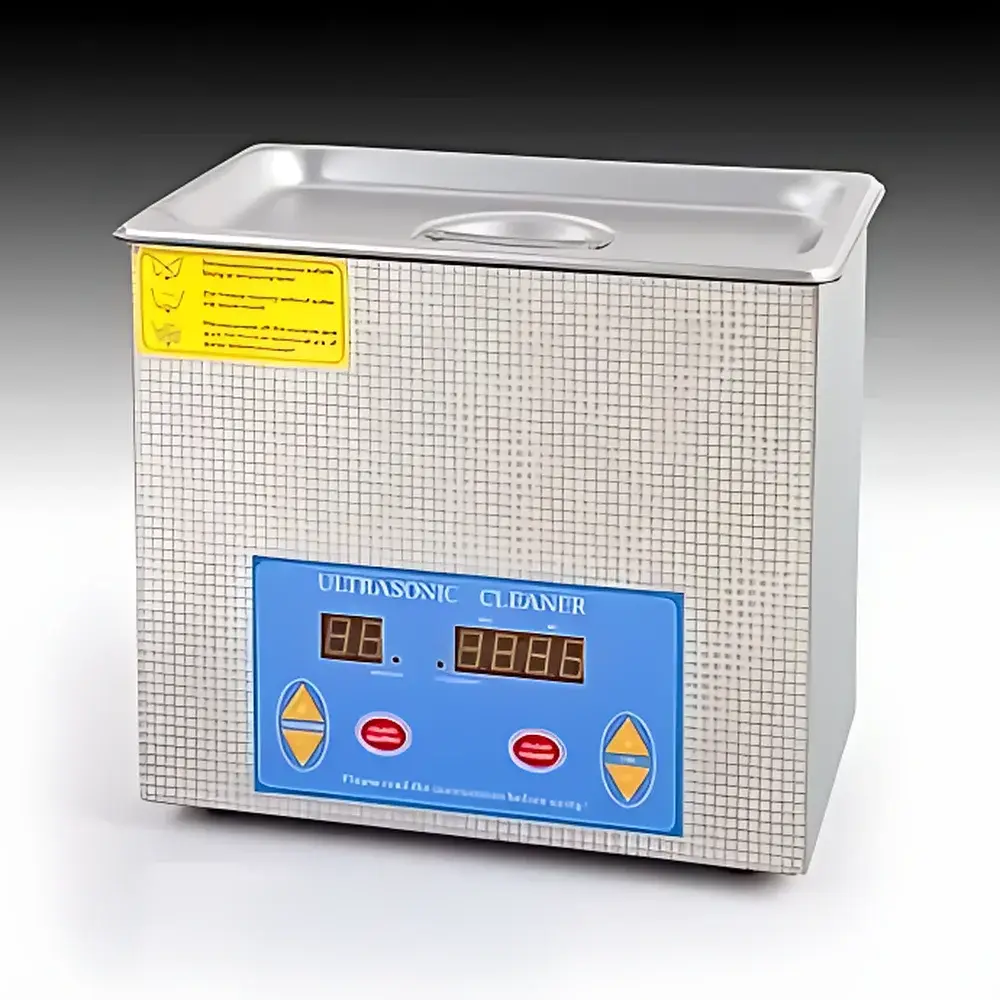
Truelab UC-T7D Benchtop Digital Ultrasonic Cleaner
| Brand | Truelab |
|---|---|
| Origin | Shanghai, China |
| Model | UC-T7D |
| Tank Capacity | 7.0 L |
| Ultrasonic Frequency | 40 kHz |
| Ultrasonic Power Output | 150 W |
| Heating Power | 300 W |
| Temperature Range | 0–80 °C |
| Timer Range | 1–99 min 59 sec |
| Built-in Drain Port | Yes |
| Sound-Insulating Lid | Yes |
| Construction | Full SUS304 Stainless Steel |
| Internal Tank Dimensions | 300 × 155 × 150 mm |
| External Dimensions | 330 × 180 × 310 mm |
| Net Weight | 5.5 kg |
Overview
The Truelab UC-T7D is a benchtop digital ultrasonic cleaner engineered for precision cleaning in analytical, quality control, and research laboratory environments. It operates on the principle of acoustic cavitation: a 40 kHz ultrasonic generator drives piezoelectric transducers bonded to the tank bottom, producing high-frequency pressure waves in the cleaning medium. These waves generate transient microbubbles that collapse violently near solid surfaces—releasing localized energy sufficient to dislodge particulate contaminants, organic residues, oxides, and biofilms from complex geometries, blind holes, and microstructures. Unlike manual scrubbing or solvent immersion, this physical cleaning mechanism ensures consistent, non-abrasive, and residue-free surface preparation without compromising sample integrity. Designed for routine use across diverse sample types—including metal components, glassware, semiconductor wafers, optical lenses, surgical instruments, and biological substrates—the UC-T7D supports reproducible pre-analytical processing aligned with ISO 13485 and CLSI EP22-A2 guidelines for cleaning validation.
Key Features
- Full SUS304 stainless steel construction—both outer housing and seamless one-piece drawn inner tank—ensures corrosion resistance, structural rigidity, and compliance with GLP lab hygiene standards.
- High-efficiency transducer array delivering stable 150 W ultrasonic output at 40 kHz, optimized for broad-spectrum contaminant removal while minimizing standing wave interference.
- Digital microcontroller-based system with intuitive push-button interface, real-time LED display of temperature (°C) and remaining time (mm:ss), and programmable start delay.
- Precise thermostatic control (0–80 °C ±1.5 °C) via integrated heating element (300 W), enabling temperature-assisted cleaning for viscous oils, polymers, or proteinaceous residues.
- Extended timer range (1–99 min 59 sec) with automatic shutdown and audible alert—supports unattended operation during overnight or shift-based workflows.
- Integrated sound-dampening lid reduces ambient noise to ≤55 dB(A) at 1 m distance, meeting OSHA workplace exposure recommendations for continuous lab operation.
- Front-mounted drain valve with quick-connect fitting and stainless steel mesh basket (included) facilitate rapid solution exchange and prevent part damage during handling.
Sample Compatibility & Compliance
The UC-T7D accommodates standard laboratory vessels including beakers (up to 250 mL), Petri dishes, pipette tips, syringe filters, cuvettes, and small mechanical parts. Its 7.0 L capacity and uniform energy distribution support simultaneous cleaning of multiple items without cross-contamination. The unit complies with IEC 61000-6-3 (EMC emission limits) and IEC 61010-1 (safety requirements for electrical equipment). All wetted surfaces meet USP Class VI biocompatibility criteria. Optional documentation packages include Factory Acceptance Test (FAT) reports and IQ/OQ protocols for GMP-regulated facilities requiring audit-ready validation records.
Software & Data Management
While the UC-T7D operates as a standalone instrument with no external software dependency, its embedded firmware logs operational history—including total run hours, number of cycles, maximum temperature reached, and fault codes—for internal traceability. The controller supports manual calibration of temperature sensor offset (±5 °C adjustment range) and retains user settings after power interruption. For laboratories implementing electronic recordkeeping per FDA 21 CFR Part 11, optional RS-232 serial output (available via accessory module) enables timestamped parameter export to LIMS or ELN platforms.
Applications
- Preparation of HPLC vials, GC autosampler trays, and ICP-MS sample introduction components to eliminate trace metal carryover.
- Cleaning of electron microscopy grids, TEM holders, and AFM probes prior to imaging to reduce artifact formation.
- Decontamination of reusable biosafety cabinet accessories and centrifuge rotors under validated disinfection protocols.
- Removal of flux residues from PCB assemblies prior to solderability testing (IPC-J-STD-001 compliant).
- Extraction support for plant tissue homogenates and microbial cell lysis in molecular biology workflows.
- Routine maintenance of volumetric glassware to ensure Class A accuracy per ISO 4787.
FAQ
What cleaning solutions are compatible with the UC-T7D?
Aqueous alkaline, neutral, or mild acidic detergents; ethanol/water mixtures; and deionized water are recommended. Avoid halogenated solvents (e.g., chloroform, acetone) unless using an explosion-proof variant—standard models are not rated for flammable vapor environments.
Can the UC-T7D be used for sterilization?
No. Ultrasonic cleaning removes bioburden but does not achieve sterility assurance levels (SAL ≤10⁻⁶). It serves as a critical pre-sterilization step prior to autoclaving, ethylene oxide, or hydrogen peroxide plasma processes.
Is degassing functionality included?
The unit does not feature active vacuum degassing; however, the 40 kHz frequency and 150 W power enable effective passive degassing of aqueous solutions within 5–10 minutes of initial activation—recommended before introducing sensitive samples.
How often should the transducers be serviced?
Under normal usage (≤4 hrs/day), transducer performance remains stable for ≥5 years. Annual visual inspection of bonding integrity and impedance verification (using manufacturer-provided test jig) is advised for regulated environments.
Does the drain port support direct floor connection?
Yes—the 1/2″ NPT threaded outlet accepts standard laboratory hose barbs or flexible PVC tubing (ID 12 mm), allowing gravity-fed drainage into floor sinks or waste collection carboys.



