
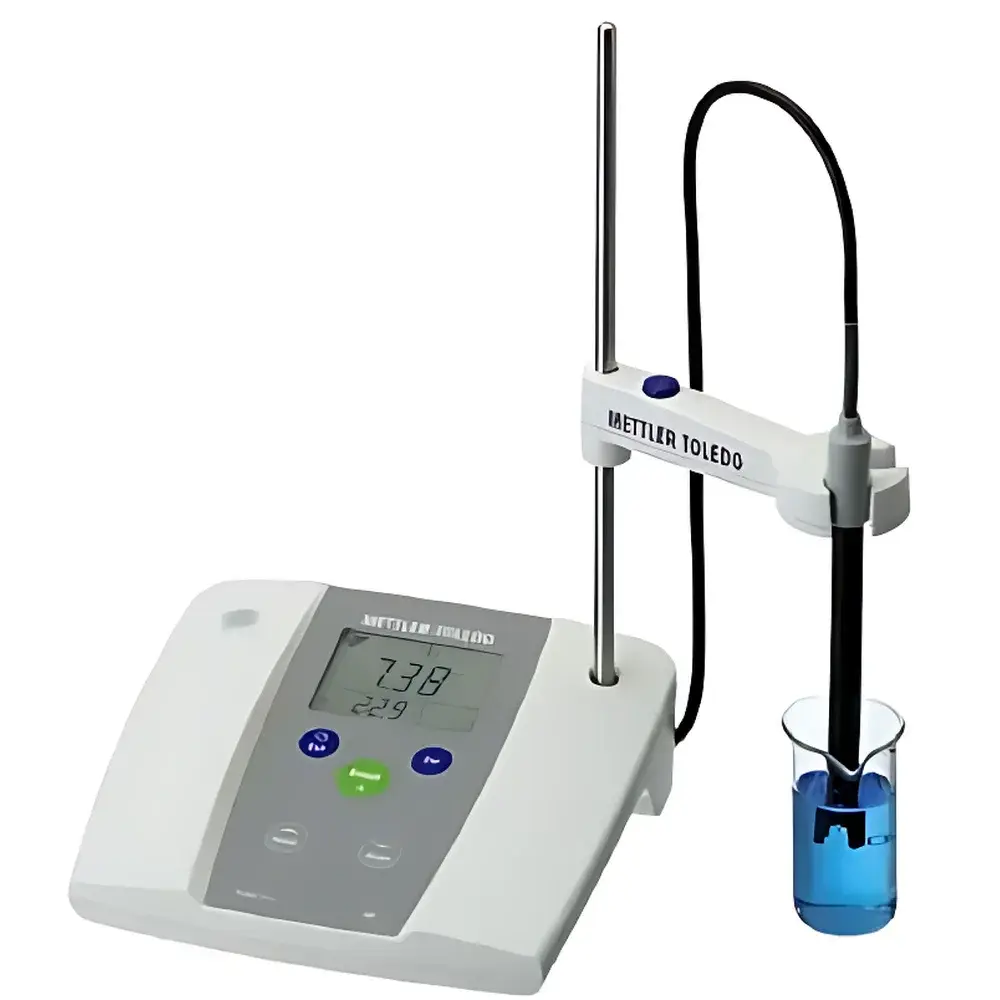
METTLER TOLEDO FE20K FiveEasy Plus Benchtop pH Meter
| Brand | METTLER TOLEDO |
|---|---|
| Origin | Switzerland |
| Model | FE20K |
| Instrument Type | Benchtop (not portable) |
| Parameter Type | Single-parameter (pH/mV/ORP) |
| pH Range | 0.00–14.00 |
| pH Resolution | 0.01 |
| pH Accuracy | ±0.01 |
| mV Range | −1999 to +1999 mV |
| mV Resolution | 1 mV |
| mV Accuracy | ±1 mV |
| Temperature Range | 0.0–100.0 °C |
| Temperature Resolution | 0.1 °C |
| Temperature Accuracy | ±0.5 °C |
| Calibration | Up to 3-point, with auto-buffer recognition for 4 pre-defined IUPAC/NIST-compatible buffers |
| Data Storage | 99 measurement records |
| Interface | RS232 |
| Display | Backlit LCD showing pH/mV value, temperature, endpoint status, and calibration indicators |
Overview
The METTLER TOLEDO FE20K FiveEasy Plus is a precision-engineered benchtop pH meter designed for routine laboratory applications requiring reliable, traceable, and repeatable electrochemical measurements. Based on potentiometric principle using glass electrode technology, the instrument measures hydrogen ion activity in aqueous solutions via a stable reference electrode and pH-sensitive glass membrane. Its architecture complies with fundamental electrochemical measurement standards—including ISO 7888, ASTM D1293, and USP —and supports GLP-compliant workflows through structured calibration logging and data integrity features. Unlike portable or handheld variants, the FE20K is engineered as a dedicated benchtop unit with fixed power supply, optimized thermal stability, and rigid mechanical layout to minimize drift during extended analysis sessions typical in QC labs, environmental monitoring, and food & beverage process control.
Key Features
- Three-point pH calibration with automatic buffer recognition for four standard IUPAC/NIST-traceable buffers (pH 4.01, 6.86, 7.00, 9.18), reducing manual entry errors and ensuring metrological consistency.
- Integrated mV and ORP measurement mode compliant with ASTM D1129 and ISO 5814, enabling redox potential assessment for disinfection validation, wastewater treatment, and corrosion studies.
- Backlit LCD display simultaneously shows real-time pH/mV value, sample temperature, endpoint stabilization indicator, calibration status, and electrode condition symbols—supporting rapid visual verification without menu navigation.
- RS232 serial interface enables direct connection to PCs or LIMS systems for automated data export; compatible with METTLER TOLEDO LabX Lite software for basic report generation and audit trail compliance.
- Self-diagnostics including electrode impedance check, open-circuit detection, and calibration deviation alert—facilitating preventive maintenance and adherence to internal SOPs.
- Ergonomic front-panel design with five tactile buttons simplifies operation: Measure, Calibrate, Recall, Clear, and Mode—eliminating multi-level menu structures common in advanced meters while retaining full functional access.
Sample Compatibility & Compliance
The FE20K is validated for use with aqueous and low-ionic-strength samples across regulated and non-regulated environments. It supports standard combination electrodes such as the included LE438 triple-junction polymer-body pH electrode—designed for robustness in food slurries, dairy products, and municipal water matrices. The instrument meets CE marking requirements per Directive 2014/30/EU (EMC) and 2014/35/EU (LVD), and its calibration traceability aligns with ISO/IEC 17025 clause 6.4.3 for measurement equipment verification. While not FDA 21 CFR Part 11–certified out-of-the-box, its RS232 output and structured data format support integration into validated systems where electronic records are governed by ALCOA+ principles.
Software & Data Management
Data is stored locally in non-volatile memory (99 entries), each timestamped and tagged with calibration ID, temperature, and electrode ID (if encoded). Export via RS232 follows ASCII-based protocol compatible with Excel, LabWare, or custom Python scripts. Though no proprietary cloud platform is bundled, the FE20K’s deterministic data structure allows seamless ingestion into ELN or LIMS environments requiring raw-value traceability. Audit-ready calibration logs include date/time, buffer IDs used, slope (%), offset (mV), and temperature at time of calibration—meeting minimum documentation expectations under ISO 9001:2015 clause 8.5.2 and EU GMP Annex 11 Annex II guidance.
Applications
- Quality control in beverage production (e.g., carbonated soft drinks, fruit juices, brewing wort)—where pH directly influences microbial stability and flavor profile.
- Environmental testing laboratories performing EPA Method 9040C (pH of aqueous samples) and ASTM D3693 (potable water pH).
- Pharmaceutical excipient release testing per USP , particularly for buffer solutions and parenteral diluents.
- Academic teaching labs requiring intuitive interface, consistent performance, and compatibility with standard electrode accessories.
- Wastewater treatment plants monitoring influent/effluent pH prior to chlorine dosing or biological digestion stages.
FAQ
Is the FE20K suitable for non-aqueous or high-viscosity samples?
No—the FE20K is calibrated and validated exclusively for aqueous solutions. Non-aqueous solvents require specialized electrodes and alternative calibration protocols outside this instrument’s scope.
Does it support automatic temperature compensation (ATC)?
Yes—when paired with a temperature probe (e.g., INLAB® TEMPERATURE PROBE), the FE20K applies Nernstian correction across 0.0–100.0 °C; manual temperature input is also supported.
Can calibration data be exported separately from measurement records?
Yes—calibration events are embedded within each measurement record and can be filtered during RS232 export using delimiter-based parsing (e.g., “CAL” prefix in line header).
What electrode types are compatible beyond the LE438?
Any BNC-compatible pH electrode with integrated temperature sensor (e.g., INLAB® SCIENCE, LE422) may be used, though accuracy claims apply only when validated with the supplied LE438.
Is firmware upgrade capability available?
Firmware updates are performed via RS232 using METTLER TOLEDO’s official service tools; end users cannot modify firmware independently.





