
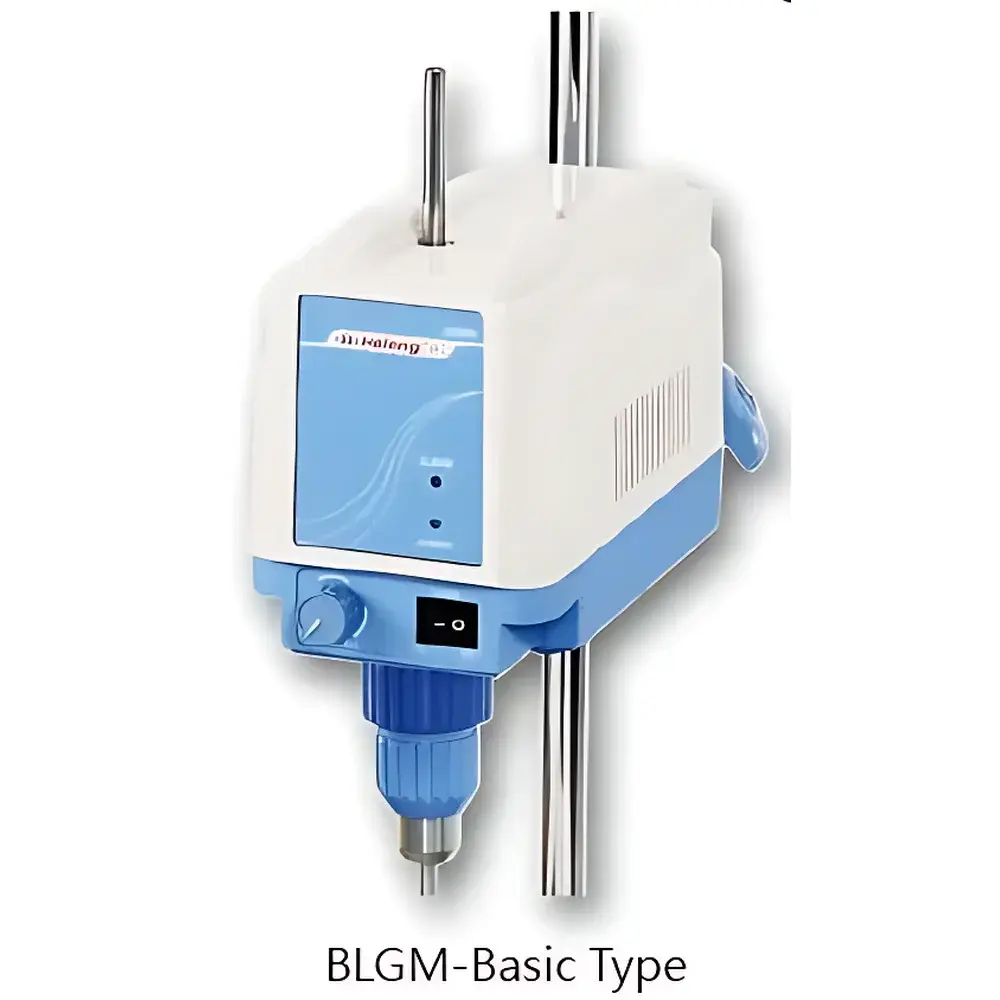
HsiangTai BLGM-2D Brushless DC Magnetic Stirrer with Digital Speed & Torque Control
| Brand | HsiangTai (HSIANGTAI) |
|---|---|
| Origin | Taiwan |
| Model | BLGM-2D / BLGM-3D / BLGM-4D |
| Motor Type | Brushless DC |
| Max. Stirring Volume | 10 L |
| Speed Range | 0–1500 rpm |
| Torque Output | 3 kgf·cm (0.29 N·m) |
| Power Input | DC 80 W |
| Timer Range | 0–99 h 59 min (digital display) |
| Dimensions (W×L×H) | 111 × 232 × 233 mm |
| Weight | 3.7 kg |
| Voltage | AC 110 V / 220 V, 50 / 60 Hz |
| Safety Protections | Overload, Overheat, Fuse |
| Torque Display | Dual-mode — 5-step analog % scale (20/40/60/80/100%) + digital numeric readout |
| Speed Display | LED digital |
| Stirring Shaft | Hollow design for vertical adjustment of impeller |
| Base | H-type adjustable leveling feet |
| Drive Mechanism | Spring-loaded vertical lift system |
| Chuck | Tool-free quick-release magnetic chuck |
Overview
The HsiangTai BLGM-2D is a precision-engineered brushless DC magnetic stirrer designed for reproducible, high-stability mixing in analytical, quality control, and research laboratories. Unlike conventional AC-motor-based stirrers, its brushless DC motor delivers consistent torque across the full speed range (0–1500 rpm), eliminates commutator wear, and enables precise speed regulation under variable load conditions—critical when handling non-Newtonian or temperature-sensitive samples. The device operates on the principle of electromagnetic coupling between the rotating stator field and the permanent magnet embedded in the stirring bar, ensuring contactless torque transmission and minimal mechanical vibration. Its hollow shaft design allows fine vertical positioning of the impeller relative to vessel geometry, optimizing flow patterns and shear distribution. Engineered for long-term reliability in regulated environments, the BLGM-2D meets essential electrical safety requirements per IEC 61010-1 and incorporates thermal cut-off, current-limiting circuitry, and redundant fuse protection.
Key Features
- Brushless DC motor architecture delivering stable rotational output with zero speed drift—even during viscosity fluctuations or extended operation.
- Tool-free magnetic chuck system enabling rapid, one-handed attachment/detachment of stirring bars without auxiliary tools.
- Spring-assisted vertical lift mechanism for intuitive height adjustment; reduces operator fatigue during repeated setup cycles.
- H-type base with independent leveling screws ensures mechanical stability on uneven work surfaces—essential for consistent vortex formation and sample homogeneity.
- Dual-torque monitoring: simultaneous 5-segment analog percentage indicator (20%, 40%, 60%, 80%, 100%) and real-time digital torque readout (kgf·cm/N·m) for process validation and troubleshooting.
- LED-backlit digital display showing both rpm and elapsed time; programmable timer supports intervals up to 99 hours 59 minutes with auto-shutdown.
- Hollow stainless-steel drive shaft permitting ±20 mm axial adjustment of impeller depth—critical for optimizing mixing efficiency in tall narrow vessels or shallow wide beakers.
Sample Compatibility & Compliance
The BLGM-2D accommodates standard laboratory glassware up to 10 L capacity, including round-bottom flasks, beakers, and jacketed reactors. It supports PTFE- and ceramic-coated stirring bars (e.g., 8 mm Ø × 500 mm shaft with No. 8 paddle blade, 50 mm diameter), with optional stainless-steel impellers available for aggressive media. The unit complies with IEC 61010-1:2010 for laboratory electrical equipment safety and conforms to EMC directive 2014/30/EU. While not intrinsically rated for hazardous areas, its sealed motor housing and low surface temperature (<45 °C at ambient 25 °C) support use in general-purpose chemical labs. For GLP/GMP workflows, the digital timer and torque logging capability (when integrated with external data acquisition systems) support audit-ready documentation of mixing parameters.
Software & Data Management
The BLGM-2D operates as a standalone instrument with no proprietary software dependency. All operational parameters—including speed setpoint, torque feedback, and timer status—are accessible via front-panel LED interface. For traceable recordkeeping, users may connect the device’s analog torque output (0–5 V) or RS-232 serial port (optional accessory) to validated laboratory information management systems (LIMS) or SCADA platforms. When deployed in FDA-regulated environments, the timer function satisfies basic 21 CFR Part 11 requirements for electronic record integrity when paired with appropriate procedural controls (e.g., operator ID logging, change history review). No firmware updates are required under normal operation; calibration verification is performed using certified tachometers and torque standards traceable to NIST.
Applications
- Homogenization of polymer solutions, colloidal suspensions, and emulsions where shear history affects rheological behavior.
- Controlled dissolution testing per USP and Ph. Eur. 2.9.3 protocols, particularly for extended-release formulations requiring consistent agitation intensity.
- Preparation of buffer solutions, culture media, and reagent stocks in microbiology and molecular biology workflows.
- Supporting titration procedures where uniform mixing prevents localized pH gradients and endpoint drift.
- Stirring during electrochemical cell conditioning or electrodeposition experiments requiring stable rotational symmetry.
FAQ
Does the BLGM-2D support external control via analog or digital signals?
Yes—the unit provides a 0–5 V analog torque output and optional RS-232 interface for integration into automated lab systems.
What is the maximum recommended viscosity for stable operation at 1500 rpm?
For continuous duty at top speed, viscosity should not exceed 5,000 mPa·s (e.g., 1% carboxymethyl cellulose solution); higher viscosities require reduced speed settings per torque limits.
Is the device suitable for use inside environmental chambers or cold rooms?
It is rated for operation between 5 °C and 40 °C and 20–80% RH non-condensing; chamber use requires verification of local voltage stability and airflow clearance.
How frequently should preventive maintenance be performed?
No scheduled maintenance is required; periodic visual inspection of chuck integrity and cleaning of ventilation grilles every 6 months is recommended.
Can the BLGM-2D be used with magnetic stir bars containing rare-earth magnets?
Yes—its high-field stator design ensures reliable coupling with NdFeB and SmCo-based stir bars up to 30 mm length.



