
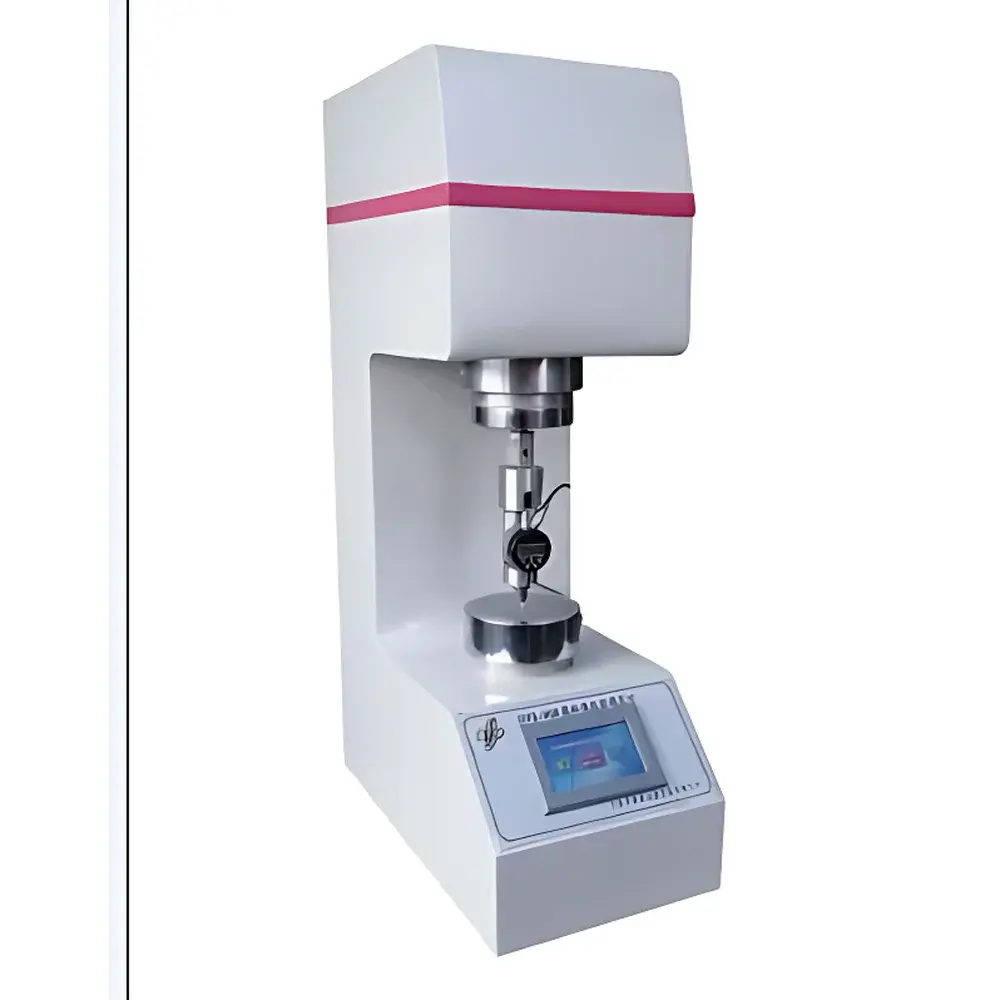
QYS-96 Petrochemical-Grade Ball Indentation Hardness Tester
| Origin | Jilin, China |
|---|---|
| Manufacturer Type | Authorized Distributor |
| Origin Category | Domestic (China) |
| Model | QYS-96 |
| Pricing | Upon Request |
| Test Principle | Ball Indentation Hardness (ISO 2039-1, ASTM D785, GB/T 3398.1–2008, DIN 53456) |
| Load Range | 9.8 N (pre-load), 25 N (petrochemical-specific), 49 N, 132 N, 358 N, 612 N, 961 N |
| Indenter Options | Ø1.8 mm, Ø5 mm, Ø10 mm hardened steel ball |
| Indentation Depth Resolution | 0.001 mm |
| Max Sample Height | 30 mm |
| Distance from Indenter to Frame Wall | 100 mm |
| Depth Measurement Accuracy | ±4% |
| Dwell Time Range | 10–90 s (±0.5% timing accuracy) |
| Valid Indentation Depth Range | 0.150–0.350 mm |
| Frame Deformation | ≤0.05 mm |
Overview
The QYS-96 Petrochemical-Grade Ball Indentation Hardness Tester is an electromechanically controlled instrument engineered for the quantitative evaluation of indentation resistance in thermoplastic and thermoset polymers—particularly polyethylene (PE) anticorrosion coatings used on buried steel pipelines, automotive engineering plastics, and construction-grade plastic profiles. It operates on the fundamental principle of ball indentation hardness as defined in ISO 2039-1, ASTM D785, GB/T 3398.1–2008, and DIN 53456, wherein a calibrated spherical indenter is pressed into the material surface under a precisely controlled load for a specified dwell time, and the residual depth of penetration is measured with micron-level resolution. Unlike conventional Shore or Rockwell hardness testers, this system quantifies deformation behavior under sustained static loading—a critical parameter for assessing long-term creep resistance and cold-flow characteristics of polymer-based protective layers in aggressive subterranean environments.
Key Features
- Multi-stage load configuration supporting seven discrete test forces: 9.8 N (pre-load), 25 N (dedicated petroleum industry compliance per SY/T 0413-2002 Annex F), 49 N, 132 N, 358 N, 612 N, and 961 N—enabling cross-standard validation across ISO, ASTM, GB, and DIN methodologies.
- Interchangeable hardened steel ball indenters (Ø1.8 mm, Ø5 mm, Ø10 mm) mounted on a rigid, low-deformation carriage; frame deflection limited to ≤0.05 mm under maximum load ensures measurement integrity.
- High-resolution digital displacement transducer with 0.001 mm minimum readout and ±4% full-scale depth accuracy—calibrated traceably to national metrological standards.
- Programmable dwell time control (10–90 s, ±0.5% timing precision) with continuous load maintenance capability—critical for simulating real-world stress relaxation in PE pipeline coatings over extended periods.
- Electromechanical servo actuation system enabling fully automated loading, dwell, and unloading sequences—eliminating operator-induced variability and ensuring repeatability per GLP-compliant testing protocols.
Sample Compatibility & Compliance
The QYS-96 accommodates flat or gently curved specimens up to 30 mm in height and 100 mm from the indenter axis to the machine frame wall—sufficient for standard pipe coating coupons, extruded plastic profiles, and molded test plaques. It is explicitly validated for use with crosslinked and non-crosslinked polyethylene systems, polypropylene, ABS, and PVC compounds. Regulatory alignment includes direct support for SY/T 0413-2002 (Appendix F), GB/T 3398.1–2008, ISO 2039-1:2019, ASTM D785-22, and DIN 53456:1982. Data output conforms to audit-ready formats suitable for FDA 21 CFR Part 11–compliant quality systems when integrated with certified laboratory software.
Software & Data Management
Equipped with embedded firmware supporting USB data export (CSV/Excel-compatible), the QYS-96 enables direct transfer of raw depth-time traces, final indentation values, calculated hardness indices (e.g., HBW equivalents), and test metadata—including operator ID, sample batch number, environmental temperature/humidity tags (when interfaced with external sensors), and timestamped execution logs. Optional PC-based control software provides real-time force-depth curve visualization, statistical process control (SPC) charting, and automated report generation compliant with ISO/IEC 17025 documentation requirements. All stored records include immutable audit trails for GMP/GLP-regulated laboratories.
Applications
- Quality assurance of fusion-bonded epoxy (FBE) and three-layer polyethylene (3LPE) pipeline coating systems prior to field deployment.
- Comparative creep resistance assessment of HDPE versus LLDPE formulations under simulated burial conditions.
- R&D evaluation of plasticizer migration effects on long-term indentation recovery in PVC window profiles.
- Batch-to-batch consistency verification for automotive interior trim materials subjected to elevated temperature dwell cycles.
- Failure analysis of thermal-aged polymer components exhibiting cold flow or stress relaxation anomalies.
FAQ
Does the QYS-96 comply with SY/T 0413-2002 Appendix F requirements for 24-hour sustained loading?
Yes—the instrument’s electromechanical load-hold architecture maintains constant force for durations exceeding 24 hours without drift, meeting the mandatory extended dwell condition for polyethylene anticorrosion layer qualification.
Can the QYS-96 be calibrated to national metrological standards?
Yes—each unit ships with a NIST-traceable calibration certificate for both load cell (Class M2 per ISO 7500-1) and displacement sensor (Class 1 per ISO 9277), with annual recalibration intervals recommended.
Is third-party software integration supported for LIMS or ELN environments?
Yes—via RS-232 and USB CDC virtual COM port protocols, the device supports bidirectional communication with validated laboratory informatics platforms including LabWare LIMS, Thermo Fisher SampleManager, and Veeva Vault eLab Notebooks.
What is the recommended maintenance schedule for the indenter sphere and guide bushings?
Visual inspection and cleaning with isopropanol after every 50 tests; replacement of Ø1.8 mm and Ø5 mm indenters recommended after 500 cycles, Ø10 mm after 2000 cycles—or immediately upon observed surface pitting or deviation from sphericity tolerance (≤0.5 µm per ISO 2039-1 Annex B).



