
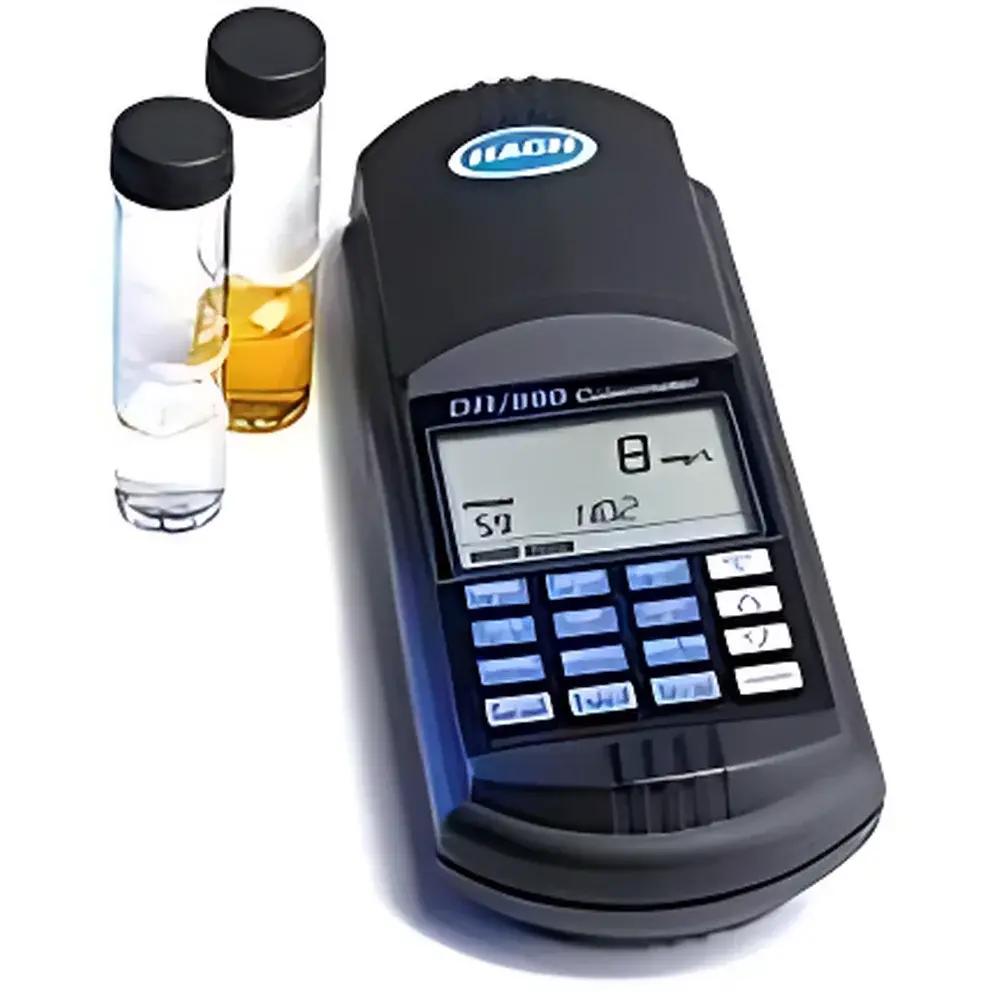
Hach DR800 Series Portable Multi-Parameter Water Quality Analyzer
| Brand | Hach |
|---|---|
| Origin | USA |
| Model | DR800 Series (DR820/DR850/DR890) |
| Instrument Type | Portable/Handheld Spectrophotometric Water Quality Analyzer |
| Detection Capability | Multi-parameter (Colorimetric Analysis via Predefined Methods) |
| Wavelength Range (DR890) | 420, 520, 560, 610 nm |
| Wavelength Accuracy | ±1 nm |
| Photometric Range | 0–2.0 Absorbance Units (A) |
| Wavelength Selection | Automatic |
| Readout Modes | % Transmittance, Absorbance, Concentration |
| Data Storage Capacity | 99 Measurement Records |
| Power Supply | 4 × AA Alkaline Batteries |
| Weight | 470 g |
| Operating Environment | 0–50 °C, ≤90% RH (non-condensing) |
| Connectivity | IR Interface (via optional RS232 Data Transfer Adapter) |
| Compliance | Designed for field use in accordance with EPA-approved colorimetric methods and ASTM D5116/D5257 practices for portable water analysis |
Overview
The Hach DR800 Series Portable Multi-Parameter Water Quality Analyzer is a rugged, field-deployable spectrophotometer engineered for rapid, reliable colorimetric analysis of water samples in environmental monitoring, wastewater treatment, drinking water distribution, and industrial process control applications. Based on fixed-wavelength visible-light absorption spectroscopy, the instrument employs pre-programmed calibration curves aligned with standardized EPA, APHA, and ASTM test methods. Unlike scanning spectrometers, the DR800 Series utilizes discrete LED-based light sources at precisely defined wavelengths—420 nm, 520 nm, 560 nm, and 610 nm (DR890 model)—to ensure high photometric stability, minimal drift, and repeatable quantification across diverse analytes including nitrate, phosphate, ammonia, chlorine, iron, manganese, and total hardness. Its optical architecture incorporates automatic wavelength selection and real-time wavelength verification, eliminating manual alignment errors and reducing operator dependency during on-site deployment.
Key Features
- Ruggedized housing with IP67-rated dust and chemical resistance, enabling operation in harsh outdoor or plant-floor environments
- Large backlit LCD display providing simultaneous readout of absorbance, transmittance, and concentration values in user-selectable units
- Preloaded method library: DR890 stores up to 90 validated colorimetric methods; DR850 supports 50; DR820 supports 20—each compliant with regulatory reference protocols
- Integrated support for multiple reagent formats: powder pillows, liquid-filled ampoules, and sealed TNTplus vials—minimizing preparation time and cross-contamination risk
- Automatic zeroing and blank compensation routines, ensuring measurement integrity even under variable ambient lighting conditions
- Low-power design with 4×AA battery operation delivering >2,000 measurements per set under typical field usage
- Onboard memory retains 99 sample records with timestamp, method ID, and calibration status metadata
Sample Compatibility & Compliance
The DR800 Series accepts standard 10 mL, 20 mL, and 25 mL glass or plastic cuvettes (via included adapter), as well as 16 mm diameter TNTplus vials and COD digestion tubes. All supported test methods align with U.S. EPA Methods (e.g., 365.4 for phosphate, 334.0 for nitrate/nitrite), ASTM D3370 and D5116 for field water sampling, and ISO 7027 for turbidity-related absorbance corrections. The analyzer’s optical path length and detector sensitivity are optimized for compliance with APHA Standard Methods 20th–23rd Edition requirements for low-concentration trace analyte detection. While not FDA 21 CFR Part 11–certified out-of-the-box, audit-ready data export functionality enables integration into GLP/GMP workflows when paired with HachLink software and documented SOPs.
Software & Data Management
Data transfer is accomplished via infrared interface using the optional HachLink™ Data Acquisition and Analysis Software (v5.x or later). The software supports direct download of all stored measurements—including method name, date/time stamp, calibration curve version, and raw absorbance values—to Windows-based PCs. Export formats include CSV, Excel (.xlsx), and PDF reports suitable for regulatory submission. HachLink enables batch calibration management, trend charting over time, outlier flagging based on user-defined QC limits, and generation of LIMS-compatible audit logs. All data files retain embedded instrument serial number and firmware revision for full traceability—a critical requirement for environmental laboratories subject to state or federal inspection.
Applications
- Field verification of disinfectant residuals (free & total chlorine) in municipal distribution systems
- Rapid screening of nutrient loads (phosphate, nitrate) in surface water bodies for eutrophication assessment
- Process monitoring of coagulant dosing efficiency in wastewater treatment plants
- Compliance testing for industrial effluent discharge permits (e.g., NPDES reporting)
- Educational laboratory instruction in environmental chemistry and analytical techniques
- Emergency response deployment following natural disasters or chemical spills
FAQ
What reagent formats are compatible with the DR800 Series?
The instrument supports powder pillows, liquid-filled ampoules, and sealed TNTplus vials—all manufactured by Hach and pre-formulated for specific EPA- or ISO-aligned methods.
Does the DR800 Series require annual recalibration by a certified lab?
No. The fixed-wavelength optical system does not require periodic wavelength recalibration; however, routine verification using Hach DR/Check™ ABS standards (Cat. No. 27639–00) is recommended before each sampling session.
Can the DR800 Series be used for turbidity measurement?
No. Turbidity requires nephelometric detection at 90° scattering geometry; this instrument performs only absorbance-based colorimetry. For turbidity, Hach recommends the 2100Q Portable Turbidimeter.
Is firmware upgrade supported in the field?
Yes. Firmware updates are distributed via Hach’s official support portal and installed using the HachLink software and RS232 adapter (Cat. No. 48490–00).
What is the expected lifetime of the internal light source?
The LED light sources are rated for ≥100,000 measurements per wavelength channel under normal operating conditions, with no scheduled replacement required during typical instrument service life.







