
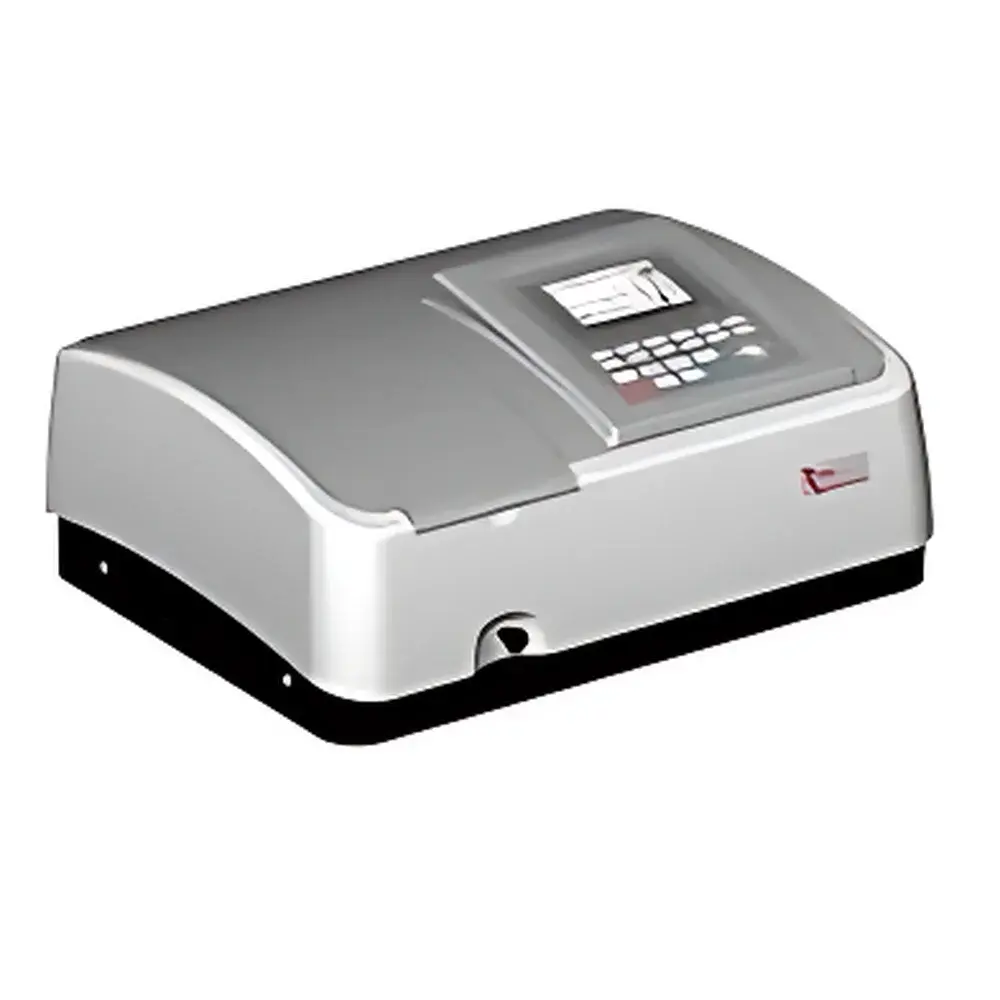
MupuDa UV-6100 Dual-Beam Ultraviolet-Visible Spectrophotometer
| Brand | MupuDa |
|---|---|
| Origin | Shanghai, China |
| Model | UV-6100 |
| Optical System | Dual-beam |
| Detector | Photodiode Array (PDA) |
| Wavelength Range | 190–1100 nm |
| Spectral Bandwidth | 1.8 nm |
| Wavelength Accuracy | ±0.3 nm |
| Wavelength Repeatability | ≤0.1 nm |
| Stray Light | ≤0.03%T at 220 nm and 360 nm |
| Photometric Accuracy | ±0.002 A (0–0.5 A), ±0.004 A (0.5–1.0 A), ±0.2%T (0–100%T) |
| Photometric Repeatability | ≤0.001 A (0–0.5 A), ≤0.002 A (0.5–1.0 A), ≤0.15%T (0–100%T) |
| Baseline Drift | ±0.0003 A/h (at 500 nm, after warm-up) |
| Baseline Flatness | ±0.0005 A |
| Noise Level | 0.0003 Abs (at 500 nm) |
| Scan Speed | High/Medium/Low, up to 3800 nm/min |
| Photometric Range | –4 to +4 A, 0–200%T, 0–9999 C |
| Display | 320 × 240 dot-matrix LCD |
| Data Interface | USB port, parallel printer port |
| Power Supply | AC 220 V/50 Hz or AC 110 V/60 Hz |
| Dimensions | 590 × 420 × 260 mm |
| Weight | 26 kg |
Overview
The MupuDa UV-6100 Dual-Beam Ultraviolet-Visible Spectrophotometer is engineered for precision quantitative and qualitative analysis across research laboratories, quality control environments, and educational institutions. Utilizing a dual-beam optical architecture with real-time reference beam compensation, the instrument eliminates errors caused by source intensity drift, lamp aging, or environmental fluctuations—ensuring high reproducibility in absorbance, transmittance, and concentration measurements. Its core optical path integrates a high-efficiency 1200 lines/mm holographic grating and optimized collimation optics, delivering consistent spectral resolution and ultra-low stray light performance (≤0.03%T at 220 nm and 360 nm). The system operates across a broad spectral range of 190–1100 nm, covering deep UV through near-infrared—enabling applications from nucleic acid quantification to pharmaceutical assay development and dye stability testing.
Key Features
- Dual-beam design with real-time background correction for enhanced photometric stability and long-term measurement reliability
- High-stability imported deuterium and tungsten-halogen lamps with intelligent power management and automatic on/off scheduling to extend operational lifetime
- Modular socket-type lamp assembly—no optical alignment required during lamp replacement
- Hermetically sealed optical compartment with SiO₂-coated mirrors to minimize degradation from ambient humidity, ozone, and airborne contaminants
- Integrated GLP self-validation function: performs automated wavelength accuracy verification, photometric linearity checks, and system diagnostics; generates audit-ready validation reports compliant with internal QA protocols
- Onboard data storage for up to 300 measurement sets (10 entries per line × 30 lines); supports USB export to external drives or PCs
- Three selectable scan speeds (high/medium/low), with maximum scanning rate of 3800 nm/min and user-defined step intervals (0.1–5.0 nm)
- Comprehensive photometric modes: Absorbance (A), Transmittance (T), Concentration (C), and Energy (E), with dynamic range spanning –4 to +4 A and 0–200%T
Sample Compatibility & Compliance
The UV-6100 accommodates standard cuvettes from 5 mm to 100 mm pathlength, including rectangular quartz, glass, and plastic cells. Optional accessories—including an 8-cell auto-sampler rack, adjustable micro-volume cell holder (down to 50 µL), and temperature-controlled cell holder—expand throughput and method flexibility. All optical components meet ISO 9001 manufacturing standards, and the instrument’s photometric performance aligns with ASTM E275, ISO 6059, and USP requirements for spectrophotometric instrumentation. While not pre-certified for FDA 21 CFR Part 11, its software architecture supports secure user authentication, electronic signature logging, and full audit trail generation when deployed with validated third-party PC control software—facilitating GxP-compliant workflows under GLP and GMP frameworks.
Software & Data Management
Controlled via optional PC-based scanning software (Windows-compatible), the UV-6100 enables advanced data acquisition and processing: full spectral scanning, multi-wavelength kinetics, DNA/protein analysis (with default 260/280/320 nm settings and custom ratio calculation), and quantitative analysis using both standard curve (up to 10-point linear/nonlinear regression) and coefficient-based methods (C = kA + b or A = kC + b). Raw spectral data can be exported directly to Excel or Word formats; graphical outputs support zoom, smoothing, peak/valley detection, and baseline correction. The instrument includes a parallel printer interface for hardcopy documentation (printer optional), and all data transfers occur via standard USB 2.0 protocol—ensuring compatibility with modern laboratory IT infrastructure and LIMS integration.
Applications
The UV-6100 serves as a foundational tool for routine and regulatory analyses across multiple sectors. In life sciences, it supports nucleic acid purity assessment (A260/A280, A260/A230), protein quantification via Bradford/Lowry assays, and enzyme kinetics monitoring. In chemistry, it facilitates reaction monitoring, equilibrium constant determination, and ligand-binding studies. Environmental labs use it for nitrate/nitrite, phosphate, and heavy metal ion quantification following colorimetric protocols. Pharmaceutical QC departments apply it for content uniformity testing, dissolution profile analysis, and excipient compatibility screening—particularly where compliance with ICH Q2(R2) analytical method validation guidelines is required. Its robust baseline flatness (±0.0005 A) and low noise floor (0.0003 Abs) make it suitable for low-concentration trace analysis in method development.
FAQ
What is the typical warm-up time required before achieving photometric stability?
The instrument achieves thermal and electronic equilibrium within 30 minutes; baseline drift is specified at ±0.0003 A/h after 30-min preheating at 500 nm.
Can the UV-6100 perform kinetic measurements over extended time periods?
Yes—user-defined parameters include total duration (up to 9999 seconds), sampling interval (0.1–999.9 s), and delay time prior to initiation, enabling reaction monitoring from seconds to hours.
Is the photodiode array detector cooled?
No—the PDA operates at ambient temperature; however, its low-noise design and integrated signal averaging ensure stable performance without active cooling.
Does the instrument support wavelength calibration using NIST-traceable standards?
Yes—users may perform manual or automated wavelength calibration using holmium oxide or didymium filters; calibration data is stored and retrievable for audit purposes.
How is lamp usage tracked and managed?
The embedded control system monitors cumulative operating hours for both deuterium and tungsten lamps, displays remaining estimated lifespan, and triggers maintenance alerts via the LCD interface.
Related Products




