
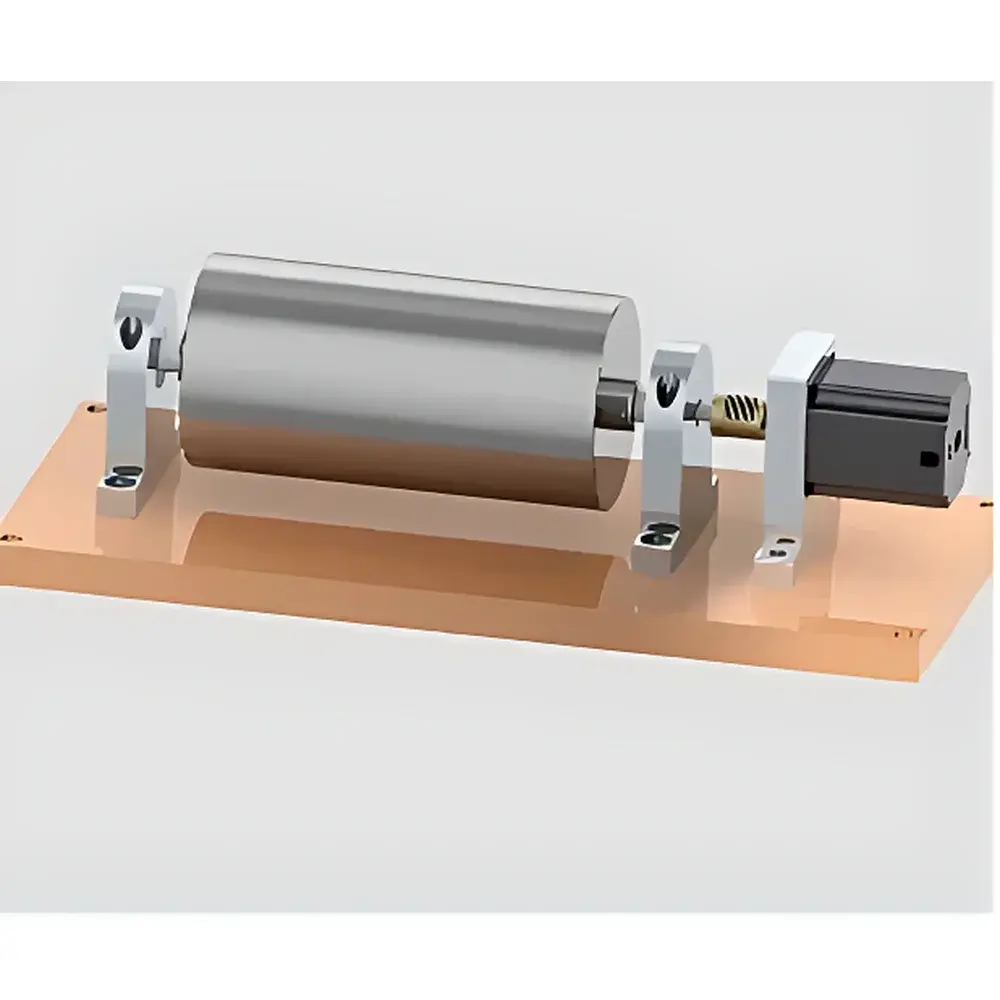
Truelab TC-1000 Electrospinning Drum Collector
| Brand | Truelab |
|---|---|
| Origin | Shanghai, China |
| Manufacturer Type | Authorized Distributor |
| Country of Origin | China |
| Model | TC-1000 |
| Drum Material | 304 Stainless Steel (Φ102 × L200 mm) |
| Base Material | Phenolic Resin (Bakelite), W450 × D200 × H20 mm |
| Motor | 57-step Hybrid Stepper Motor |
| Speed Range | 0–1000 rpm (±1 rpm accuracy) |
| Direction Control | Bidirectional (CW/CCW) |
| Overall Dimensions | W450 × D200 × H135 mm |
| Weight | 12 kg |
| Controller Compatibility | K11 Digital Speed Controller |
| Electrical Insulation | Class II, Bakelite base ensures high dielectric strength (>20 kV/mm) |
Overview
The Truelab TC-1000 Electrospinning Drum Collector is an engineered rotational collection system designed specifically for high-fidelity nanofiber deposition in laboratory-scale electrospinning processes. It operates on the principle of controlled rotational capture: as charged polymer jets are ejected from a needle tip under high voltage, the rotating drum provides tangential velocity and centrifugal stabilization to align fibers preferentially along the drum’s axial direction—enabling fabrication of highly oriented, low-porosity nonwovens. Its core architecture integrates mechanical precision with electrical safety: the 304 stainless steel drum (Φ102 × 200 mm) offers corrosion resistance, surface uniformity, and thermal stability during extended operation; the phenolic resin (Bakelite) base delivers >20 kV/mm dielectric strength, eliminating arcing risks when used with high-voltage electrospinning setups (typically 10–30 kV). The system achieves speed regulation from 0 to 1000 rpm with ±1 rpm repeatability via closed-loop control with the K11 digital controller—critical for tuning fiber alignment, mat thickness, and crystallinity in polymeric systems such as PCL, PLLA, PAN, and gelatin-based solutions.
Key Features
- Precision-engineered 57-step hybrid stepper motor delivering smooth, jitter-free rotation across full 0–1000 rpm range with <±1 rpm speed stability under load
- Electrostatically optimized 304 stainless steel drum (Φ102 × L200 mm) featuring mirror-finish surface finish (Ra ≤ 0.4 µm) to minimize fiber adhesion irregularities and facilitate clean substrate removal
- Class II insulated Bakelite base (W450 × D200 × H20 mm) certified to IEC 60664-1 for reinforced insulation in high-voltage environments up to 30 kV
- Bidirectional rotation capability (CW/CCW) programmable via K11 controller—enabling alternating deposition protocols for layered or gradient fiber architectures
- Modular mechanical design with M6 threaded mounting points on base plate for integration into custom electrospinning rigs, environmental chambers, or inline solvent recovery systems
- Low electromagnetic interference (EMI) motor drive compliant with CISPR 11 Group 1, Class B limits—ensuring compatibility with adjacent analytical instrumentation (e.g., HV power supplies, syringe pumps, real-time imaging systems)
Sample Compatibility & Compliance
The TC-1000 accommodates standard collector substrates including aluminum foil, silicon wafers, conductive textiles, and sacrificial polymer films (e.g., PVP, PEO) without mechanical modification. Its drum geometry supports uniform fiber winding across viscosities ranging from 500 to 15,000 cP (measured at 25°C, 1 s⁻¹ shear rate), consistent with common electrospinning solvents (DMF, THF, chloroform, HFIP). The system complies with ISO 13849-1 (PL d, Category 3) for functional safety in lab automation workflows and meets GLP documentation requirements for traceable speed calibration—each unit ships with a factory-verified speed calibration certificate referenced to NIST-traceable tachometer standards. No regulatory filings are required under FDA 21 CFR Part 11, as the device performs no data acquisition or electronic record generation; however, its K11 controller supports optional RS-485 output for external logging in validated GMP environments.
Software & Data Management
The TC-1000 operates as a standalone electromechanical subsystem with no embedded firmware or onboard software. Speed setpoints, direction, and ramp profiles are configured exclusively via the K11 controller’s front-panel keypad and LCD interface. For automated integration, the K11 provides isolated 0–10 V analog input (for external PID setpoint modulation) and TTL-level digital I/O (start/stop, direction toggle) compatible with LabVIEW, Python (PySerial), or PLC-based orchestration platforms. Audit trails require external timestamped logging; no internal memory or user-accessible storage is present—aligning with ALCOA+ principles for raw data integrity in regulated research settings.
Applications
- Production of aligned nanofiber scaffolds for neural tissue engineering and tendon regeneration studies
- Controlled fabrication of piezoelectric PVDF membranes for self-powered biosensors
- Rapid prototyping of battery separator layers (e.g., PAN-based) with tunable porosity and ionic conductivity
- In situ fiber morphology studies using synchronized high-speed imaging (≥1000 fps) during dynamic speed ramping
- Multi-material coaxial electrospinning where drum speed directly influences core–shell sheath thickness ratio
- Accelerated aging tests requiring repeated cyclic loading of electrospun mats under defined rotational stress profiles
FAQ
Is the TC-1000 compatible with high-voltage power supplies exceeding 25 kV?
Yes—the Bakelite base is rated for continuous operation at 30 kV DC with clearance/creepage distances exceeding IEC 60950-1 requirements.
Can the drum be replaced with custom-diameter cylinders?
Yes—drum mounting uses standardized M8×1.25 threads; users may install alternative drums (Φ80–Φ150 mm) provided mass moment of inertia remains within 0.015 kg·m² to maintain motor torque response.
Does Truelab provide calibration services beyond initial factory certification?
Yes—annual recalibration with NIST-traceable tachometric verification is available through Truelab’s Shanghai service center (lead time: 5 business days).
What maintenance is required for long-term reliability?
Biannual inspection of stepper motor coupling alignment and Bakelite base surface integrity; no lubrication required—motor bearings are sealed for lifetime operation.
Is the TC-1000 CE-marked?
It carries CE marking per EMC Directive 2014/30/EU and Low Voltage Directive 2014/35/EU, verified by TÜV Rheinland (Report No. RHE/2023/08764).



