
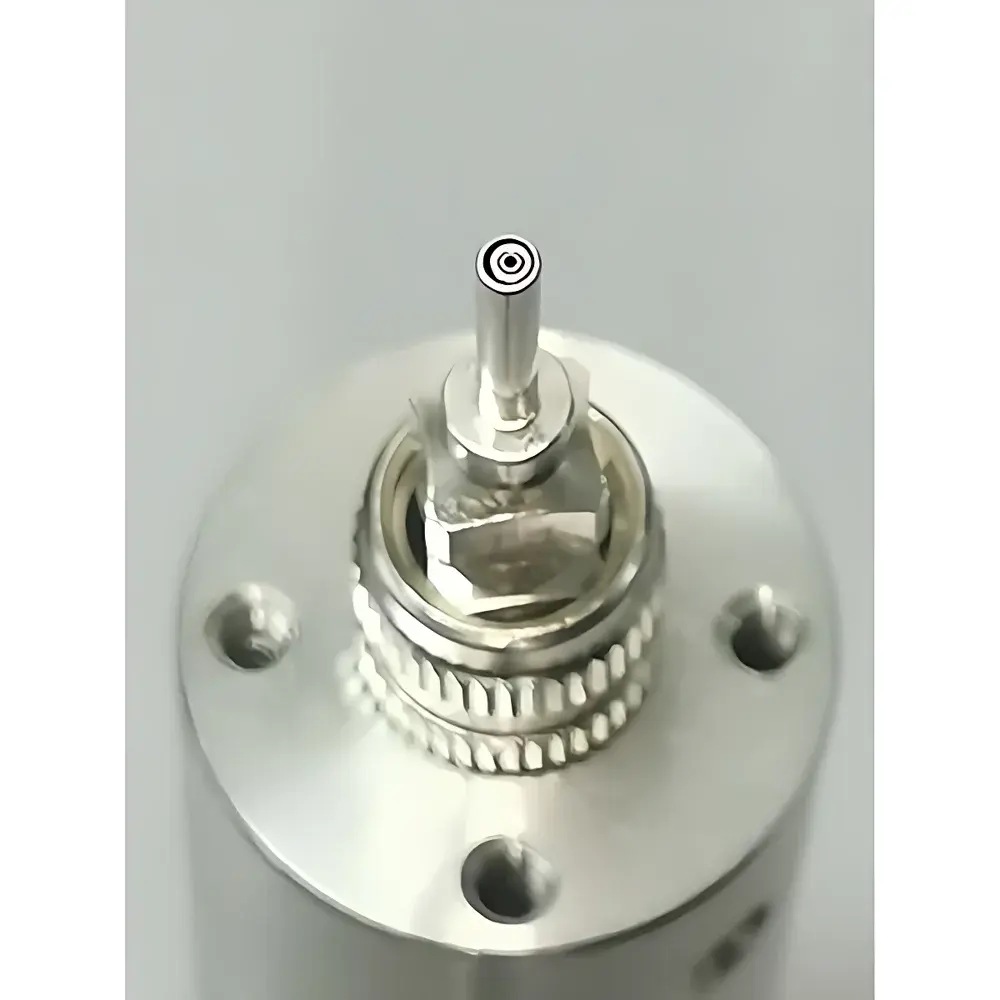
Truelab SZPT-3P Detachable Triple-Coaxial Electrospinning Needle
| Brand | Truelab |
|---|---|
| Origin | Shanghai, China |
| Model | SZPT-3P |
| Material | 316L stainless steel (needle body & seat), medical-grade polypropylene (Luer adapter) |
| Dead Volume | Outer-Middle layer: 1.4 mL |
| Middle-Inner layer | 2.0 mL |
| Inner layer | 0.2 mL |
| Weight | ~300 g |
| Configurable needle gauges | e.g., 13G+16G+20G, 13G+18G+25G, 15G+20G+25G |
| Includes | 1× modular needle seat, 3× triple-needle sets, 10× 1/16″ tubing fittings, 10× small O-rings, 4× large O-rings, 4× Luer-lock adapters, 1× dual-purpose wrench, 1× metal mounting bracket |
Overview
The Truelab SZPT-3P Detachable Triple-Coaxial Electrospinning Needle is an engineered solution for advanced multi-fluid electrospinning and electrospraying applications requiring precise, reproducible coaxial flow control. Unlike monolithic welded coaxial nozzles—whose internal channels are inaccessible for cleaning—the SZPT-3P employs a fully modular, three-segment detachable architecture: outer needle, middle needle, inner needle, precision-machined needle seat, and Luer-compatible fluidic interface. This design enables complete disassembly without tools beyond the included dual-purpose wrench, allowing thorough ultrasonic cleaning of each component to prevent cross-contamination and polymer residue buildup. The system operates on the principle of concentric laminar flow under high-voltage electric fields, where independent fluid delivery through three isolated lumens supports core–shell, Janus, or tri-layer nanofiber fabrication with controlled interfacial dynamics.
Key Features
- Fully detachable three-tier assembly: outer, middle, and inner needles independently removable for inspection, cleaning, and replacement—eliminating irreversible clogging and extending service life.
- Modular needle seat constructed from ASTM F138-certified 316L stainless steel, offering superior corrosion resistance, biocompatibility, and dimensional stability under prolonged solvent exposure (e.g., HFIP, DMF, chloroform).
- Medical-grade polypropylene Luer-lock adapters compliant with ISO 8536-4 and USP Class VI standards; chemically inert, low extractables, and suitable for GMP-aligned lab environments.
- High-concentricity needle alignment (< ±5 µm radial deviation) ensured by precision CNC turning and mirror-finish polishing of all stainless-steel components.
- Configurable gauge combinations: standard kits include (13G+16G+20G), (13G+18G+25G), and (15G+20G+25G); custom gauge pairings available upon request to match viscosity differentials and throughput requirements.
- Convertible architecture: removal of one needle segment transforms the triple-coaxial configuration into a dual-coaxial system—enabling rapid reconfiguration between tri-layer and core–shell fiber production without purchasing separate hardware.
- Integrated mounting interface with M4 threaded fixing holes compatible with standard XYZ translation stages and syringe pump manifolds.
- Pre-shipment hydrostatic pressure testing at 0.8 MPa (116 psi) for 60 seconds confirms leak integrity across all sealing interfaces—including O-ring grooves and tapered Luer junctions.
Sample Compatibility & Compliance
The SZPT-3P supports a broad range of polymer solutions and functional suspensions used in nanofiber synthesis, including but not limited to PCL, PLA, PAN, gelatin, chitosan, and conductive composites (e.g., PEDOT:PSS, graphene oxide dispersions). Its 316L stainless steel wetted path meets ISO 10993-5 cytotoxicity requirements and is compatible with cleaning protocols validated under ASTM E3106 (standard guide for cleaning verification in pharmaceutical manufacturing). The PP Luer adapters comply with FDA 21 CFR §177.1520 for repeated-use fluid contact. While not a standalone regulated device, the needle system is routinely deployed in GLP-compliant material development workflows and supports audit-ready documentation when integrated with Part 11–compliant pump controllers and data acquisition software.
Software & Data Management
As a passive fluidic interface, the SZPT-3P does not incorporate embedded electronics or firmware. It is fully agnostic to third-party syringe pump platforms—including Harvard Apparatus PHD Ultra, KD Scientific Legato, and Chemyx Fusion Series—and integrates seamlessly with LabVIEW, Python (via PySerial or pyvisa), or MATLAB-based automation scripts for synchronized multi-channel flow rate control. Dead volume specifications (Outer–Middle: 1.4 mL; Middle–Inner: 2.0 mL; Inner: 0.2 mL) are traceably documented per batch and support accurate residence time modeling in process scale-up calculations. All mechanical tolerances and material certifications are archived in the product’s digital DMR (Device Master Record), accessible upon request for quality system integration.
Applications
- Tri-axial electrospinning of hierarchical nanofibers with spatially segregated drug payloads (e.g., burst-release shell + sustained-release core + stabilizing intermediate layer).
- In situ encapsulation of thermally labile biologics (e.g., enzymes, antibodies) within protective polymer sheaths using low-voltage, room-temperature electrospraying.
- Multi-material fiber fabrication for battery separators, wound dressings, and filtration membranes requiring zoned chemical functionality.
- Process development studies comparing coaxial vs. emulsion-based spinning routes—enabled by rapid hardware reconfiguration between dual- and triple-lumen modes.
- Academic and industrial R&D labs conducting DOE (Design of Experiments) on needle geometry effects—viscosity ratio, flow rate asymmetry, and Taylor cone stability—under ISO/IEC 17025-aligned test protocols.
FAQ
Can the SZPT-3P be sterilized for biomedical applications?
Yes—autoclaving at 121 °C, 15 psi for 20 minutes is validated for the 316L stainless steel components; PP adapters must be replaced after each autoclave cycle due to thermal degradation limits.
What is the maximum recommended operating pressure?
Continuous operation up to 0.6 MPa (87 psi) is supported; transient spikes ≤ 0.8 MPa are permissible during priming if duration remains < 5 seconds.
Are custom needle length or taper angles available?
Yes—custom lengths (10–50 mm) and tip geometries (flat-cut, beveled, or conical) can be machined per ISO 8536-3 Annex B specifications; lead time extends by 12 business days.
How often should O-rings be replaced in routine use?
Under daily 8-hour operation with organic solvents, small O-rings should be replaced every 150 hours; large O-rings every 300 hours—replacement kits (TR-O-RK-01) are available separately.
Does Truelab provide calibration certificates for concentricity or dead volume?
Concentricity is verified via coordinate measuring machine (CMM) per ISO 1101; dead volume is measured gravimetrically using certified reference fluids (traceable to NIST SRM 2192); certificates issued upon request with NIST-traceable uncertainty budgets.
Related Products





