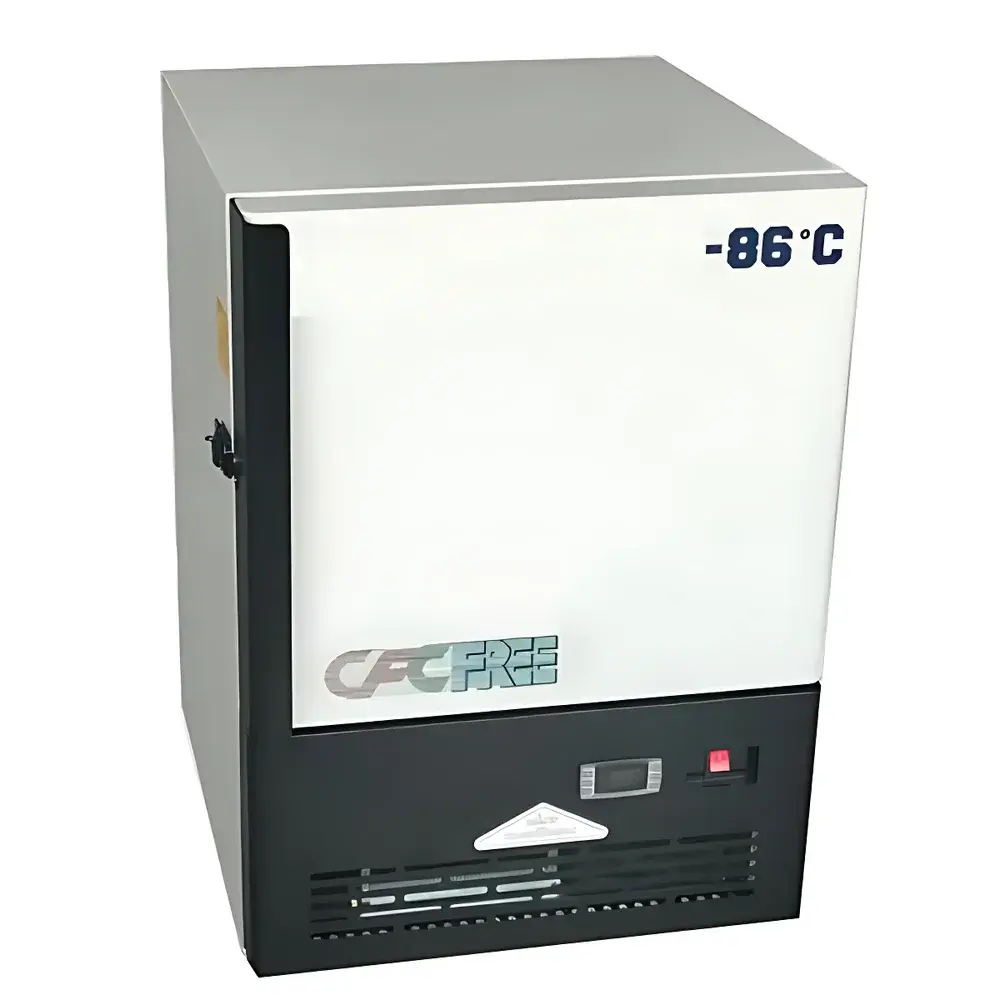
Truelab DW-45/DW-60/DW-86 Series 30L Benchtop Ultra-Low Temperature Freezer
| Brand | Truelab |
|---|---|
| Origin | Shanghai, China |
| Model | DW-45 / DW-60 / DW-86 |
| Cabinet Type | Upright |
| Effective Volume | 30 L |
| Internal Dimensions (W×D×H) | 330 × 350 × 260 mm |
| External Dimensions (W×D×H) | 550 × 580 × 780 mm |
| Power Supply | 220 V AC, 50 Hz |
| Rated Power Consumption | 130 W (DW-45) / 160 W (DW-60) / 280 W (DW-86) |
| Weight | 55 kg (DW-45) / 62 kg (DW-60) / 70 kg (DW-86) |
| Temperature Range | –15 to –45 °C (DW-45) / –25 to –65 °C (DW-60) / –45 to –86 °C (DW-86) |
| Refrigerant | R290/R170 (non-ozone-depleting, low-GWP hydrocarbon blend) |
| Insulation | High-density polyurethane foam (≥100 mm thickness, CFC/HCFC-free) |
| Door Seal | Dual magnetic gasket system |
| Compressor | Hermetic scroll compressor (imported brand, high-efficiency) |
Overview
The Truelab DW-45/DW-60/DW-86 series represents a class of compact, upright ultra-low temperature (ULT) freezers engineered for precision cold storage in space-constrained laboratory environments. Designed around single-stage cascade refrigeration architecture with hydrocarbon-based refrigerants (R290/R170), these units deliver stable thermal performance across three distinct operational ranges: –15 to –45 °C (DW-45), –25 to –65 °C (DW-60), and –45 to –86 °C (DW-86). Unlike large-scale ULT systems relying on multi-stage compressors or liquid nitrogen backup, this benchtop platform achieves deep-cold stability through optimized heat exchange pathways, high-density polyurethane insulation (≥100 mm wall thickness), and dual magnetic door seals—enabling consistent temperature uniformity (±2.5 °C at setpoint) and minimal thermal recovery time (<15 min after 30-sec door opening). Its 30 L internal volume is calibrated for high-value biological specimens—including cryovials, microtubes, tissue fragments, and primary cell aliquots—while also supporting materials science workflows requiring controlled cryogenic conditioning prior to mechanical processing.
Key Features
- Compact upright footprint (550 × 580 × 780 mm) suitable for biosafety cabinets, fume hoods, or under-bench installation
- Three-tiered temperature capability: DW-45 (–45 °C), DW-60 (–65 °C), and DW-86 (–86 °C) models address tiered cold-chain requirements from long-term RNA/DNA storage to protein crystallization support
- Energy-efficient single-stage scroll compressor (imported OEM unit) with low-noise operation (<48 dB[A]) and extended service life
- Dual magnetic door gaskets and vacuum-insulated panel options (available on request) reduce standby heat ingress by >35% versus standard ULT cabinets
- Digital PID temperature controller with ±0.1 °C setpoint resolution, real-time display, and programmable ramp-hold profiles
- Multi-level alarm system: audible/visual alerts for high-temperature deviation (>±5 °C), door ajar, power failure, and compressor fault—with relay output for external monitoring integration
- Environmentally compliant design: R290/R170 refrigerant blend (GWP < 10) and zero-ozone-depletion-potential (ODP = 0) polyurethane foam insulation
Sample Compatibility & Compliance
The DW-series accommodates standard cryogenic consumables including 0.5–2.0 mL externally threaded cryovials (Nunc, Thermo Fisher), 96-well PCR plates, and aluminum foil-wrapped tissue blocks. Internal chamber geometry (330 × 350 × 260 mm) supports vertical stacking of up to six 10 × 10 cryoboxes or equivalent microtube racks. All models comply with IEC 61010-1:2010 (Safety Requirements for Electrical Equipment for Measurement, Control, and Laboratory Use) and meet CE marking requirements for electromagnetic compatibility (EMC Directive 2014/30/EU). While not certified to ISO 13485 or FDA 21 CFR Part 11 out-of-the-box, the digital controller supports audit-trail-ready logging when paired with optional USB data export or RS485 Modbus RTU interface—enabling alignment with GLP/GMP documentation standards for QC/QA labs handling clinical trial samples or biobank inventories.
Software & Data Management
Temperature logging is performed via embedded non-volatile memory (retains 30 days of 10-minute interval data without power). Optional USB-C port enables direct CSV export of time-stamped temperature records, alarm logs, and compressor runtime statistics. For networked deployment, the RS485 interface supports integration into LabVantage, STARLIMS, or custom SCADA platforms using standard Modbus RTU protocol. Firmware updates are delivered via secure HTTPS portal; all configuration changes are timestamped and user-logged—supporting traceability requirements under ISO/IEC 17025:2017 Clause 7.7 (Control of Records). No cloud connectivity or proprietary SaaS platform is included, preserving data sovereignty for regulated institutions.
Applications
- Cryopreservation of primary cells, stem cell lines, and organoids at –86 °C to minimize ice recrystallization during thaw cycles
- Pre-cooling of thermosensitive reagents (e.g., restriction enzymes, ligases, CRISPR-Cas complexes) prior to bench use
- Cryogenic machining support: pre-chilling of metallic components (bearings, bushings, shafts) to enable interference-fit assembly or disassembly via thermal contraction
- Cryo-milling preparation: embrittlement of polymers, plant tissues, or pharmaceutical excipients prior to pulverization in planetary ball mills
- Long-term archival storage of reference standards (e.g., NIST SRMs) requiring stable sub–60 °C conditions per ASTM E2932-22 guidelines
- Temporary dry ice replenishment staging for field-deployable sample transport systems
FAQ
What is the minimum ambient temperature required for stable operation?
The unit is rated for continuous operation in ambient environments between +10 °C and +32 °C. Performance validation was conducted at 25 °C/60% RH per IEC 60068-3-4; operation above 32 °C may extend compressor duty cycle and reduce achievable low-temperature setpoints.
Can the freezer be installed in an unventilated enclosure?
No. A minimum clearance of 150 mm on all sides—and 300 mm above the top vent—is mandatory for condenser airflow. Restricted ventilation will trigger thermal overload protection and void warranty coverage.
Is remote monitoring supported natively?
Native Ethernet/Wi-Fi is not integrated. Remote access requires third-party hardware gateways (e.g., Advantech ECU-1251) connected via RS485 Modbus RTU or USB-to-serial adapters with compatible SCADA drivers.
Does the unit include validation documentation?
Factory-installed IQ/OQ documentation (in English) is available upon request at time of order. PQ protocols must be developed in-house per user-defined acceptance criteria and executed with NIST-traceable thermocouples.
What maintenance intervals are recommended?
Compressor oil inspection every 24 months; condenser coil cleaning every 6 months in dust-prone environments; door gasket integrity verification quarterly using the “dollar bill test” per ISO 20417:2021 Annex B.