
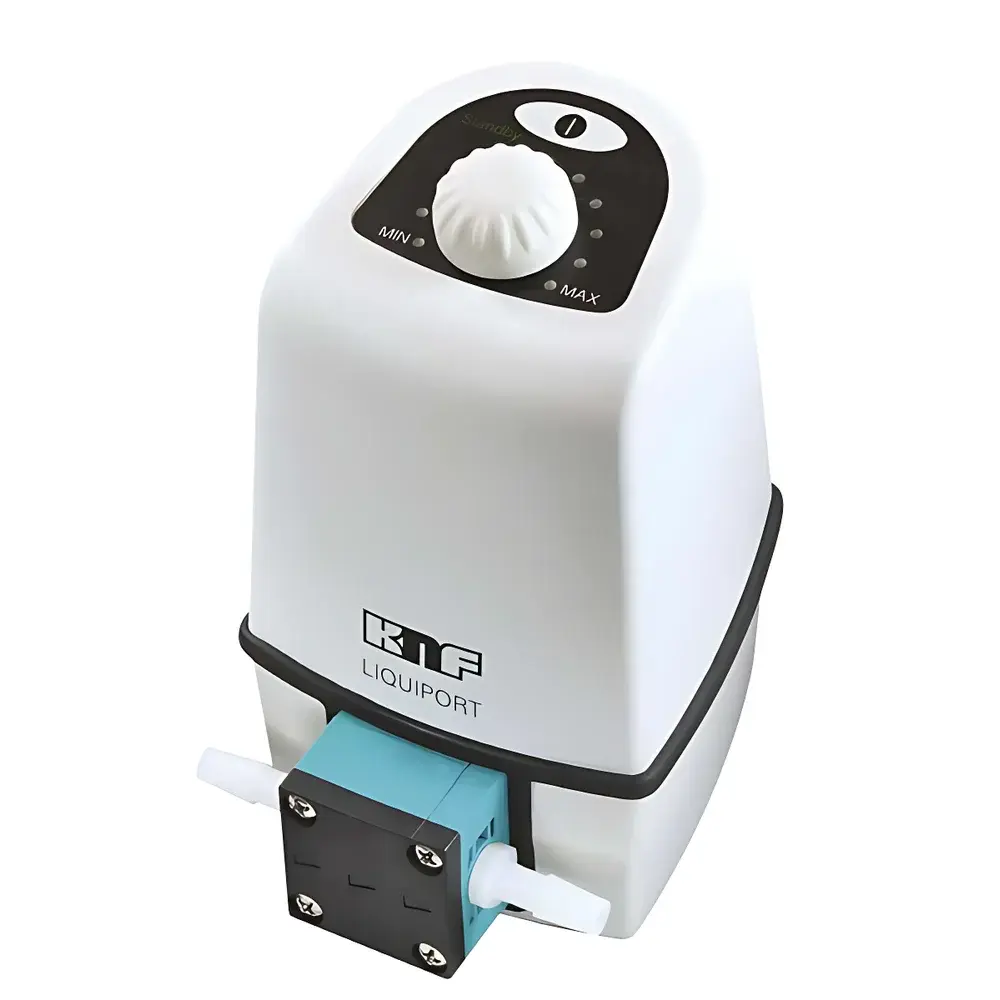
KNF LIQUIPORT NF300 Diaphragm Liquid Transfer Pump
| Brand | KNF |
|---|---|
| Origin | Germany |
| Model | NF300 |
| Flow Rate | 0.5–3.0 L/min |
| Self-Priming Height | 10 mWg |
| Discharge Head | 60 mWg |
| Inlet/Outlet Port | ID 12 mm |
| Pump Head Material | PP (KT), PVDF (TT), or PTFE (FT) |
| Diaphragm | PTFE-coated |
| Valve | FFKM |
| Operating Liquid Temperature | 5–80 °C |
| Ambient Temperature | 5–40 °C |
| IP Rating | IP65 |
| Power Supply | 100–230 V AC, 50–60 Hz |
| Weight | 1.5 kg |
| Accuracy | ±2% |
| Control | Manual (S) or 0–10 V Analog + TTL Logic (RC) |
| Max. Fluid Viscosity | 150 cSt |
Overview
The KNF LIQUIPORT NF300 is a compact, high-reliability diaphragm liquid transfer pump engineered for precise, pulse-free fluid handling in demanding laboratory and analytical instrumentation environments. Unlike peristaltic or syringe pumps—whose performance degrades with tubing fatigue, pulsation-induced measurement uncertainty, and limited pressure capability—the NF300 employs a dual-head, mechanically actuated PTFE-coated diaphragm system to deliver continuous, metered flow across a wide chemical compatibility spectrum. Its positive displacement architecture ensures consistent volumetric delivery independent of backpressure fluctuations up to 60 mWg (≈0.6 bar), making it suitable for pressurized recirculation, reagent dosing, wash cycles, and interfacing with HPLC, ICP-MS, or automated sample preparation systems. Designed and manufactured in Freiburg, Germany, the NF300 adheres to DIN EN ISO 9001 quality management standards and integrates seamlessly into GLP- and GMP-compliant workflows where traceability, repeatability, and material integrity are critical.
Key Features
- Pulse-free, continuous flow output with ±2% volumetric accuracy over the full 0.5–3.0 L/min operating range
- Dry-run capability enables safe operation during transient empty-suction conditions without diaphragm damage
- Self-priming lift of up to 10 mWg (≈1 m H₂O), eliminating need for flooded inlet in benchtop installations
- Three chemically resistant pump head configurations: polypropylene (KT), polyvinylidene fluoride (TT), or fully fluoropolymer (FT) for aggressive solvents, acids, bases, and oxidizers
- PTFE-coated elastomeric diaphragms and FFKM (perfluoroelastomer) valves ensure long service life in corrosive media up to 80 °C
- IP65-rated enclosure provides protection against dust ingress and low-pressure water jets—ideal for wet-lab and cleanroom-adjacent deployment
- Flexible control options: manual knob adjustment (S version) or 0–10 V analog input + TTL logic interface (RC version) for integration with PLCs, DAQ systems, or LIMS platforms
- Compact footprint (160 × 188 × 104 mm L×H×W) minimizes bench space while enabling vertical or panel-mount installation using optional brackets (e.g., order no. 160473)
Sample Compatibility & Compliance
The NF300 is validated for use with aqueous solutions, organic solvents (including acetone, methanol, THF), dilute mineral acids (HCl, HNO₃ ≤30%), caustic alkalis (NaOH ≤20%), and halogenated compounds—provided material selection aligns with chemical exposure profiles (e.g., FT configuration for HF or fuming nitric acid). It complies with CE marking requirements under the EU Machinery Directive 2006/42/EC and Low Voltage Directive 2014/35/EU. While not intrinsically rated for ATEX Zone 1, its brushless motor design and absence of sparking components support safe operation in non-hazardous ambient conditions per IEC 60079-0. For regulated environments, the RC variant supports audit-ready control logging when paired with compliant SCADA software, satisfying foundational data integrity expectations aligned with FDA 21 CFR Part 11 Annex 11 principles.
Software & Data Management
The NF300 RC model outputs real-time operational status—including run/fault states, overtemperature warnings, and stall detection—via discrete TTL signals and mirrored analog voltage (0–10 V proportional to flow %). No proprietary driver or firmware update is required; integration leverages standard industrial I/O protocols (e.g., Modbus RTU via optional gateway). When connected to validated laboratory data systems (e.g., LabWare LIMS, Thermo Fisher SampleManager), pump actuation events and runtime logs can be timestamped and archived with user-defined metadata fields. The analog control loop exhibits <50 ms response latency from setpoint change to stabilized flow, supporting closed-loop feedback applications such as pH-controlled titration or density-matched solvent gradient generation.
Applications
- Automated liquid handling in ICP-OES/ICP-MS sample introduction systems requiring stable nebulizer feed pressure
- Reagent delivery and waste aspiration in clinical chemistry analyzers and ELISA washers
- Closed-loop coolant circulation in laser ablation or cryogenic sample stages
- Low-flow calibration fluid transport in gravimetric or conductivity-based meter verification rigs
- On-demand solvent transfer in modular synthesis platforms where tubing replacement downtime must be minimized
- Integration into ASTM D86 or ISO 3405 distillation apparatus as condensate return pump
FAQ
Can the NF300 operate continuously at maximum flow and pressure?
Yes—when cooled within ambient limits (5–40 °C) and supplied with clean, non-abrasive fluid ≤150 cSt, the NF300 sustains rated 3.0 L/min at 60 mWg indefinitely per DIN EN 60034-1 thermal class B duty cycle.
Is validation documentation available for GMP environments?
KNF provides Factory Acceptance Test (FAT) reports, material compliance certificates (e.g., USP Class VI, FDA 21 CFR 177.2430), and IQ/OQ protocol templates upon request—though final PQ remains site-specific.
How does the NF300 compare to peristaltic pumps in terms of maintenance cost?
Eliminating elastomeric tubing reduces consumable expenditure by >70% annually in high-throughput labs; mean time between failures exceeds 20,000 hours based on MTBF field data from 2022–2023 European QC deployments.
Does the RC version support 4–20 mA control?
No—only 0–10 V analog input is natively supported; external signal converters are required for 4–20 mA integration.
Can it handle suspended solids?
Not recommended—particles >50 µm may compromise valve seating; inline filtration (e.g., 100 µm stainless steel mesh) is mandatory for slurries or cell lysates.



