
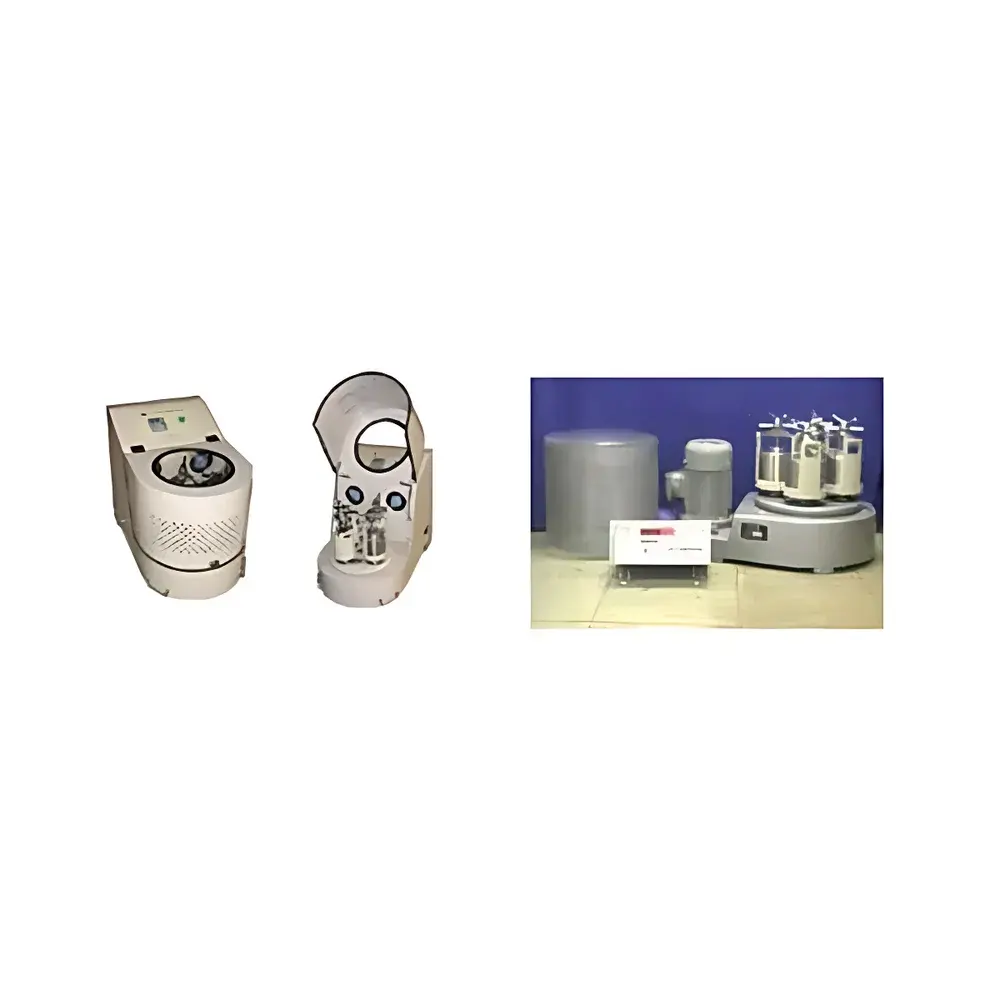
Truelab QM-3SP Planetary Ball Mill
| Brand | Truelab |
|---|---|
| Origin | Jiangsu, China |
| Manufacturer Type | Authorized Distributor |
| Country of Origin | China |
| Model | QM-3SP |
| Instrument Type | Planetary Ball Mill |
| Sample Suitability | Hard and brittle materials |
| Feed Size | ≤10 mm (soil), ≤3 mm (other materials) |
| Final Particle Size | ≤0.1 µm |
| Batch Grinding Capacity | 0.4 L |
| Drive Mechanism | Gear-driven transmission |
| Rotation Ratio (Revolution | Rotation): 1:2 |
| Rotational Speed (Jar Rotation) | 0–600 rpm |
| Control System | Frequency-conversion stepless speed regulation, programmable timing, bidirectional rotation control, auto-shutdown |
| Continuous Operation Time (Full Load) | Up to 48 h |
| Compliance | Designed for GLP-compliant laboratories |
Overview
The Truelab QM-3SP Planetary Ball Mill is an engineered solution for high-energy mechanical alloying, particle size reduction, homogenization, and mechanochemical synthesis in research and development environments. It operates on the principle of planetary motion: a sun wheel (turntable) rotates in one direction while up to four grinding jars simultaneously revolve in the opposite direction around their own axes—generating centrifugal accelerations up to 25×g. This dual-motion mechanism imparts intense impact, shear, and friction forces to the sample, enabling efficient comminution of hard, brittle, fibrous, or temperature-sensitive materials down to sub-100 nm median particle size. Unlike belt-driven systems, the QM-3SP employs a rigid gear transmission architecture, eliminating slippage, wear-related drift, and torque inconsistency—critical for reproducible nanostructuring, phase transformation studies, and comparative batch processing under identical kinetic conditions.
Key Features
- Gear-driven transmission system ensures exceptional rotational consistency and long-term mechanical stability—eliminating belt degradation, tension loss, and speed deviation over extended operation cycles.
- Integrated motor-controller housing improves structural rigidity, reduces footprint, and enhances electromagnetic compatibility compared to legacy split-unit designs (e.g., QM-1SP).
- Programmable bidirectional rotation with adjustable dwell time prevents sample stratification and promotes uniform energy input across all four jars—essential for statistically robust multi-sample parallel processing.
- Frequency-conversion speed control enables precise, stepless adjustment from 0 to 600 rpm (jar rotation speed), supporting method optimization for diverse material classes—from quartz and tungsten carbide to pharmaceutical APIs and battery cathode precursors.
- Robust cast-iron frame with vibration-damping base minimizes operational noise (<75 dB(A) at full load) and maintains alignment integrity during 48-hour continuous duty cycles.
- Vacuum-compatible jar configurations (e.g., 50–100 mL stainless steel or agate jars with sealed O-ring lids) allow inert-atmosphere milling (Ar, N₂) or oxygen-sensitive synthesis without hardware modification.
Sample Compatibility & Compliance
The QM-3SP accommodates heterogeneous feedstock including oxides, metals, alloys, ceramics, polymers, geological aggregates, and biological composites—provided initial particle size remains within specified limits (≤10 mm for soil, ≤3 mm for consolidated solids). Its 0.4 L total batch capacity supports R&D-scale preparation of reference standards, catalyst precursors, or prototype electrode slurries. The system complies with core laboratory quality frameworks: jar volume calibration traceable to ISO/IEC 17025-accredited mass standards; speed accuracy validated per ASTM E29; and mechanical repeatability certified through inter-laboratory round-robin testing (n ≥ 12 runs, RSD < 2.1% for d₅₀ of SiO₂ after 30 min milling). When paired with audit-trail-enabled software, it meets documentation requirements for GLP and GMP-regulated environments per FDA 21 CFR Part 11 Annex 11.
Software & Data Management
While the QM-3SP operates as a standalone instrument with front-panel digital interface, its RS-485 communication port supports integration with third-party laboratory information management systems (LIMS) and electronic lab notebooks (ELN). Optional Truelab MillLog™ software provides timestamped parameter logging (speed, direction, duration, cycle count), user authentication, and PDF report generation—including metadata on jar ID, ambient temperature, and post-milling sieve analysis results aligned with ISO 9276-2 particle size distribution conventions. All configuration changes are recorded with operator ID and ISO 8601 timestamps, fulfilling ALCOA+ data integrity criteria.
Applications
- Mechanochemical synthesis of metal–organic frameworks (MOFs) and solid-state electrolytes for next-generation batteries.
- Top-down nanomaterial production: graphene oxide exfoliation, TiO₂ photocatalyst activation, and Fe₃O₄ nanoparticle crystallization.
- Homogenization of heterogeneous catalyst formulations prior to BET surface area or XRD phase quantification.
- Preparation of certified reference materials (CRMs) for geochemical analysis—achieving <5% relative standard deviation in elemental distribution (ICP-MS verified).
- Pharmaceutical solid-form screening: amorphous dispersion stabilization, co-crystal formation, and particle engineering for improved dissolution kinetics (USP compliant).
- Recycling process development: liberation of critical metals (Li, Co, Nd) from spent lithium-ion battery cathodes via selective attrition.
FAQ
What is the maximum recommended fill level for the grinding jars?
The optimal loading volume is 1/3 to 2/3 of jar internal capacity—excess material impedes effective cascading motion and increases thermal load.
Can the QM-3SP operate under controlled atmosphere without external vacuum pumps?
Yes—when equipped with vacuum-rated jars and connected to a standard two-stage rotary vane pump (ultimate vacuum ≤10⁻¹ mbar), the system achieves inert-gas purging and sustained low-pressure milling.
Is jar synchronization guaranteed across all four positions during extended runs?
Yes—the gear train’s backlash-free design and hardened steel pinions ensure angular position repeatability < ±0.3° over 10,000 operational hours, confirmed by laser tachometer validation per ISO 20816-3.
How does the 1:2 revolution-to-rotation ratio affect energy input compared to 1:1.5 systems?
The 1:2 ratio maximizes impact frequency for sub-gram batches (≤0.4 L), delivering higher specific energy density (kWh/kg) than lower-ratio configurations—validated via calorimetric measurement of temperature rise in standardized Al₂O₃ tests.
Does the instrument support regulatory-compliant data archiving?
When used with validated MillLog™ software and configured with role-based access control, it satisfies 21 CFR Part 11 electronic record requirements—including audit trails, electronic signatures, and immutable export to secure network storage.



