
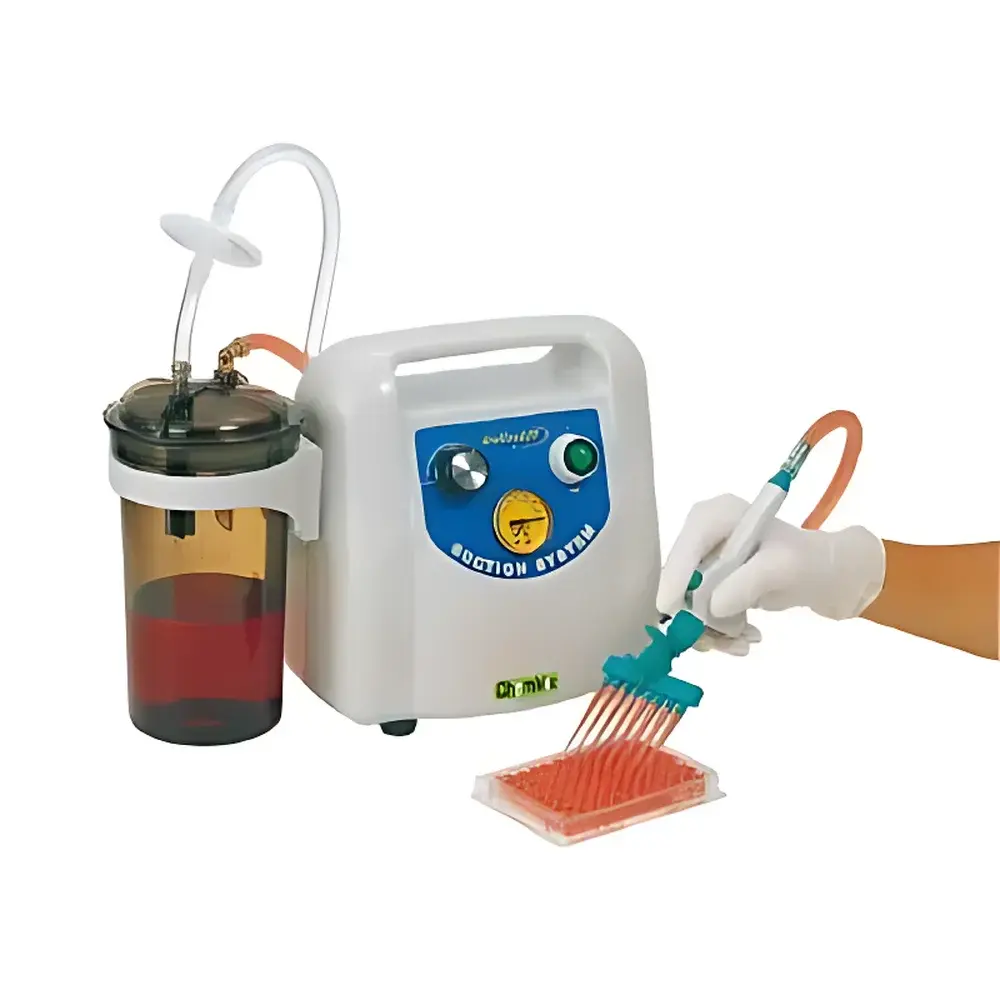
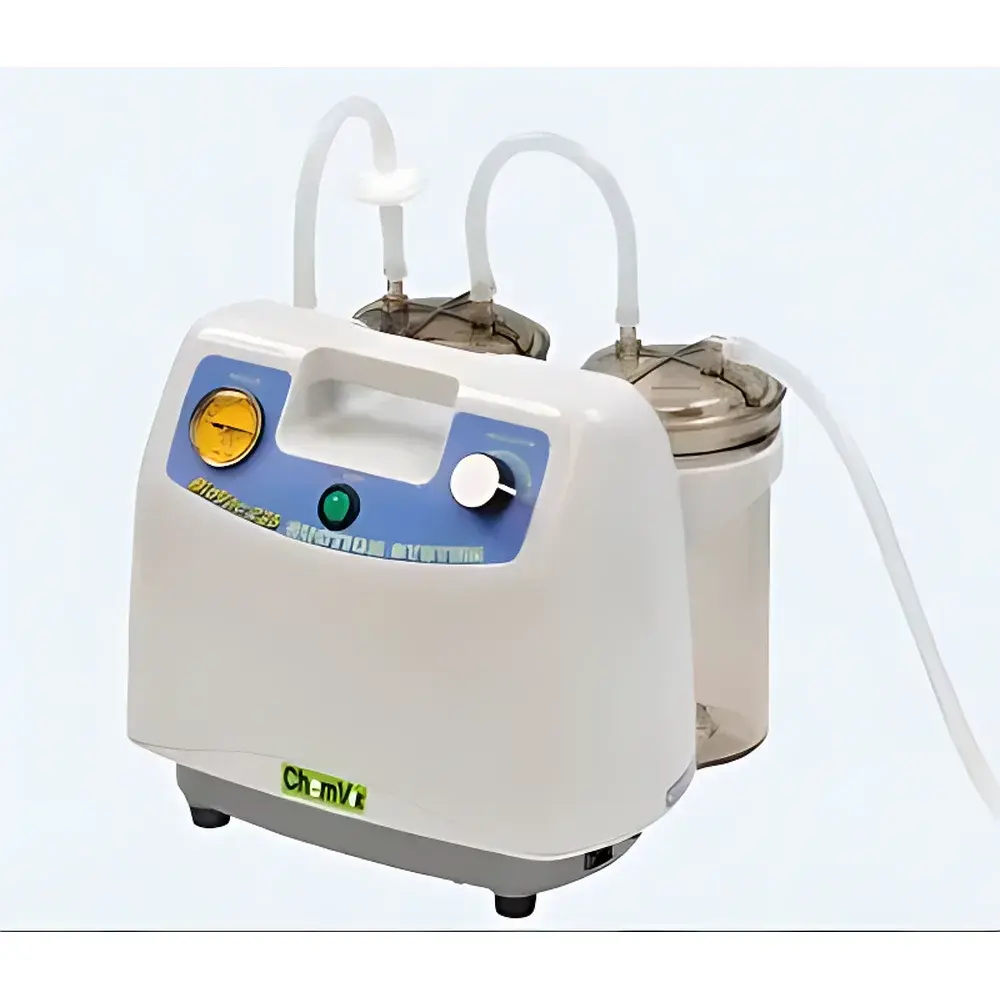
ChemVak BioVac 225 / BioVac 240 Portable Waste Aspiration System
| Brand | ChemVak |
|---|---|
| Origin | Germany |
| Pump Type | Diaphragm (BioVac 225) / Piston (BioVac 240) |
| Oil-Free Design | Yes |
| Ultimate Vacuum | 680 mmHg (BioVac 225) / 700 mmHg (BioVac 240) |
| Flow Rate | 25 L/min (BioVac 225) / 40 L/min (BioVac 240) |
| Motor Power | 25 W (BioVac 225) / 200 W (BioVac 240) |
| Dimensions (W×D×H) | 37×15×25 cm (BioVac 225) / 54×26×35 cm (BioVac 240) |
| Weight | 4.3 kg (BioVac 225) / 12 kg (BioVac 240) |
| Filtration | 0.2 µm disc filter |
| Sterilization | Autoclavable bottle and filter |
| Safety Certifications | CE compliant |
| Foot Switch | Included (BioVac 240 only) |
Overview
The ChemVak BioVac 225 and BioVac 240 are compact, oil-free portable waste aspiration systems engineered for reliable, low-maintenance fluid removal in biosafety cabinets, laminar flow hoods, and general laboratory workstations. Designed to meet the stringent demands of life science and clinical laboratories, these units operate on distinct vacuum generation principles: the BioVac 225 utilizes a maintenance-free diaphragm pump, while the BioVac 240 employs a robust piston pump architecture—delivering higher flow rates and deeper ultimate vacuum for demanding applications such as high-volume media aspiration or viscous sample handling. Both models eliminate hydrocarbon contamination risks associated with oil-lubricated pumps, ensuring compliance with ISO 14644 cleanroom compatibility requirements and supporting GLP/GMP workflows where trace solvent or oil residue must be avoided. The integrated dual-protection system—comprising a buoyant float valve inside the autoclavable collection bottle and an inline 0.2 µm hydrophobic disc filter—prevents liquid ingress into the pump chamber, significantly extending service life and reducing unplanned downtime.
Key Features
- Oil-free diaphragm (BioVac 225) and piston (BioVac 240) vacuum technologies — no lubricants, no oil changes, no vapor emissions
- Dual-stage liquid ingress protection: mechanical float shutoff + certified 0.2 µm PTFE membrane filter
- Full autoclave compatibility: collection bottles and filter housings withstand standard 121 °C, 20 min steam sterilization cycles (EN 285)
- Chemically resistant ABS housing — lightweight (4.3–12 kg), impact-resistant, non-porous, and easy to decontaminate with ethanol or 0.5% sodium hypochlorite
- Integrated cable management compartment and ergonomic handheld controller with intuitive tactile feedback
- BioVac 240 includes foot switch for hands-free operation — essential during sterile procedures requiring glove integrity
- CE-marked per Directive 2014/30/EU (EMC) and 2014/35/EU (LVD); RoHS-compliant construction
Sample Compatibility & Compliance
The BioVac systems are validated for aspiration of aqueous buffers, cell culture media, centrifugation supernatants, enzymatic digests, and diluted disinfectants. They are not rated for organic solvents (e.g., acetone, chloroform), strong acids (pH 12), nor for radioactive or biohazardous aerosols without additional containment (e.g., HEPA-filtered exhaust). All wetted components—including tubing ports, bottle threads, and filter holders—are manufactured from USP Class VI-certified polymers. Device documentation supports audit readiness for ISO/IEC 17025-accredited labs and aligns with CLSI EP19-A2 guidance for verification of aspiration performance. Optional stainless-steel and polymer single- or eight-channel tips enable seamless integration with common pipette tip formats (including LTS and FT).
Software & Data Management
As standalone benchtop instruments, the BioVac 225 and 240 operate without embedded firmware or digital interfaces—ensuring electromagnetic stability in sensitive instrumentation environments (e.g., near NMR spectrometers or electron microscopes). No software installation, network connectivity, or data logging is required. This analog architecture eliminates cybersecurity vulnerabilities and satisfies FDA 21 CFR Part 11 requirements for “non-electronic record” devices. Maintenance logs, calibration intervals (per manufacturer-recommended annual visual inspection), and sterilization cycle records may be maintained manually in lab notebooks or LIMS-compatible spreadsheets—fully traceable under GLP audit protocols.
Applications
- Routine aspiration from Petri dishes, flasks, and multiwell plates during cell passaging and transfection workflows
- Removal of supernatant post-centrifugation in molecular biology and immunology labs
- Decontamination of biosafety cabinet surfaces using diluted bleach or ethanol solutions
- Supporting histology tissue processing — aspiration of xylene-alcohol transition baths (when used with compatible chemically resistant tubing)
- Field-deployable aspiration in mobile diagnostic units or BSL-2 satellite labs where plug-and-play reliability is critical
- Integration into automated liquid handling platforms via foot-switch triggered external control signals (BioVac 240 only)
FAQ
Can the BioVac 240 be used continuously for extended periods?
Yes—the piston pump is thermally protected and rated for continuous duty at ambient temperatures ≤35 °C; derating is recommended above this threshold.
Is the 0.2 µm filter sufficient for my biosafety level 2 (BSL-2) applications?
The hydrophobic PTFE disc filter prevents liquid passage but does not provide aerosol containment; use with a certified BSC or secondary vented enclosure is mandatory for BSL-2 pathogens.
What is the expected service life of the pump under normal lab usage?
Diaphragm pump (BioVac 225): ≥10,000 operating hours; piston pump (BioVac 240): ≥8,000 hours with periodic intake filter inspection every 6 months.
Are replacement bottles and filters supplied with traceable lot numbers?
Yes—each consumable kit carries a unique batch ID, CoA, and sterilization validation summary per EN ISO 11135 for ethylene oxide or EN ISO 17665 for steam.
Does ChemVak provide IQ/OQ documentation support?
Standard factory test reports are included; full qualification packages (including protocol templates and execution logs) are available upon request for regulated environments.



