
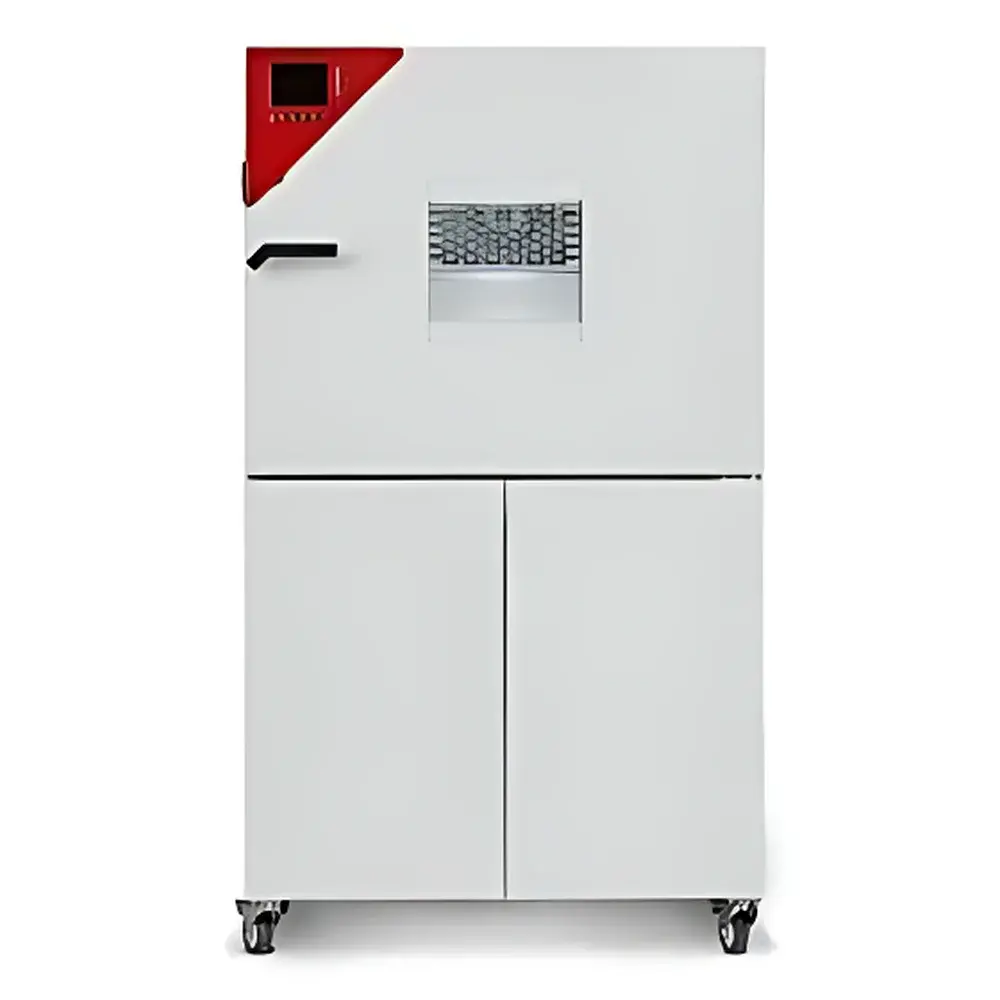
BINDER MKF115 / MK115 / MKT115 Environmental Simulation Chamber
| Brand | BINDER |
|---|---|
| Origin | Germany |
| Model | MKF115, MK115, MKT115 |
| Temperature Range | -70 °C to +180 °C |
| Thermal Shock Range | -70 °C to +180 °C |
| Temperature Stability | ±0.1 °C to ±0.6 °C |
| Heating Rate | 5.3 °C/min |
| Cooling Rate | 4.2 °C/min |
| Humidity Control (MKF/MKFT only) | 10–98 % RH |
| Integrated Water Reservoir | 20 L |
| Programmable Condensation Protection | Yes |
| APT.line™ Preheating Technology | Standard |
| MCS Controller with 4 Zero-Voltage Switch Outputs | Standard |
| Heated & LED-Illuminated Viewing Window | Standard |
Overview
The BINDER MKF115, MK115, and MKT115 environmental simulation chambers are precision-engineered thermal shock and climatic test systems designed for rigorous dynamic material evaluation under accelerated, reproducible conditions. These chambers operate on the principle of rapid, programmable temperature transition between extreme thermal boundaries—leveraging dual-circuit refrigeration (for MKT/MKFT models) and high-efficiency forced-air convection—to generate controlled thermal gradients across test specimens. The MKF series integrates humidity control (10–98 % RH) via an internal 20 L water reservoir and steam generator, while the MKT and MKFT variants extend low-temperature capability to -70 °C using cascade refrigeration. All models feature BINDER’s proprietary APT.line™ preheating technology, which ensures uniform temperature distribution (< ±0.6 °C deviation across chamber volume) even at full load and across the entire operating range (–70 °C to +180 °C). This architecture supports compliance with internationally recognized test standards including IEC 60068-2-14 (thermal shock), MIL-STD-810H Method 503.7, EN 60068-2-1/2/14, and ASTM D3418 for thermal transition performance validation.
Key Features
- APT.line™ preheating technology for exceptional temperature homogeneity and stability (±0.1 °C to ±0.6 °C) across full working volume
- Rapid thermal transition: heating rate up to 5.3 °C/min and cooling rate up to 4.2 °C/min (measured per IEC 60068-3-5)
- Three distinct platform families: MK (dry thermal cycling), MKF/MKFT (humidity-enabled), MKT/MKFT (ultra-low-temperature capable to –70 °C)
- MCS microprocessor controller with intuitive touchscreen interface, real-time data logging, and 4 configurable zero-voltage switch outputs for external device synchronization
- Heated, anti-fog viewing window with integrated LED illumination for continuous visual monitoring without thermal disturbance
- Programmable condensation protection algorithm to prevent moisture accumulation on sensitive samples during humidity transitions
- Robust stainless-steel inner chamber construction with seamless welding and corrosion-resistant exterior housing
- Compliance-ready architecture supporting audit trails, user-level access control, and optional 21 CFR Part 11–compliant software modules
Sample Compatibility & Compliance
The MKF115, MK115, and MKT115 accommodate a broad spectrum of sample geometries and materials—including polymer composites, aerospace alloys, printed circuit boards (PCBs), battery cells, automotive sensors, and medical device components—within their 115 L working volume. Chamber design conforms to ISO/IEC 17025 requirements for testing laboratory competence, and thermal performance is validated per VDI/VDE 2655 Part 2 (temperature uniformity and stability verification). Humidity control in MKF/MKFT models meets ISO 12479 and DIN EN ISO 6270-2 specifications for condensation resistance testing. All units are CE-marked and comply with electromagnetic compatibility (EMC) directives (2014/30/EU) and low-voltage safety standards (2014/35/EU). Optional qualification packages support IQ/OQ documentation aligned with GMP/GLP environments.
Software & Data Management
BINDER’s standard MCS controller provides local operation with up to 100 programmable test profiles, each supporting multi-segment ramp-soak cycles, humidity modulation, and trigger-based output activation. Data export is supported via USB or Ethernet (Modbus TCP/IP) in CSV or XML format. For enterprise integration, optional BINDER CLOUD Connect enables remote monitoring, alarm notification via email/SMS, and secure cloud-based data archival. Advanced users may deploy BINDER’s optional Validation Package, which includes electronic signatures, change management logs, and 21 CFR Part 11–compliant audit trail generation—fully traceable to individual operator, timestamp, parameter modification, and system event.
Applications
- Aerospace component qualification per RTCA DO-160 Section 4 (temperature shock) and SAE AS4792
- Automotive electronics stress screening (AEC-Q200, GMW3172)
- Lithium-ion battery thermal runaway propagation studies under combined thermal-humidity stress
- Accelerated aging of optical coatings, adhesives, and encapsulants per IPC-9701
- Reliability assessment of semiconductor packaging (JEDEC JESD22-A104, JESD22-A106)
- Pharmaceutical primary packaging stability per ICH Q1A(R2) and USP
- Validation of hermetic seal integrity in MEMS devices under cyclic dew-point stress
FAQ
What distinguishes the MKF115 from the MKT115?
The MKF115 integrates humidity control (10–98 % RH) and operates from –40 °C to +180 °C, whereas the MKT115 extends the low-temperature limit to –70 °C using a cascade refrigeration system but does not include humidity control.
Is APT.line™ technology validated per industry standards?
Yes—APT.line™ chamber geometry and airflow dynamics are verified per VDI/VDE 2655 Part 2, ensuring temperature uniformity ≤ ±0.6 °C across the full 115 L volume at any setpoint.
Can the MCS controller support automated pass/fail criteria?
While the base controller supports threshold-based alarms, advanced pass/fail logic requires integration with BINDER’s optional TestSuite software or third-party SCADA platforms via Modbus TCP/IP.
Are calibration certificates included with shipment?
Factory calibration reports (traceable to DAkkS-accredited standards) are provided; ISO/IEC 17025–accredited on-site calibration services are available as an add-on option.
What maintenance intervals are recommended for ultra-low-temperature operation?
For MKT/MKFT models operating regularly below –40 °C, compressor oil analysis and refrigerant charge verification are advised every 12 months, per BINDER Technical Bulletin TB-MKT-02.



