
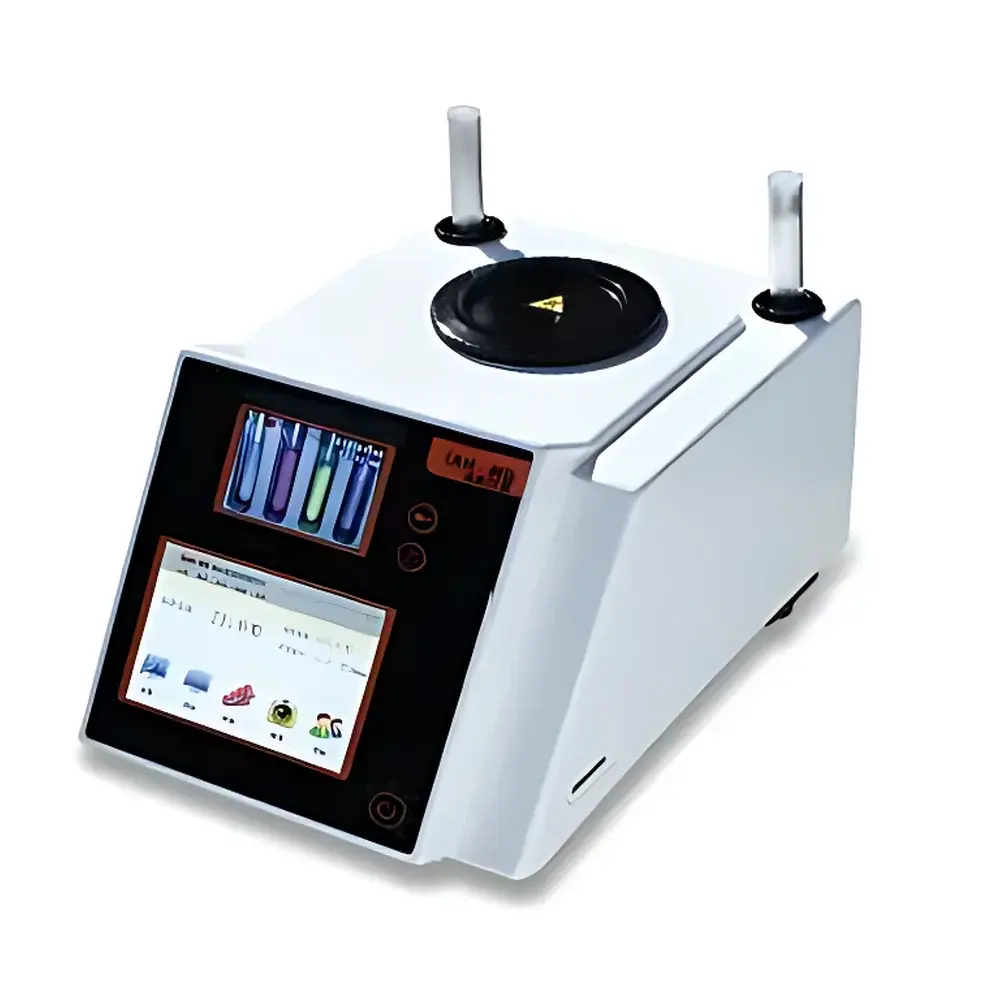
J70 Automated Video Melting Point Apparatus
| Origin | Shanghai, China |
|---|---|
| Manufacturer Type | Authorized Distributor |
| Origin Category | Domestic (PRC) |
| Model | J70 |
| Price Range | USD 7,000–14,000 |
| Temperature Range | Ambient to 350 °C |
| Heating Rate | 0.1–20 °C/min (200-step continuous adjustment) |
| Temperature Repeatability | ±0.1 °C at 0.1 °C/min |
| Temperature Accuracy | ±0.3 °C (<250 °C), ±0.5 °C (>250 °C) |
| Capillary Dimensions | OD 1.4 mm, ID 1.0 mm |
| Sample Capacity | 4 samples per run |
| Temperature Resolution | 0.1 °C |
| Data Storage | 8 GB internal flash |
| Image Storage | 400 frames |
| Video Recording | Yes (TFT-displayed real-time capture) |
| User Accounts | 8 configurable profiles |
| Display | TFT high-definition true-color LCD |
| Interface | USB, RS-232, Ethernet |
| Power | 220 V AC, 50 Hz, 120 W |
| Magnification | 7× optical |
Overview
The J70 Automated Video Melting Point Apparatus is an advanced thermal analysis instrument engineered for precise, reproducible, and visually documented determination of melting point and melting range (melting interval) of crystalline organic solids. Unlike conventional capillary-based analog instruments relying on subjective visual observation through ocular lenses, the J70 integrates high-resolution real-time video imaging with closed-loop PID temperature control and automated event detection. It operates on the fundamental principle of monitoring optical transmittance and morphological transition—specifically, the onset of crystal lattice disintegration and phase change from solid to liquid—as captured dynamically via a calibrated CCD camera system aligned coaxially with the heated capillary stage. This approach eliminates observer bias, enhances traceability, and supports objective endpoint identification in compliance with pharmacopeial standards including USP <741>, EP 2.2.17, and JP 2.60.
Key Features
- Real-time HD video acquisition (7× optical magnification) with on-device image capture and playback capability—enabling retrospective verification of melt onset and completion without reliance on operator timing.
- Simultaneous four-sample processing with independent thermal profiling per position, significantly improving throughput in QC laboratories handling batch-release testing.
- Fully automated measurement sequence: auto-heating, real-time video recording, dynamic frame-by-frame analysis for initial melt (onset) and complete liquefaction (offset), and automatic report generation.
- Ultra-fine heating rate control across 200 discrete steps from 0.1 to 20 °C/min, allowing method optimization for thermally sensitive or polymorphic compounds.
- High-stability platinum resistance thermometer (PRT) sensor and dual-zone furnace architecture ensure ±0.1 °C repeatability under standardized ramp conditions (0.1 °C/min) and certified accuracy per ISO/IEC 17025 calibration protocols.
- TFT full-color touchscreen interface with intuitive workflow navigation, multilingual OS support (English, Chinese, Spanish), and secure user role management (8 configurable accounts with password protection).
Sample Compatibility & Compliance
The J70 accommodates standard thin-walled capillaries (OD 1.4 mm, ID 1.0 mm), compatible with both powdered and compacted solid samples—including irregular granules, pressed pellets, and small crystalline fragments. Optional accessories enable evaluation of semi-solid or low-viscosity melts using specialized sample holders. The system meets essential regulatory requirements for GMP/GLP environments: audit-trail-enabled data logging (time-stamped, user-ID-tagged), encrypted local storage (8 GB), and export-ready reports in PDF and CSV formats. All thermal calibrations are traceable to NIST-certified reference standards (e.g., indium, tin, lead). Instrument validation documentation supports IQ/OQ/PQ execution per FDA 21 CFR Part 11 and EU Annex 11 guidelines.
Software & Data Management
Built-in embedded firmware provides standalone operation without external PC dependency. Measurement data—including raw video clips (H.264), thermal curves, annotated still frames, and calculated melting parameters—is stored locally with timestamp, operator ID, method name, and environmental metadata. USB and Ethernet interfaces allow secure transfer to LIMS or ELN systems; RS-232 supports legacy integration with laboratory automation platforms. The reporting engine generates compliant summaries showing onset temperature, offset temperature, melting range, heating rate, and pass/fail status against user-defined specification limits. Data integrity safeguards include write-once storage mode, tamper-evident file hashing, and session-level access control.
Applications
The J70 serves critical roles across pharmaceutical development (API purity assessment, polymorph screening, stability-indicating assays), fine chemical synthesis (reaction endpoint confirmation, intermediate qualification), food science (fat melting behavior, cocoa butter equivalence), and academic research (thermodynamic characterization of metal-organic frameworks, ionic liquids, and chiral resolution studies). Its robustness and precision make it suitable for routine QC release testing in contract manufacturing organizations (CMOs), national metrology institutes, and university core facilities—validated by long-term deployment at institutions including the Shanghai Institute of Organic Chemistry (CAS), Shanghai Institute of Materia Medica (CAS), and Hong Kong Chinese University.
FAQ
Does the J70 support ASTM E324 or ISO 6179 methodologies?
Yes—the instrument’s heating profile fidelity, temperature accuracy, and automated endpoint detection align with the procedural requirements of ASTM E324 (Standard Test Method for Melting Range of Organic Compounds) and ISO 6179 (Determination of Melting Point of Organic Crystalline Substances).
Can video recordings be exported and archived externally?
Yes—recordings are saved in H.264 MP4 format and can be retrieved via USB drive or network share; metadata (date, time, user, method) is embedded in file properties.
Is calibration certificate included with shipment?
A factory calibration report (traceable to national standards) is provided; optional UKAS-accredited calibration service is available upon request.
What maintenance is required for long-term accuracy?
Annual verification using certified reference materials (e.g., pure indium, 114.2 °C) is recommended; optical path cleaning and capillary stage inspection should be performed quarterly per SOP.
Does the system comply with 21 CFR Part 11 for electronic records?
While the base firmware supports ALCOA+ principles (Attributable, Legible, Contemporaneous, Original, Accurate), full Part 11 compliance requires configuration of electronic signatures and audit trail activation—both supported in v2.3+ firmware with validated installation packages.



