
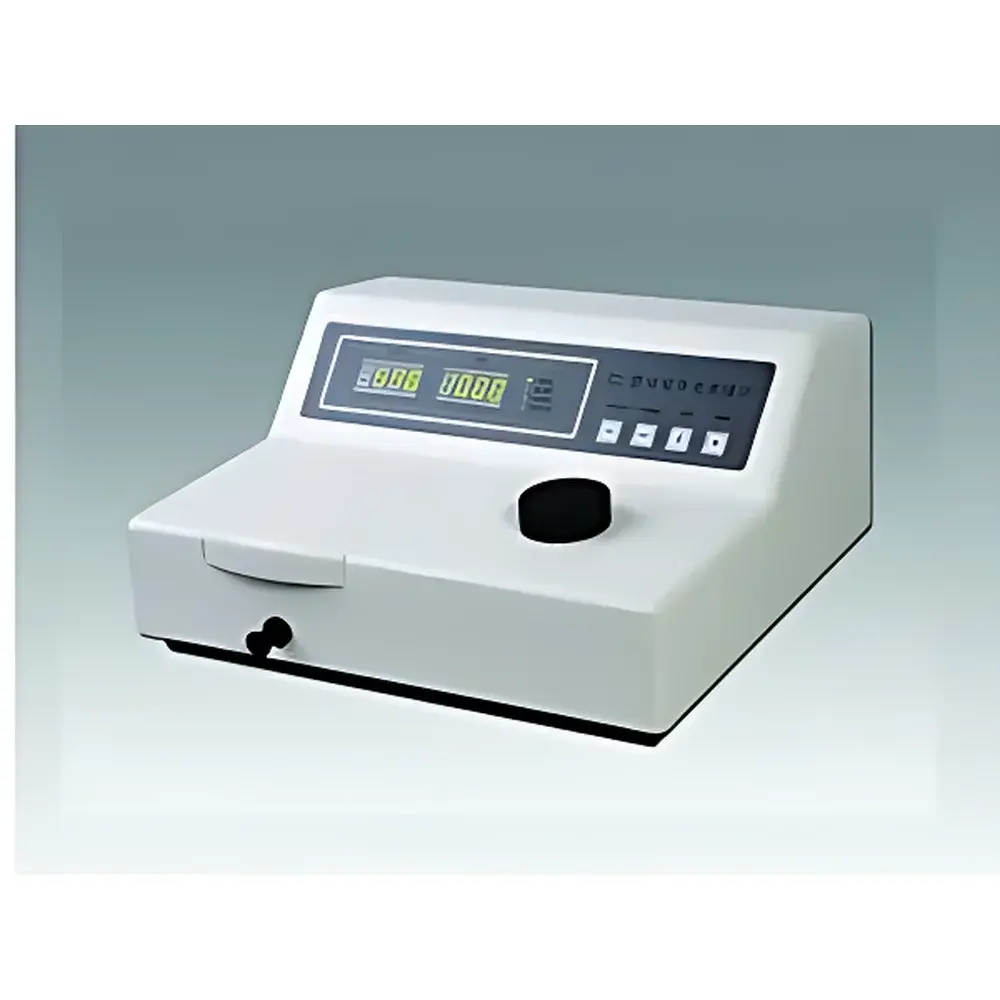
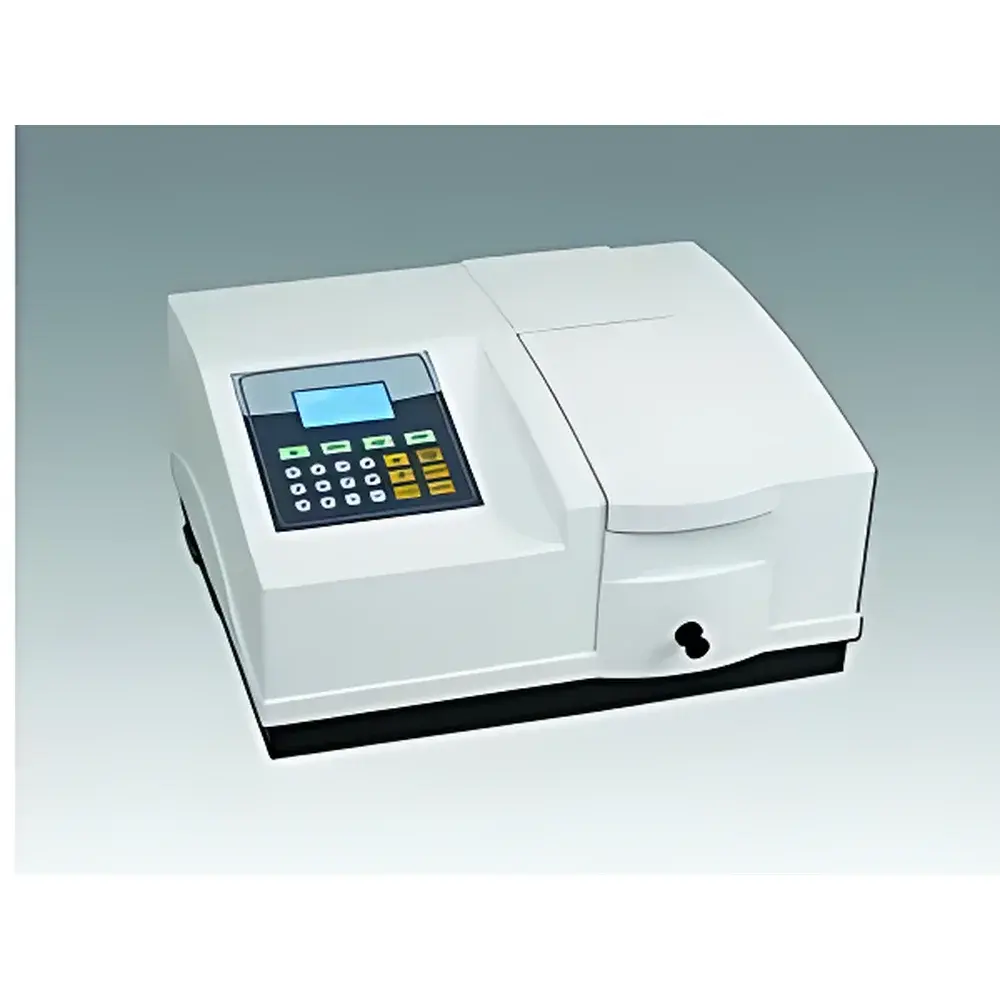
SOPOTOP 721 / 722 / 7230G / 723PC Visible Spectrophotometers
| Brand | SOPOTOP |
|---|---|
| Origin | Shanghai, China |
| Model Series | 721, 722, 7230G, 723PC |
| Optical System | Dual-beam |
| Detector Type | Photodiode Array |
| Wavelength Range | 325–1100 nm (model-dependent) |
| Spectral Bandwidth | 2–5 nm |
| Wavelength Accuracy | ±1.0 nm (7230G & 723PC), ±2.0 nm (721 & 722) |
| Wavelength Repeatability | 0.5–1.0 nm |
| Stray Light | ≤0.2%T at 360 nm (723PC) to ≤0.5%T at 360 nm (721) |
| Photometric Accuracy | ±0.5%T (722/7230G/723PC), ±1.0%T (721) |
| Photometric Repeatability | ±0.2%T (722/7230G/723PC), ±0.5%T (721) |
| Baseline Linearity | ±0.004A (723PC only) |
| Stability | ±0.003A/h (7230G & 723PC), ±0.5%T/5min (721 & 722) |
| Display | 128×64 LCD |
| Dimensions | 456 × 375 × 220 mm |
Overview
The SOPOTOP 721, 722, 7230G, and 723PC visible spectrophotometers are benchtop dual-beam instruments engineered for precise quantitative analysis in the visible and near-UV spectral range (325–1100 nm). Based on classical absorption photometry principles—governed by the Beer–Lambert law—these systems measure transmittance (T%), absorbance (A), concentration (C), and factor (F) with calibrated optical paths and stabilized light sources. The dual-beam architecture compensates for source drift and detector sensitivity fluctuations in real time, ensuring high reproducibility across extended measurement sessions. Designed for routine laboratory use—not research-grade spectroscopy—the series delivers robust performance for teaching laboratories, quality control environments, and field-deployable analytical workflows where cost-efficiency, ease of operation, and regulatory traceability are prioritized over ultra-high resolution or scanning flexibility.
Key Features
- Dual-beam optical design with real-time reference beam compensation for enhanced photometric stability
- Photodiode array (PDA) detection enabling rapid single-shot spectral acquisition without mechanical scanning
- Wavelength programmability with step intervals as fine as 0.1 nm (7230G and 723PC models)
- Integrated 128×64 dot-matrix LCD display supporting simultaneous readout of multiple photometric modes (T%, A, C, F)
- Onboard wavelength auto-calibration function (7230G and 723PC) using internal holmium oxide or didymium filters per ISO 17025-recommended practices
- Modular firmware architecture allowing future calibration file updates and protocol expansion via USB interface
- Compact footprint (456 × 375 × 220 mm) optimized for shared lab benches and mobile analytical carts
Sample Compatibility & Compliance
These spectrophotometers accept standard 10-mm pathlength cuvettes (glass, quartz, or plastic) and support both liquid and semi-solid sample formats—including suspensions and colloidal dispersions—within defined turbidity limits. All models comply with basic electromagnetic compatibility (EMC) requirements per IEC 61326-1 and safety standards per IEC 61010-1. While not certified for GMP or GLP-regulated production environments, the 7230G and 723PC variants include audit-trail-capable firmware logging (time-stamped measurements, user ID, wavelength settings, and calibration events), aligning with FDA 21 CFR Part 11 data integrity expectations for non-critical QC applications. Instrument validation documentation—including factory-installed wavelength and photometric accuracy certificates—is provided with each unit and conforms to ASTM E275 and ISO 6060 guidelines for visible spectrophotometer verification.
Software & Data Management
The 723PC model supports optional PC connectivity via RS-232 or USB-to-serial adapter, enabling direct data export to CSV or Excel-compatible formats. SOPOTOP’s proprietary SpectraView Lite software (Windows 10/11 compatible) provides batch measurement logging, calibration curve generation (linear, quadratic, and polynomial regression), and limit-checking alerts for out-of-spec results. All models store up to 200 measurement records internally; the 7230G and 723PC retain calibration history and user-defined method parameters. No cloud synchronization or remote access functionality is implemented—consistent with institutional IT security policies governing analytical instrumentation in academic and industrial labs.
Applications
- Educational instruction in analytical chemistry, biochemistry, and environmental science curricula
- Raw material verification and finished-product release testing in food, beverage, and pharmaceutical manufacturing (non-sterile, non-potent compounds)
- Water quality monitoring (e.g., nitrate, phosphate, iron, and manganese quantification per APHA Standard Methods)
- Enzyme kinetics assays (e.g., NADH/NADPH oxidation at 340 nm) and protein concentration determination (Bradford/Lowry at 595/750 nm)
- Colorimetric analysis in textile dyeing, paint formulation, and agricultural soil extract testing
- Basic spectral profiling of dyes, pigments, and plant extracts in botanical research labs
FAQ
What is the difference between the 721, 722, 7230G, and 723PC models?
The primary distinctions lie in spectral bandwidth (5 nm → 2 nm), wavelength accuracy (±2.0 nm → ±1.0 nm), stray light performance (≤0.5%T → ≤0.2%T), baseline linearity capability (absent → ±0.004A), and data management features (standalone → PC-connected with method storage).
Are these instruments suitable for UV-range measurements below 325 nm?
No. These are strictly visible/near-UV spectrophotometers. For true UV–Vis work (190–1100 nm), a dedicated UV–Vis instrument with deuterium/tungsten dual-source optics and quartz optics is required.
Can I perform kinetic or multi-wavelength scanning with these units?
No. These are fixed-wavelength or manually stepped instruments. They do not support continuous spectral scanning or time-resolved kinetic mode.
Do they meet ISO/IEC 17025 calibration traceability requirements?
Yes—each unit ships with a factory calibration certificate referencing NIST-traceable standards for wavelength and photometric accuracy, satisfying Clause 6.4.10 of ISO/IEC 17025:2017 for equipment verification.
Is service and spare parts support available outside mainland China?
SOPOTOP authorizes select regional distributors in Southeast Asia, the Middle East, and Latin America for technical support and consumables supply; full-service contracts require local partnership registration.
Related Products





