
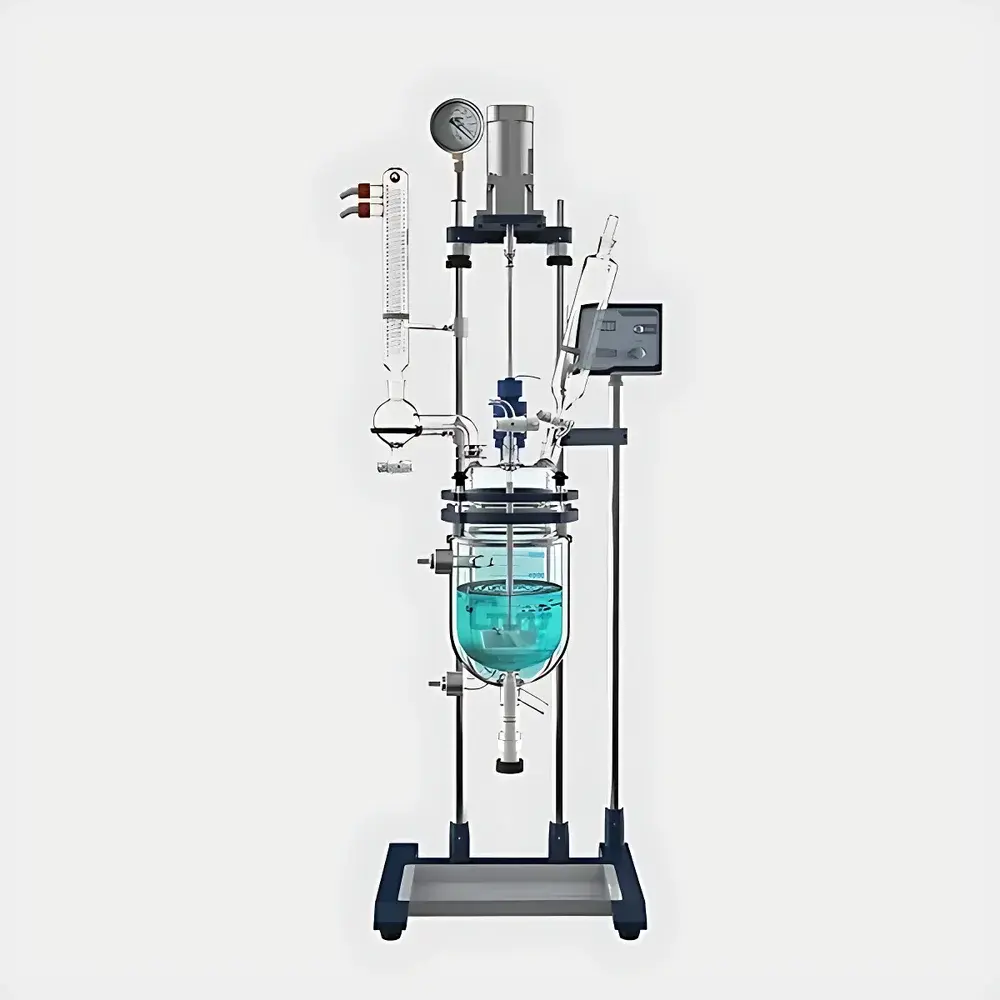
Truelab GR-5Ex Explosion-Proof Glass Reactor
| Brand | Truelab |
|---|---|
| Model | GR-5Ex |
| Capacity | 5 L |
| Material | Borosilicate Glass 3.3 |
| Max Working Pressure (Jacket) | ≤0.03 MPa |
| Vacuum Level | ≤0.03 MPa |
| Temperature Range | −80 °C to +200 °C |
| Stirring Speed | 50–500 rpm |
| Stirring Motor | Explosion-Proof Three-Phase Induction Motor |
| Power | 180 W |
| Sealing Type | Vacuum Mechanical Seal |
| Stirrer Shaft & Blades | 06Cr19Ni10 Stainless Steel with PTFE Cladding |
| Stirrer Geometry | Single-Layer Four-Blade Open Turbine |
| Temperature Sensor | PT100 (±0.1 °C accuracy) |
| Frame Material | 06Cr19Ni10 + Powder-Coated Carbon Steel + Anodized Aluminum |
| Overall Dimensions (W×D×H) | ~600 × 575 × 1600 mm |
| Net Weight | ~50 kg |
Overview
The Truelab GR-5Ex Explosion-Proof Glass Reactor is an engineered laboratory-scale reaction system designed for safe, transparent, and controllable synthesis, distillation, and concentration under moderate pressure and vacuum conditions. Built on the foundational principles of jacketed thermal management and magnetically or mechanically coupled agitation, this reactor employs a double-walled borosilicate glass 3.3 vessel—featuring high chemical inertness, exceptional thermal shock resistance (up to 80 °C ΔT), and optical clarity for real-time visual monitoring of phase behavior, precipitate formation, reflux dynamics, and emulsion stability. Its explosion-proof configuration complies with IEC 60079-0 and IEC 60079-1 standards for equipment used in potentially explosive atmospheres (Zone 1/2), making it suitable for handling flammable solvents (e.g., ether, acetone, THF, ethanol) and exothermic reactions where spark-free operation is mandatory. The reactor operates across a wide thermal envelope (−80 °C to +200 °C) via external circulator coupling to the jacket, while maintaining internal process pressures from full vacuum (≤−0.03 MPa gauge) up to ambient—enabling controlled solvent removal, low-boiling-point distillations, and inert-gas purged reactions.
Key Features
- Explosion-proof three-phase induction motor (180 W) certified per ATEX/IECEx directives, eliminating ignition risk during volatile solvent handling.
- Borosilicate glass 3.3 construction for all wetted parts—including main vessel, condenser, dropping funnel, and receiver interfaces—ensuring hydrolytic stability, low alkali leaching, and UV transparency.
- Vacuum-compatible mechanical seal with PTFE-stabilized stirrer shaft and four-blade open turbine impeller, delivering consistent shear profiles and minimal dead volume.
- Stress-relieved jacket inlet/outlet ports with stainless steel insulated flexible hoses (Rc 3/4), preventing thermal expansion-induced cracking at glass-metal junctions.
- Drain valve with φ21 mm PTFE-lined bore and zero-residue discharge geometry—critical for quantitative product recovery and cross-contamination prevention in multi-step syntheses.
- Modular five-port lid (50# central, two × 24/29, two × 29/32) supporting simultaneous addition, temperature sensing, condensation, gas sparging, and sampling without breaking vacuum or pressure integrity.
- Integrated PT100 sensor with ±0.1 °C digital readout and 0.1 °C resolution, mounted directly in the reaction headspace for representative bulk-phase temperature feedback.
Sample Compatibility & Compliance
The GR-5Ex supports a broad range of organic, inorganic, and organometallic reaction systems—including Grignard formations, lithium–halogen exchanges, hydrogenations (with catalyst slurries), esterifications, polymerizations, and enzymatic transformations. Its chemically resistant wetted path accommodates aggressive reagents such as concentrated acids (H₂SO₄, HCl), bases (NaOH, KOH), halogenated solvents (CH₂Cl₂, CHCl₃), and peroxides. All glass components meet ASTM E438 Type I, Class A specifications for laboratory glassware. The explosion-proof motor and control circuitry conform to IEC 60079-0 (general requirements) and IEC 60079-1 (flameproof enclosure “d” protection). Structural design follows ISO 7208 for glass apparatus safety margins under thermal cycling and vacuum loading. Documentation includes full EC Declaration of Conformity and traceable material certifications for borosilicate glass and stainless-steel components.
Software & Data Management
While the GR-5Ex operates as a stand-alone analog/digital hybrid instrument, its PT100 output and motor speed signal (0–10 V DC or 4–20 mA) are compatible with third-party data acquisition systems (e.g., LabVIEW, DeltaV, or custom SCADA platforms) for time-synchronized logging of temperature, agitation rate, and vacuum level. Optional RS485 Modbus RTU interface enables integration into centralized lab automation networks compliant with ISA-88 and ISA-95 frameworks. All digital displays retain audit trail-capable firmware—supporting GLP-aligned recordkeeping when paired with timestamped external logging. No proprietary software is required; calibration certificates for PT100 and tachometer are provided with NIST-traceable references.
Applications
- Process development of API intermediates under controlled exotherm conditions in non-GMP research labs.
- Vacuum-assisted fractional distillation of heat-sensitive natural product extracts.
- Catalytic hydrogenation screening using Pd/C or Raney Ni under nitrogen or hydrogen blanket.
- Multi-stage sequential addition protocols requiring precise stoichiometric control and real-time visual endpoint detection.
- Photochemical reactions utilizing the reactor’s UV-transparent glass body with external LED or mercury lamp coupling.
- Teaching laboratories demonstrating reaction kinetics, equilibrium shifts, and mass transfer limitations in undergraduate organic chemistry curricula.
FAQ
What is the maximum allowable jacket pressure for thermal fluid circulation?
The夹套 (jacket) is rated for ≤0.03 MPa (30 kPa) gauge pressure—sufficient for standard silicone oil or glycol-based circulators operating below 200 °C.
Can the reactor be used for hydrogenation with H₂ gas at elevated pressure?
No. The GR-5Ex is designed for vacuum-to-atmospheric internal pressure only. For pressurized hydrogenation (>0.1 MPa), a dedicated stainless-steel autoclave with ASME Section VIII certification is required.
Is the mechanical seal maintenance-free over its service life?
The vacuum-rated mechanical seal requires periodic inspection every 500 operational hours; PTFE stator and graphite rotor components are field-replaceable using standard tools and OEM spare kits.
Does the system support GLP-compliant electronic records?
Yes—when interfaced with validated external DAQ hardware and 21 CFR Part 11–compliant software, all process parameters (temperature, speed, time stamp) can be archived with user authentication and electronic signature capability.
What cold trap configuration is recommended for high-vacuum distillations?
A separate liquid nitrogen-cooled cold trap (−196 °C) with DN25/KF25 interface should be installed between the reactor’s vacuum port and the vacuum pump to prevent solvent vapor ingress and oil contamination.
Related Products



