
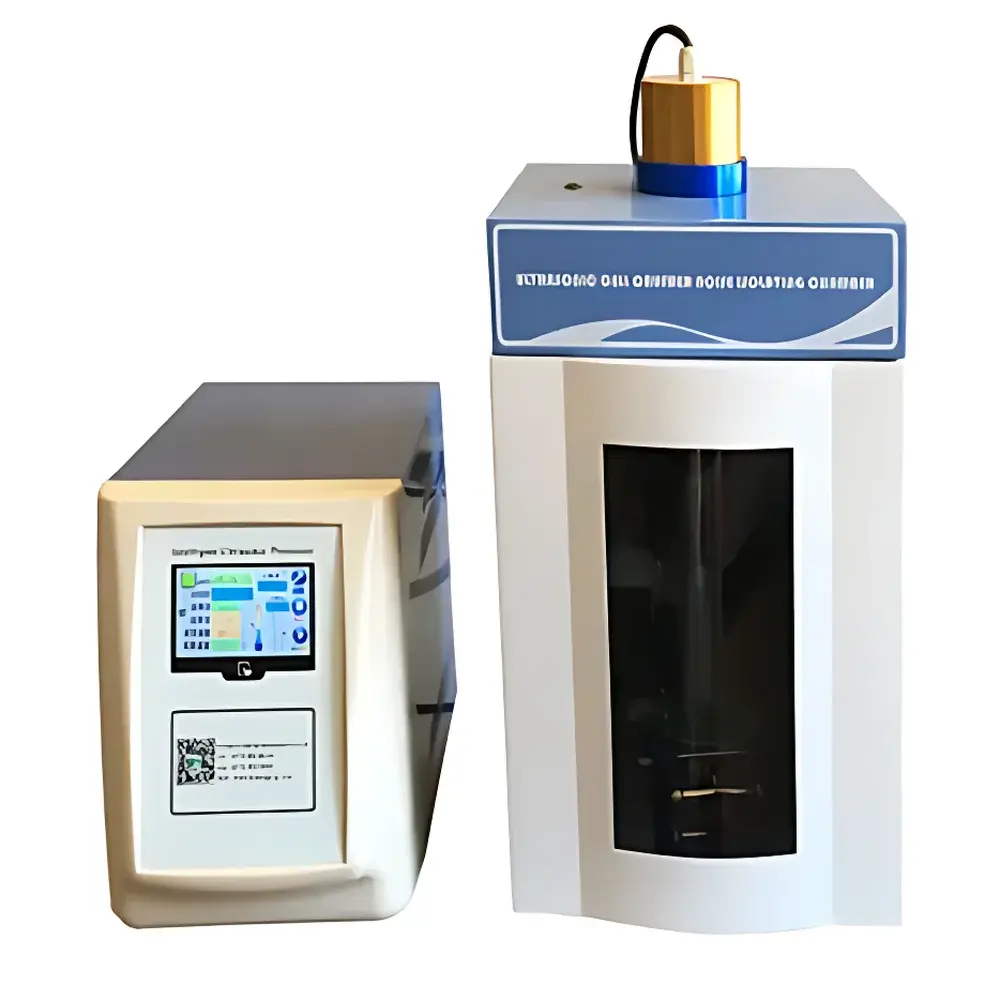
Truelab 1000N Advanced Ultrasonic Homogenizer
| Brand | Truelab |
|---|---|
| Origin | Shanghai, China |
| Model | 1000N |
| Power Range | 10–1000 W (continuously adjustable) |
| Sample Volume Capacity | 0.1–700 mL (with optional probes) |
| Frequency Range | 20–25 kHz |
| Display | 4.3-inch TFT touch screen |
| Ultrasonic Pulse Duration | 0.1–99.9 s |
| Interval Time | 0.1–99.9 s |
| Total Processing Time | 1 s–99 h 59 min 59 s |
| Temperature Monitoring Range | 0–100 °C (optional cryogenic cooling cup available) |
| Probe Options | Φ2, Φ3, Φ6, Φ10, Φ12, Φ15, Φ20, Φ22, Φ25 mm |
| Data Storage | 20 protocols |
| Dimensions (H×W×D) | 290×225×410 mm |
| Net Weight (incl. soundproof chamber) | 26 kg |
| Soundproof Chamber Dimensions | 450×280×280 mm |
| Input Voltage | 220 V / 110 V, 50 / 60 Hz |
| Safety Alarms | Overtemperature, overtime, overload, no-load, probe fault |
Overview
The Truelab 1000N Advanced Ultrasonic Homogenizer is a high-performance laboratory instrument engineered for precise cell disruption, emulsification, dispersion, and extraction via controlled acoustic cavitation. Operating on the principle of piezoelectric transduction, it converts electrical energy into high-frequency mechanical vibrations (20–25 kHz), generating transient microbubbles in liquid media that collapse violently—producing localized shear forces, microstreaming, and extreme transient temperatures (>5,000 K) and pressures (>1,000 atm). This physical mechanism enables efficient lysis of prokaryotic and eukaryotic cells—including bacteria, yeast, plant tissues, mammalian cells, and viral particles—without chemical additives or thermal degradation. Designed for reproducible, scalable sample preparation, the system supports both benchtop and regulated lab environments where traceability, parameter control, and process consistency are critical.
Key Features
- Full digital control via 4.3-inch TFT capacitive touch screen with intuitive icon-based navigation and real-time parameter feedback
- Microprocessor-regulated frequency tracking ensures stable resonance across probe types and load conditions
- Programmable pulse mode (ultrasonic ON/OFF cycles) minimizes thermal accumulation during sensitive biological processing
- Integrated temperature sensor with continuous display and configurable overtemperature alarm (0–100 °C range)
- 20-user-storable protocols with timestamped execution logs for audit-ready operation
- Modular probe architecture supporting nine standardized titanium alloy sonotrodes (Φ2 to Φ25 mm) for volume- and viscosity-matched applications
- Dual-layer soundproof chamber with acoustic foam lining and tempered glass front panel for operator safety and visual monitoring
- Motorized height-adjustable sample platform for rapid probe immersion depth optimization
- Comprehensive fault diagnostics: automatic detection and audible/visual alerts for no-load operation, probe detachment, power surge, and thermal excursion
Sample Compatibility & Compliance
The Truelab 1000N accommodates aqueous, organic, and mixed-phase samples across diverse viscosities and particulate loads. It is routinely employed in ISO 17025-accredited labs for nucleic acid isolation, protein solubilization, nanoparticle dispersion, and liposome formation. While not certified to IEC 61000-4 or UL 61010-1 as a standalone unit, its electrical architecture complies with CE marking requirements for laboratory equipment (2014/30/EU EMC Directive and 2014/35/EU LVD). When operated under documented SOPs—including probe calibration verification, temperature logging, and cycle validation—the instrument supports GLP-compliant workflows. Optional accessories such as PTFE-coated probes and sterilizable stainless-steel cooling cups facilitate USP analytical instrument qualification (AIQ) and FDA 21 CFR Part 11–aligned electronic record integrity when integrated with validated LIMS platforms.
Software & Data Management
No proprietary PC software is bundled; however, all operational parameters—including amplitude (%), pulse duration, interval time, total runtime, and real-time temperature—are logged internally and exportable via USB flash drive in CSV format. Timestamped protocol records include operator ID field (manually entered), start/stop timestamps, and alarm event flags. The system supports manual entry of sample IDs and batch numbers directly on the touchscreen interface. For laboratories requiring automated data capture, the RS-232 serial port (standard) enables integration with third-party SCADA or ELN systems using ASCII command protocol (AT+ commands), allowing remote start/stop, status polling, and error code retrieval without driver installation.
Applications
- Cell lysis for genomic DNA, plasmid, and total RNA extraction from Gram-negative/positive bacteria, fungi, cultured mammalian cells, and plant leaf tissue
- Preparation of subcellular fractions (e.g., mitochondrial isolation) via differential sonication intensity and duration
- Homogenization of tissue biopsies for proteomic analysis and immunoassay sample prep
- Emulsification of oil-in-water and water-in-oil systems for pharmaceutical nanoemulsions and cosmetic formulations
- Dispersion of carbon nanotubes, graphene oxide, and metal oxide nanoparticles in polymer matrices
- Accelerated solvent extraction (ASE) of phytochemicals and environmental contaminants from solid matrices
- Inactivation of enzymatic activity during sample stabilization prior to HPLC or LC-MS analysis
- Cleaning and decontamination of microfluidic channels and quartz cuvettes using cavitation-assisted rinsing
FAQ
What is the recommended maintenance schedule for the ultrasonic probe?
Titanium alloy probes require visual inspection before each use for pitting or erosion at the tip. Clean immediately after use with 70% ethanol or mild detergent; avoid abrasive scrubbing. Annual recalibration of amplitude output (via calorimetric measurement per ASTM E2810) is advised for GMP environments.
Can the 1000N be used for continuous (non-pulsed) operation?
Yes—continuous mode is selectable, but not recommended for volumes >100 mL or heat-sensitive biomolecules without active cooling. Pulse mode (e.g., 5 s ON / 5 s OFF) is preferred for reproducible thermal management.
Is probe sterilization possible?
Probes may be autoclaved at 121 °C, 15 psi for 20 minutes. However, repeated autoclaving accelerates fatigue cracking; chemical sterilization (e.g., 2% glutaraldehyde, 30 min) is preferred for long-term probe integrity.
How does frequency drift affect performance?
The built-in frequency tracking circuit maintains resonance within ±0.2 kHz of nominal setpoint. Drift beyond this triggers automatic amplitude reduction and alarm—ensuring consistent energy delivery regardless of probe wear or liquid load changes.
Does the system support external temperature control integration?
Yes—the analog 0–5 V output signal from the internal temperature sensor can interface with external chillers or recirculating baths via standard PID controllers for closed-loop thermal regulation.
Related Products



