
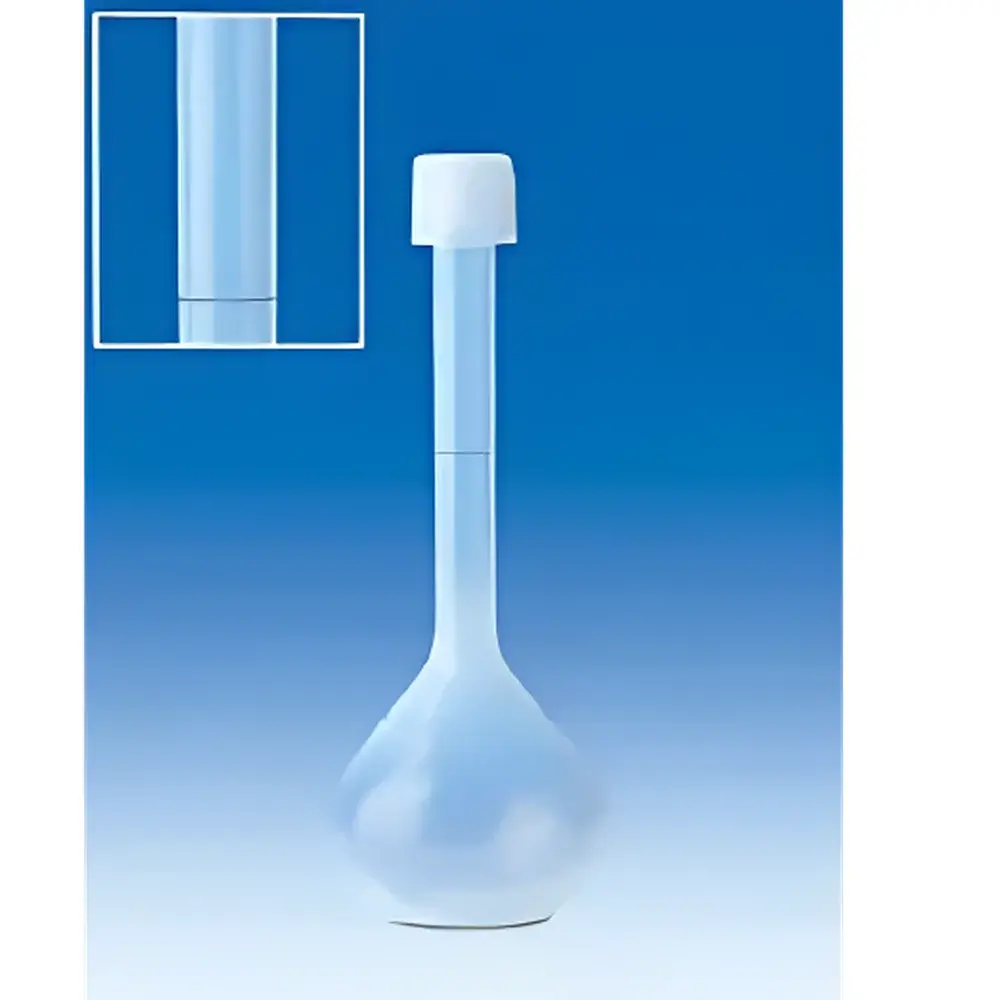
Vitlab PFA Volumetric Flask, Class A (DIN EN ISO 1042), 10–500 mL
| Brand | Vitlab |
|---|---|
| Origin | Germany |
| Model Range | 10–500 mL |
| Calibration Type | “In” (TC), Ring-Graduated |
| Accuracy Class | DIN EN ISO 1042 Class A |
| Material | Perfluoroalkoxy (PFA) |
| Cap | PFA Screw Cap with Sealing Ring |
| Max. Sterilization Temp. | 121 °C (autoclave) |
| Max. Cleaning Temp. | 60 °C |
| Thermal Stability | –200 °C to +260 °C |
| Chemical Resistance | Resistant to concentrated acids/bases, oxidizers, hydrocarbons, ketones |
| Surface Property | Ultra-low adhesion, hydrophobic, non-porous, laser-etched batch traceability |
| Transparency | Optical-grade clarity for precise meniscus reading |
| Packaging | Individual blister or bulk in sealed polybag per size |
Overview
The Vitlab PFA Volumetric Flask (Class A, DIN EN ISO 1042) is a high-purity, chemically inert volumetric standard engineered for trace-level analytical workflows where contamination control, dimensional stability, and long-term calibration integrity are non-negotiable. Constructed entirely from perfluoroalkoxy alkane (PFA), this flask eliminates leaching, adsorption, and carryover—critical for preparing and storing ultra-trace standards (e.g., sub-ppq metal calibration solutions), reference materials for ICP-MS, EPA Method 200.8/6020B, and certified reference material (CRM) dilution series. Unlike borosilicate glass or standard PTFE, PFA offers superior optical clarity while retaining full fluoropolymer inertness, enabling accurate meniscus visualization without compromising chemical resistance. Each flask undergoes individual “In” (to contain) calibration at 20 °C and is certified to DIN EN ISO 1042 Class A tolerances—ensuring volumetric accuracy within ±0.04 mL (10 mL), ±0.06 mL (50 mL), and ±0.10 mL (100 mL)—with laser-etched batch ID and certificate of conformance permanently embedded into the body.
Key Features
- Class A volumetric accuracy per DIN EN ISO 1042: independently verified and documented for each unit
- Full-body PFA construction—including neck, body, and screw cap—eliminates material interface boundaries and ensures homogeneous chemical resistance
- Laser-etched batch number and certification mark provide full traceability compliant with ISO/IEC 17025 and GLP audit requirements
- Ring-graduated scale optimized for meniscus alignment under standard laboratory lighting; calibrated for use at 20 °C with TC (“to contain”) designation
- PFA screw cap with integrated sealing ring prevents evaporation, particulate ingress, and cross-contamination during storage and handling
- Autoclavable at 121 °C for 20 minutes without measurable volume drift or surface degradation—validated per ISO 17025 internal verification protocols
- Maximum cleaning temperature limited to 60 °C to preserve ring-scale legibility and dimensional fidelity over repeated use cycles
Sample Compatibility & Compliance
These flasks are validated for use with aggressive matrices including aqua regia, 48% hydrofluoric acid, 70% nitric acid, 30% hydrogen peroxide, acetone, chloroform, and aromatic hydrocarbons. Their ultra-smooth, non-polar surface minimizes analyte adhesion—demonstrated in inter-laboratory studies for Cr(VI), As(III), and methylmercury recovery (>99.2% mean recovery, n=12). Compliant with USP , ASTM D5127 (fluoropolymer purity), and EU Regulation (EC) No 1935/2004 for food contact materials. Batch-specific CoA includes gravimetric calibration data, extractables testing (per USP ), and heavy metals screening (<1 ng/g total metals by ICP-MS).
Software & Data Management
While inherently hardware-based, Vitlab PFA flasks integrate seamlessly into digital lab infrastructure. Each laser-etched batch ID links to Vitlab’s online Certificate Portal (accessible via QR code on packaging), providing downloadable PDF CoAs with metrological uncertainty budgets, calibration history, and raw gravimetric data. Compatible with LIMS platforms supporting GS1 DataMatrix import; batch metadata auto-populates upon scan into electronic lab notebooks (ELNs) compliant with 21 CFR Part 11 when paired with validated scanning workflows.
Applications
- Preparation and long-term storage of CRM dilutions for environmental monitoring (EPA, ISO 17294-2)
- Standard addition calibration in ICP-OES/ICP-MS requiring sub-part-per-quadrillion sensitivity
- Pharmaceutical impurity quantification per ICH Q2(R2) where carryover must be <0.01%
- Reference solution management in accredited testing labs (ISO/IEC 17025 Clause 6.4.10)
- High-temperature dissolution testing of APIs in aggressive solvents (e.g., HF-containing media)
- Trace metal analysis in semiconductor-grade ultrapure water systems (SEMI F57)
FAQ
Are these flasks suitable for use with hydrofluoric acid (HF)?
Yes—PFA exhibits exceptional resistance to HF across concentrations up to 48%, including boiling conditions, with no measurable etching or weight loss after 72 h exposure.
Can I autoclave these flasks repeatedly without affecting calibration?
Yes—validation testing confirms no statistically significant volume deviation (p > 0.05, t-test) after 50 autoclave cycles at 121 °C, 15 psi, 20 min per cycle.
Why is the maximum cleaning temperature limited to 60 °C?
To preserve the precision of the laser-etched ring graduation and prevent localized thermal stress that could affect meniscus reading consistency.
Do you provide individual calibration certificates?
Yes—each flask ships with a unique, laser-etched batch ID linked to a digitally signed CoA containing gravimetric measurement data, uncertainty budget, and compliance statements.
How does PFA compare to FEP or ETFE for volumetric applications?
PFA offers superior melt-processability for tight-tolerance neck geometry, higher transparency than ETFE, and lower gas permeability than FEP—making it the only fluoropolymer qualified for Class A volumetric certification.



