
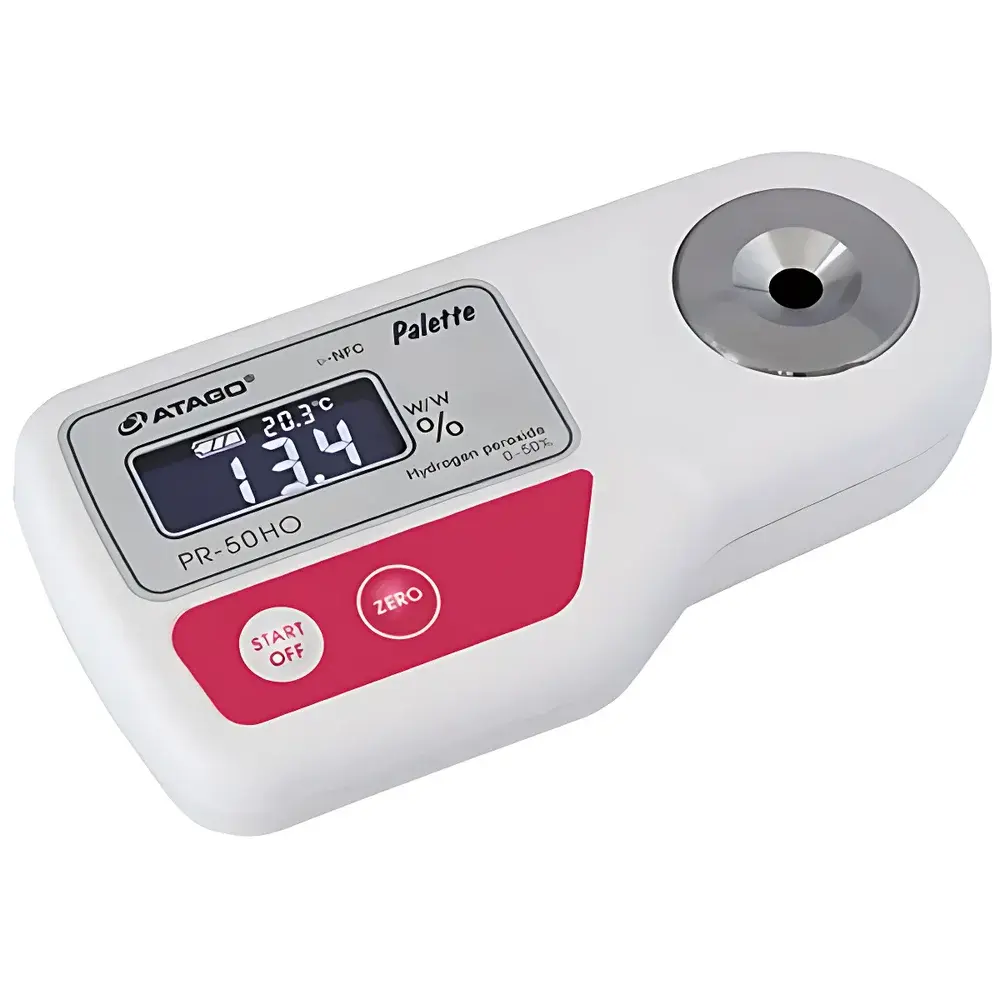
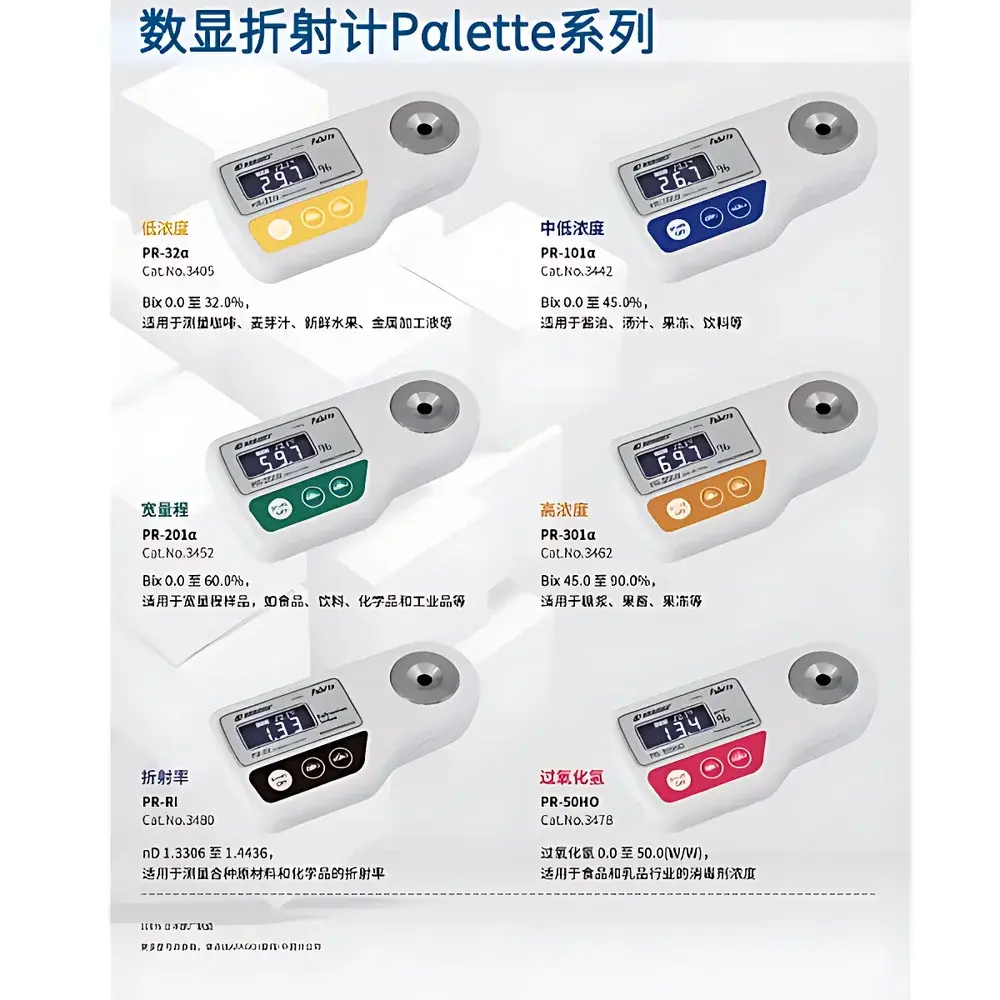
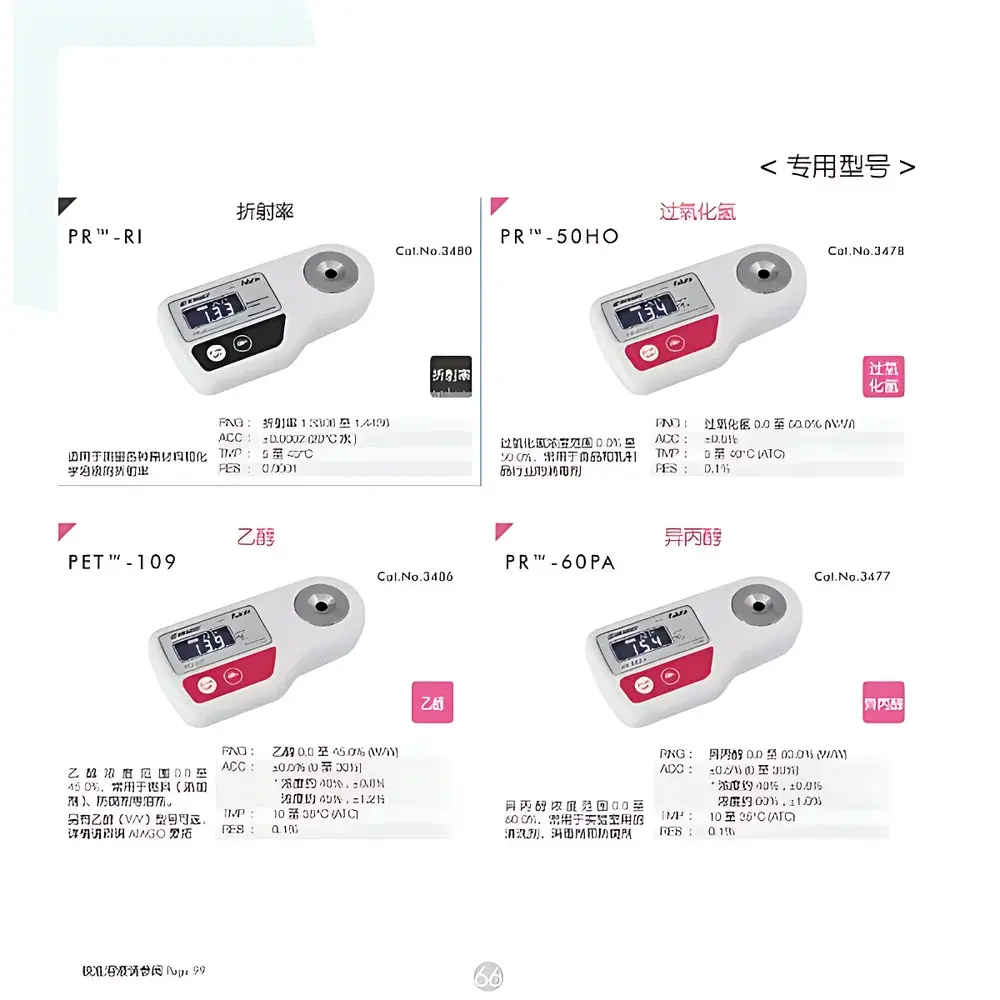
ATAGO PR-50HO Handheld Hydrogen Peroxide Refractometer
| Brand | ATAGO |
|---|---|
| Origin | Japan |
| Model | PR-50HO |
| Product Type | Handheld Refractometer |
| Temperature Control | Yes (Automatic Temperature Compensation) |
| Digital Display | Yes |
| Measurement Range | 0.0–50.0% w/w H₂O₂ |
| Accuracy | ±0.5% w/w |
| Operating Temperature | 5–40°C |
| Environmental Rating | IP64 |
| Power Supply | 9V battery (006P) |
| Dimensions | 170 × 90 × 40 mm |
| Weight | 300 g (without accessories) |
Overview
The ATAGO PR-50HO Handheld Hydrogen Peroxide Refractometer is a precision optical instrument engineered for rapid, field-deployable quantification of hydrogen peroxide (H₂O₂) concentration in aqueous solutions. It operates on the fundamental principle of critical-angle refractometry: as light passes through a sample placed on the prism surface, the degree of refraction correlates directly with the solution’s solute concentration—here, hydrogen peroxide mass fraction (w/w %). This correlation is calibrated against certified reference standards traceable to NIST-maintained protocols, enabling reliable conversion from refractive index to % H₂O₂ without chemical reagents or consumables. Designed specifically for industrial hygiene and food safety applications, the PR-50HO delivers consistent results under variable ambient conditions thanks to its built-in automatic temperature compensation (ATC) system, which corrects measurements across the full operational range of 5–40°C. Its compact form factor and robust mechanical architecture make it suitable for routine use in production lines, clean-in-place (CIP) verification, sterilization validation, and quality control laboratories where portability and repeatability are essential.
Key Features
- Optimized optical path geometry with high-stability sapphire prism for long-term refractive index stability and resistance to chemical etching by oxidizing agents.
- Integrated ATC sensor (thermistor-based) that continuously monitors sample temperature and applies real-time correction using a polynomial calibration curve validated over 5–40°C.
- Digital LCD display with 0.1% resolution and backlighting for low-light environments; measurement result stabilizes within 3 seconds after sample application.
- IP64-rated enclosure ensures protection against dust ingress and water splashes—critical for humid or washdown-intensive settings such as food processing facilities and pharmaceutical manufacturing suites.
- Battery-powered operation using a single 9V alkaline cell (006P), supporting approximately 5,000 measurements per charge; low-battery indicator prevents data integrity compromise.
- Ergonomic, one-handed design with non-slip rubberized grip and recessed prism cover to minimize accidental contamination or scratching during transport.
Sample Compatibility & Compliance
The PR-50HO is validated exclusively for aqueous hydrogen peroxide solutions containing no suspended solids, emulsifiers, or high-viscosity additives that may scatter incident light or interfere with prism-sample interface homogeneity. It is not intended for use with organic peroxides, stabilized formulations containing surfactants, or mixtures containing ethanol or glycerol above 1% v/v. In food-grade applications, the device supports compliance with FDA 21 CFR §173.328 (hydrogen peroxide as a sanitizer), EU Regulation (EC) No 396/2005 (maximum residue limits), and ISO 22000:2018 requirements for monitoring critical control points in HACCP plans. While the instrument itself does not generate audit trails, its measurement methodology aligns with ISO 5725 (accuracy and precision of measurement methods) and ASTM D1293 (standard test method for pH of water), serving as a primary verification tool for process consistency rather than final regulatory submission.
Software & Data Management
The PR-50HO operates as a standalone analog-to-digital measurement platform with no embedded firmware update capability or USB/Bluetooth connectivity. All calibration and verification procedures are performed manually using ATAGO-certified H₂O₂ standard solutions (0%, 10%, 25%, and 50% w/w). Calibration verification is recommended before each shift or after exposure to extreme thermal gradients. Users maintain calibration logs per GLP/GMP guidelines, recording date, operator ID, standard lot number, and observed deviation. Optional accessories—including calibration storage cases, prism cleaning kits (lens tissue + isopropyl alcohol), and traceable calibration certificates issued by ATAGO Japan—support documented quality assurance workflows in regulated environments.
Applications
- Verification of food-contact surface sanitizers in bakeries, dairies, and ready-to-eat (RTE) packaging lines.
- Monitoring residual H₂O₂ levels in aseptic filling equipment prior to product contact.
- Batch release testing of pharmaceutical-grade hydrogen peroxide used in medical device sterilization cycles.
- On-site validation of vapor-phase H₂O₂ decontamination efficacy in isolators and transfer hatches (via liquid condensate sampling).
- Process troubleshooting in electroplating and semiconductor wafer cleaning where precise oxidant dosing affects etch uniformity.
FAQ
Can the PR-50HO measure hydrogen peroxide in acidic or alkaline solutions?
No. The calibration curve assumes neutral pH (5.5–7.5). Significant deviations in pH alter the refractive index contribution of H₂O₂ and introduce systematic bias beyond ±0.5%.
Is periodic recalibration required?
Yes. ATAGO recommends daily verification with a mid-range standard (e.g., 25% H₂O₂) and full two-point calibration (0% and 50%) at least once per week or after any physical impact to the prism.
Does this instrument comply with FDA 21 CFR Part 11?
No. As a non-networked, non-auditable analog optical device, it lacks electronic records, signature functionality, or system security controls required under Part 11. It serves as a manual verification tool only.
What is the minimum sample volume needed?
Approximately 0.3 mL is sufficient to fully cover the prism surface without overflow; excess liquid must be wiped away before measurement to avoid edge refraction artifacts.
Can I use ethanol or acetone to clean the prism?
No. These solvents may degrade the prism adhesive or coating. Only lens-grade tissue and >99% isopropyl alcohol are approved for cleaning.




