
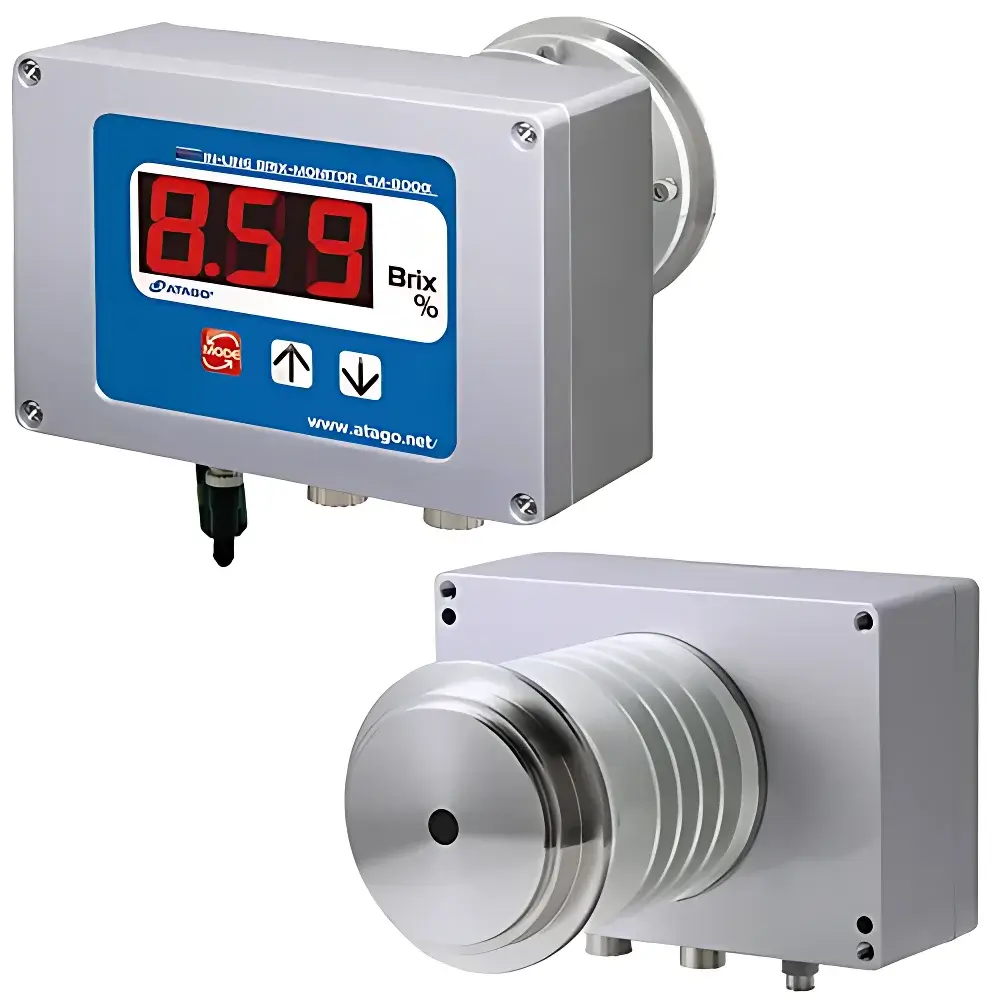
ATAGO CM-800α In-Line Process Refractometer
| Brand | ATAGO |
|---|---|
| Origin | Japan |
| Model | CM-800α |
| Product Type | In-Line Refractometer |
| Temperature Control | Yes |
| Digital Display | Yes |
| Measurement Range | Brix 0.0–80.0% (ATC) |
| Accuracy | ±0.1% Brix |
| Temperature Compensation Range | 5–100°C |
| Operating Temperature | −15–160.0°C |
| Environmental Operating Temp | 5–40°C |
| Resolution | 0.01% (≤9.99%), 0.1% (≥10.0%) Brix |
| Temperature Resolution | 1°C/°F |
| Output | DC 4–20 mA, RS-232C |
| Measurement Interval | Adjustable (default 1 s) |
| IP Rating | IP67 |
| Light Source | LED (≈589 nm, sodium D-line equivalent) |
| Power Supply | DC 24 V (AC 100 V optional with AD-32 adapter) |
| Prism Material | Synthetic Sapphire |
| Body Material | SUS316L stainless steel |
| Dimensions | 160 × 167 × 110 mm |
| Weight | 2.4 kg |
Overview
The ATAGO CM-800α is an industrial-grade in-line process refractometer engineered for continuous, real-time measurement of dissolved solids concentration—expressed as Brix—in liquid streams under dynamic production conditions. It operates on the principle of critical-angle refractometry: a collimated LED light source (spectrally centered near 589 nm, matching the sodium D-line standard) passes through a synthetic sapphire prism in direct contact with the process fluid; the resulting refraction angle is detected by a high-stability photodiode array and converted into a precise Brix value using factory-calibrated algorithms. Built-in Automatic Temperature Compensation (ATC) ensures metrological integrity across a wide operational temperature range (5–100°C), while the robust SUS316L wetted housing and IP67-rated enclosure enable reliable deployment in demanding hygienic or corrosive environments—including steam-in-place (SIP), clean-in-place (CIP), and alkaline wash applications. Unlike benchtop or handheld refractometers, the CM-800α integrates directly into process piping via sanitary clamp or flanged connections, eliminating sampling delays, operator variability, and contamination risks associated with offline analysis.
Key Features
- Real-time Brix monitoring with ≤1-second default measurement interval—configurable to five user-defined intervals for synchronization with PLC scan cycles or control logic.
- High-precision ATC algorithm compliant with ISO 21542:2020 (Refractometric determination of sugar content in aqueous solutions) and aligned with USP and FDA 21 CFR Part 11 data integrity expectations when paired with validated SCADA systems.
- Synthetic sapphire prism (Mohs hardness ≥9) and electropolished SUS316L flow cell resist erosion, scaling, and chemical attack from caustic cleaners (e.g., NaOH up to 5% w/w), organic acids, and fermentation broths containing ethanol, acetic acid, or proteolytic enzymes.
- Dual-output capability: simultaneous analog (4–20 mA, HART-compatible) and digital (RS-232C) signals—RS-232C supports configurable output formats including refractive index (nD), Brix (%), and temperature (°C/°F), enabling traceable audit logs and integration with MES or LIMS platforms.
- Self-diagnostic firmware with status indicators for prism fouling detection, temperature sensor validation, and optical path integrity—reducing unplanned downtime and supporting predictive maintenance protocols.
Sample Compatibility & Compliance
The CM-800α is validated for use with low-to-medium viscosity aqueous solutions typical in bioprocessing and food manufacturing: fermentation liquors (yeast, bacterial, and fungal cultures), enzymatic hydrolysates, soy sauce mash, wort, fruit juice concentrates, dairy permeate, and CIP rinse water. It is not intended for opaque suspensions, highly viscous polymer melts (>10,000 mPa·s), or fluids containing particulates >50 µm that may occlude the optical interface. The device conforms to IEC 61000-6-2 (EMC immunity) and IEC 61000-6-4 (EMC emissions), carries CE marking for industrial instrumentation, and meets hygienic design principles outlined in EHEDG Doc. 8 and 3-A Sanitary Standards 01-05 for dairy and beverage processing equipment.
Software & Data Management
While the CM-800α operates autonomously without embedded software, its RS-232C interface enables bidirectional communication with third-party control systems. When integrated into validated environments, it supports full electronic record retention per FDA 21 CFR Part 11 requirements—including user authentication, audit trails for parameter changes, and timestamped Brix/temperature datasets. Optional ATAGO-supplied configuration utilities (Windows-based, password-protected) allow calibration verification, zero-point adjustment using certified sucrose standards (NIST-traceable), and firmware updates—each logged with operator ID and UTC timestamp. Data export formats include CSV and ASCII for compatibility with JMP, MATLAB, or LabVIEW-based SPC dashboards.
Applications
- Fermentation process control: Real-time tracking of substrate depletion (e.g., glucose in ethanol or citric acid production) and biomass-associated solids accumulation to optimize feeding strategies and harvest timing.
- Concentration endpoint detection in vacuum evaporation or reverse osmosis systems—replacing manual grab sampling and reducing energy overuse by up to 12% (per peer-reviewed case studies in Journal of Food Engineering, Vol. 294, 2021).
- CIP solution monitoring: Continuous verification of alkaline (NaOH) and acidic (HNO₃/H₃PO₄) cleaner concentrations to ensure microbiological efficacy while minimizing chemical waste and rinse water volume.
- Blending consistency assurance: Closed-loop feedback for ratio-controlled mixing of syrups, flavor bases, or nutrient media where Brix deviation >±0.2% triggers automatic valve modulation.
- Regulatory documentation support: Automated generation of GMP-compliant batch records for pharmaceutical excipient preparation (e.g., dextrose solutions) and dietary supplement manufacturing.
FAQ
Does the CM-800α require periodic recalibration?
Yes—annual verification against NIST-traceable sucrose reference standards is recommended; field zero checks using deionized water can be performed daily or per shift.
Can it measure non-sugar solutes such as salts or alcohols?
It reports total dissolved solids as Brix-equivalent; for non-sucrose matrices (e.g., NaCl brines or ethanol-water mixtures), a custom correlation curve must be established and loaded via RS-232C.
Is the unit suitable for sterile filtration skids?
Yes—when installed upstream of 0.22 µm filters with appropriate gasket material (EPDM or silicone) and validated SIP cycle parameters (121°C, 30 min), provided pressure drop remains within specified limits (max ΔP = 3 bar).
What is the minimum flow rate required for stable measurement?
A laminar, bubble-free flow of ≥0.3 m/s across the prism surface is required; turbulent flow or air entrainment will degrade accuracy and induce signal noise.
How does ATAGO support validation in regulated industries?
ATAGO provides IQ/OQ documentation templates, factory calibration certificates with uncertainty budgets, and technical support for protocol development aligned with ASTM E2500 and Annex 11 (EU GMP) requirements.





