
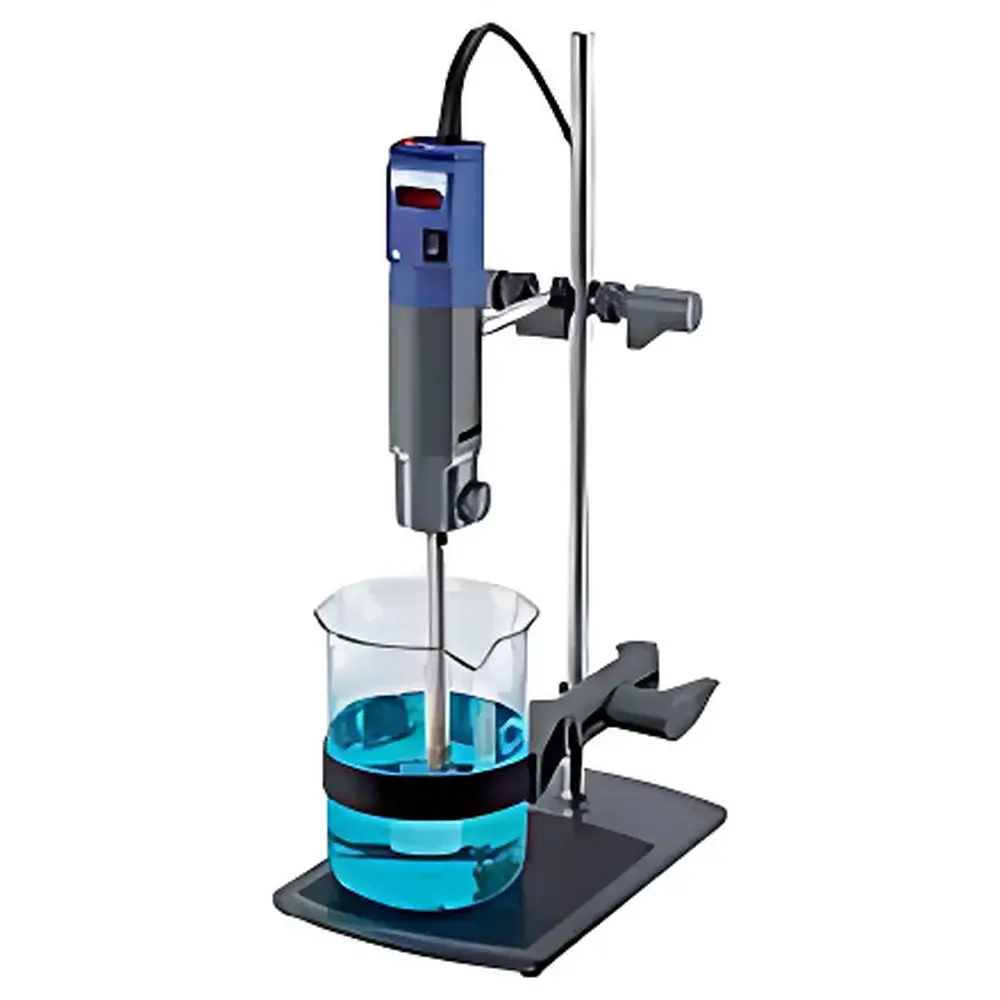
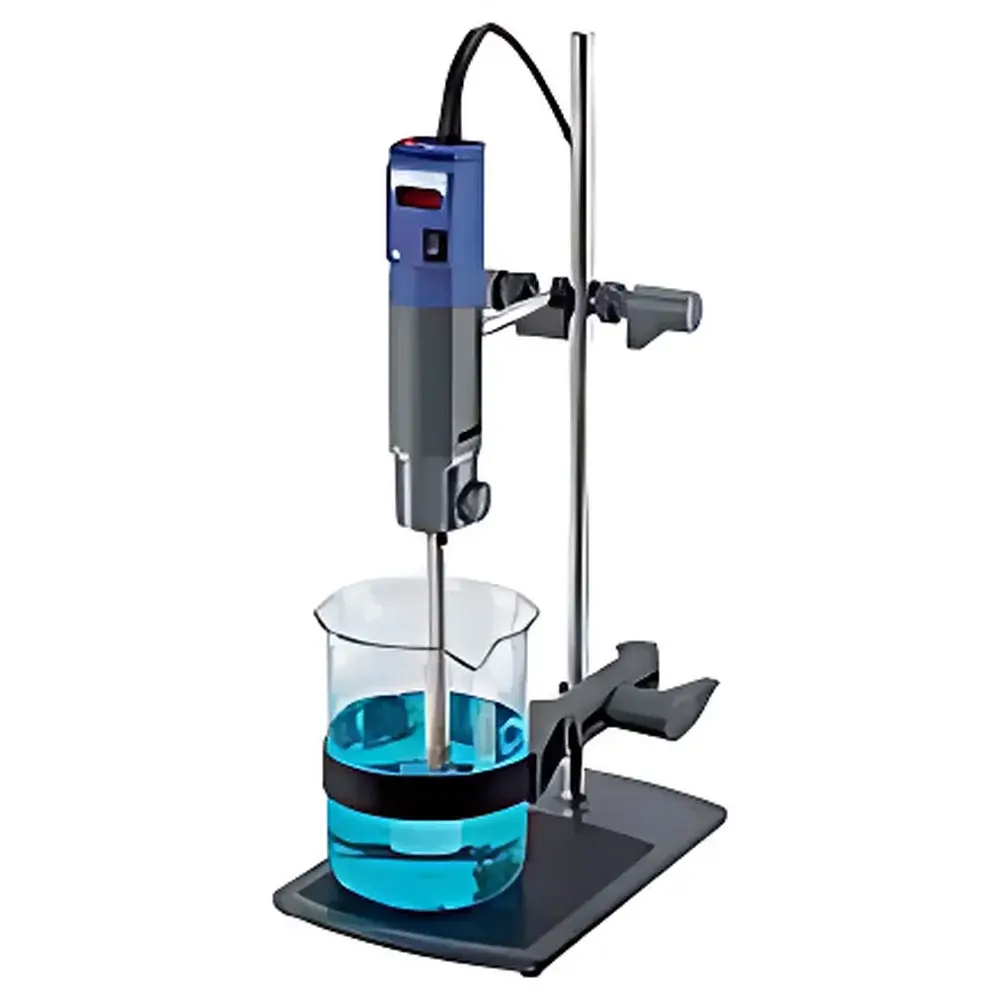
IKA T25 Basic Homogenizer
| Brand | IKA |
|---|---|
| Origin | Germany |
| Model | IKA T25 Basic Kit |
| Drive Type | High-Speed Rotational (Rotor-Stator) |
| Dimensions (W×D×H) | 65 × 240 × 80 mm |
| Processing Volume Range | 1–2000 mL (H₂O) |
| Motor Input Power | 500 W |
| Motor Output Power | 300 W |
| Speed Range | 6,500–24,000 rpm |
| Speed Accuracy | ±1% |
| Max. Viscosity | 5,000 mPa·s |
| Shaft Diameter | 13 mm |
| Shaft Length | 175 mm |
| Weight | 1.6 kg |
| Protection Class | IP20 (DIN EN 60529) |
| Operating Ambient | 5–40 °C, ≤80% RH |
| Power Supply | 230/115 V, 50/60 Hz |
| Noise Level (no head) | 73 dB(A) |
Overview
The IKA T25 Basic Homogenizer is a precision-engineered rotor-stator homogenization system designed for reliable, reproducible sample disruption and dispersion in academic, industrial, and regulatory-compliant laboratories. Based on Couette flow principles, the device generates high-shear forces through the relative motion of a rapidly rotating rotor within a fixed stator—enabling efficient cell lysis, emulsification, suspension homogenization, and particle size reduction across a broad viscosity range (up to 5,000 mPa·s). As the direct successor to the IKA T18 platform, the T25 introduces enhanced mechanical stability, improved thermal management, and digital speed display with continuous (stepless) adjustment—ensuring consistent energy input per unit volume regardless of processing scale. Its compact footprint (65 × 240 × 80 mm), lightweight aluminum housing (1.6 kg), and IP20-rated enclosure make it suitable for benchtop use in controlled environments operating between 5–40 °C and ≤80% relative humidity.
Key Features
- High-performance 300 W output motor delivering stable rotational speeds from 6,500 to 24,000 rpm with ±1% deviation—critical for method transfer and inter-laboratory comparability
- Digital LED speed display providing real-time, non-ambiguous feedback without reliance on analog dials or external tachometers
- Three-point precision bearing assembly ensuring axial and radial runout control under load—minimizing vibration and extending service life beyond 30,000 operational hours
- Modular rotor-stator geometry: interchangeable dispersing heads (S25N and S25KV series) engineered for defined shear profiles and laminar-to-turbulent transition control
- Standardized mounting interface compatible with R182 clamping system and R1822 universal support stand—enabling secure fixation of vessels ranging from 1 mL microtubes to 2 L beakers
- Batch-mode operation only; no continuous-flow capability—optimized for discrete sample integrity and traceability in regulated workflows
Sample Compatibility & Compliance
The T25 Basic supports heterogeneous matrices including biological tissues, microbial cultures, food homogenates, environmental sludges, polymer dispersions, and diagnostic specimens (e.g., blood, saliva, stool). Its validated performance aligns with multiple ISO and ASTM standards for sample preparation: ISO 6887-1 (microbiological examination of food and animal feeding stuffs), ASTM D4052 (density of liquids by digital density meter—requiring homogeneous reference solutions), and USP (dissolution testing—where uniform particle distribution affects release kinetics). While not intrinsically compliant with FDA 21 CFR Part 11, the instrument’s mechanical design facilitates integration into GLP/GMP environments when paired with documented SOPs, calibration logs, and maintenance records. All dispersing elements are manufactured from corrosion-resistant stainless steel (AISI 316) and undergo passivation per ASTM A967, supporting repeated sterilization via autoclaving (121 °C, 20 min) or chemical disinfection (e.g., 70% ethanol, 0.5% sodium hypochlorite).
Software & Data Management
The IKA T25 Basic operates as a standalone electromechanical device without embedded firmware, network connectivity, or data logging capabilities. It features no RS232, USB, or analog output interfaces—intentionally omitting digital control surfaces to maximize operational robustness, reduce electromagnetic interference in sensitive measurement zones, and simplify validation protocols. Speed settings are manually adjusted via calibrated potentiometer; all parameters remain user-documented externally. This architecture meets the requirements of laboratories implementing paper-based or LIMS-integrated quality systems where instrument control is decoupled from data acquisition—ensuring audit trails originate solely from procedural documentation rather than automated logs subject to software qualification.
Applications
- Pre-analytical sample preparation for HPLC, GC-MS, and ICP-MS—including tissue homogenization prior to metal extraction and lipid-rich food matrix dispersion for pesticide residue analysis
- Microbial cell disruption for plasmid isolation and enzyme activity assays—validated for E. coli, S. cerevisiae, and Gram-positive bacteria using S25N-10G and S25N-18G heads
- Environmental testing: homogenization of wastewater solids, sediment cores, and biofilm samples per EPA Method 1664B (n-hexane extractable material)
- Pharmaceutical QA/QC: uniform suspension of poorly soluble APIs in dissolution media and excipient blending verification
- Vaccine development: adjuvant emulsion stabilization and antigen dispersion consistency testing under low-oxygen conditions using optional vacuum-rated vessel adapters
FAQ
What is the minimum and maximum processing volume for the IKA T25 Basic?
The instrument accommodates volumes from 1 mL (using S25N-8G head) up to 2,000 mL (using S25N-25G head), with optimal efficiency observed between 10–1,500 mL depending on head selection and medium viscosity.
Is the T25 Basic suitable for high-viscosity samples?
Yes—rated for media up to 5,000 mPa·s when operated within its specified speed range and matched with appropriate rotor-stator geometry (e.g., S25N-18G or S25KV-18G). Exceeding this limit may cause motor overload or inconsistent shear delivery.
Can the T25 Basic be used in cold rooms or under inert atmosphere?
The unit is rated for ambient operation between 5–40 °C and is compatible with glovebox integration via custom feedthrough mounts; however, condensation-sensitive electronics require environmental monitoring to maintain IP20 integrity.
Does IKA provide calibration certificates for speed accuracy?
Factory calibration is performed against NIST-traceable tachometric standards; users may request optional UKAS-accredited calibration reports at time of purchase or during scheduled service intervals.
Are spare parts and service support available globally?
All mechanical components—including bearings, shafts, and dispersing heads—are stocked by IKA’s authorized distribution network; technical service is supported through regional application engineers trained to ISO/IEC 17025 competency criteria.



