
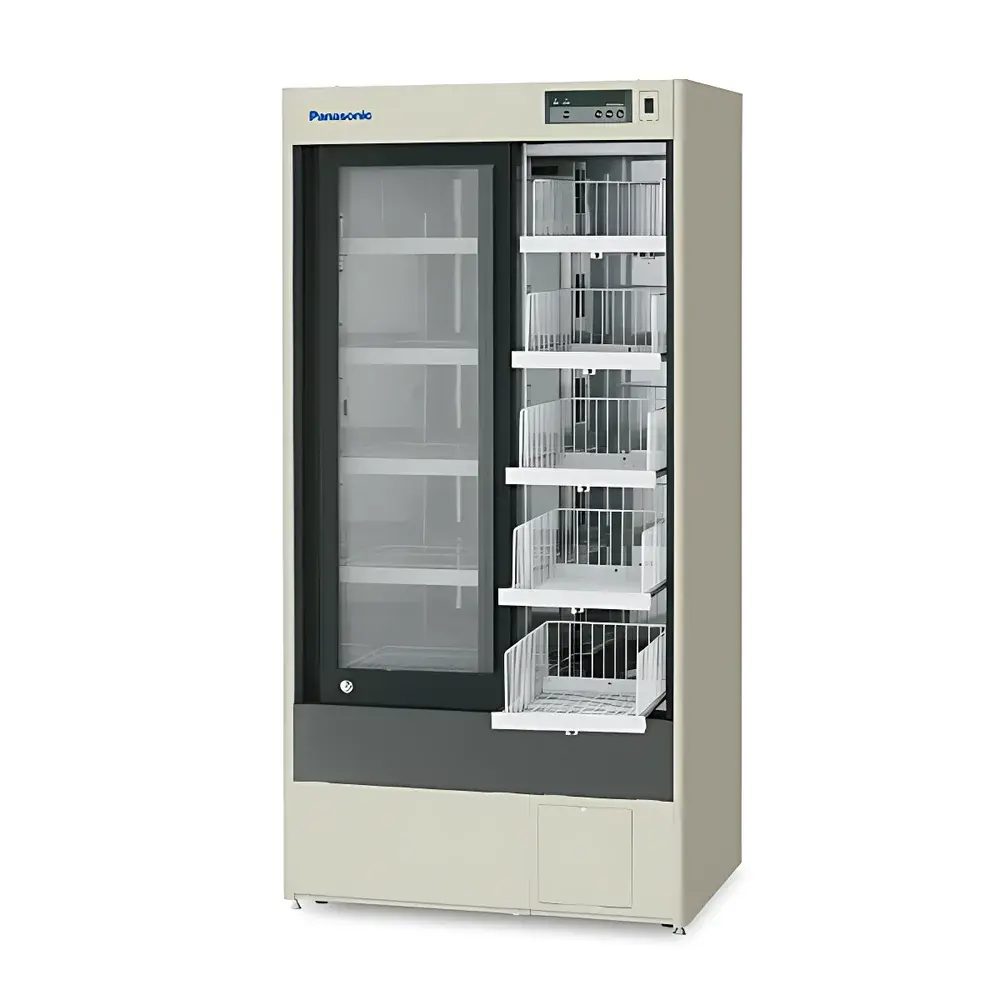
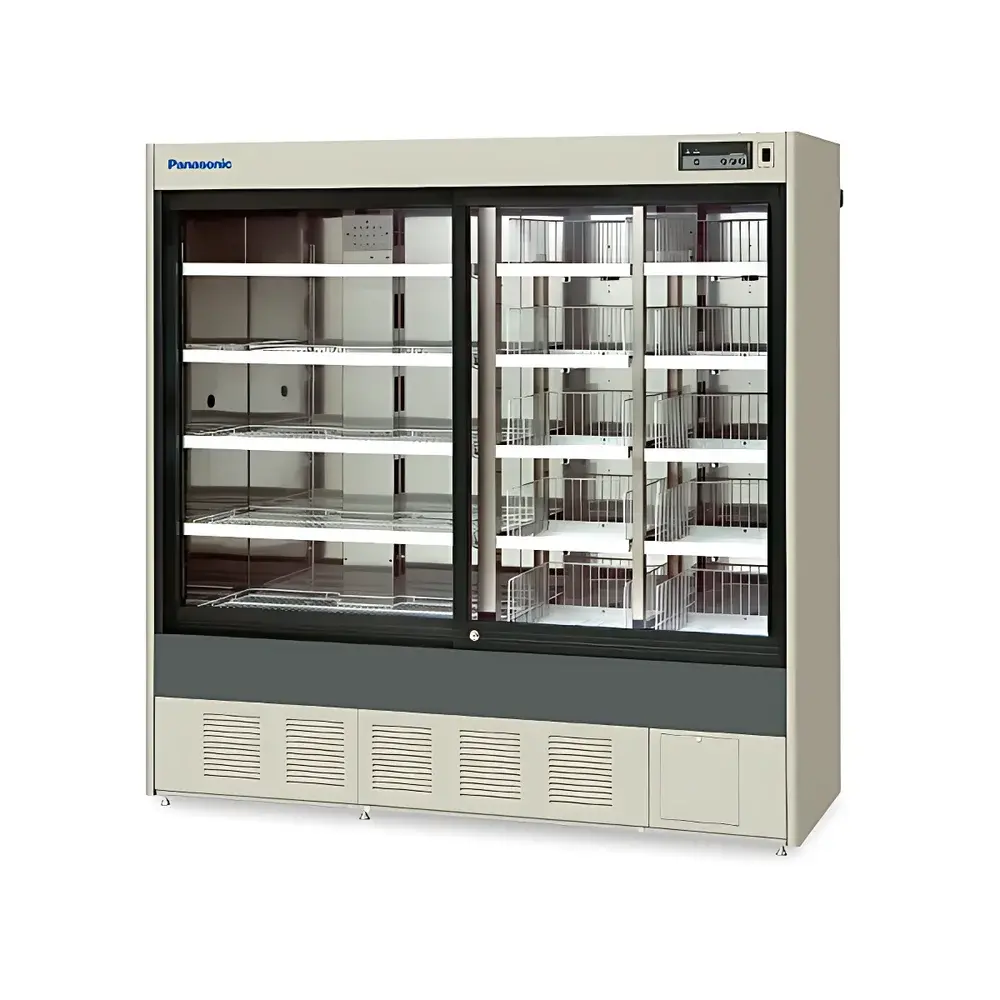
Panasonic MPR-514R & MPR-1014R Pharmaceutical Refrigerated Storage Cabinets (Sliding Shelf Models)
| Brand | Panasonic |
|---|---|
| Origin | Japan |
| Model | MPR-514R, MPR-1014R |
| Temperature Range | 2°C to 14°C (ambient: −5°C to 35°C) |
| External Dimensions (W×D×H) | 900×600×1790 mm / 1800×600×1790 mm |
| Internal Dimensions (W×D×H) | 800×465×1300 mm / 1700×465×1300 mm |
| Net Volume | 489 L / 133 L |
| Net Weight | 141 kg / 243 kg |
| Power Consumption (220 V, 50 Hz) | 215 W / 320 W |
| Insulation | In-situ rigid polyurethane foam |
| Exterior | Pre-coated steel sheet |
| Interior | Stainless steel (SUS304) |
| Shelving | 5 wire shelves (20 kg/shelf) + 5 sliding shelves (20 kg/shelf) / 5 wire shelves (50 kg/shelf) + 10 sliding shelves (20 kg/shelf) |
| Door | Dual-pane low-emissivity glass doors with safety film |
| Cooling System | Forced-air circulation with hermetic compressor (200 W / 250 W) |
| Defrost System | Automatic demand-based hot-gas defrost with dual heating elements (73.8 W × 2 / 141 W) |
| Refrigerant | HFC blend (R134a or equivalent) |
| Temperature Control | Dual Pt100 sensors + microprocessor PID control |
| Alarm System | Audible/visual high/low temperature, door ajar, power failure, remote alarm contact |
| Optional | Data logging module with RS-485 interface compliant with FDA 21 CFR Part 11 audit trail requirements |
Overview
The Panasonic MPR-514R and MPR-1014R Pharmaceutical Refrigerated Storage Cabinets are precision-engineered, GxP-aligned cold storage systems designed for the secure, stable, and auditable preservation of temperature-sensitive pharmaceuticals, clinical trial materials, reference standards, and laboratory reagents. Operating within a tightly controlled range of 2°C to 14°C—validated under ambient conditions from −5°C to 35°C—these cabinets employ a dual-sensor microprocessor-controlled refrigeration architecture to maintain thermal uniformity and stability across the entire working volume. Unlike standard laboratory refrigerators, the MPR series integrates active air management, adaptive defrost logic, and structural redundancy to mitigate risks associated with door cycling, ambient fluctuations, and long-term drift. The system complies with core environmental and operational requirements outlined in ISO 14644-1 (cleanroom classification support), ICH Q5C (stability testing storage conditions), and WHO Technical Report Series No. 961 (good storage practices for pharmaceutical products). Its design prioritizes not only thermal integrity but also operational traceability, mechanical safety, and ergonomic accessibility—making it suitable for use in QC laboratories, clinical research facilities, biobanks, and regulated manufacturing environments.
Key Features
- Dual Pt100 Temperature Sensing & PID Microprocessor Control: Independent high-accuracy platinum resistance thermometers continuously monitor both upper and lower chamber zones; real-time feedback enables dynamic compressor modulation and fan-speed adjustment to maintain ±0.5°C uniformity (per ICH Q5C Zone III mapping protocols).
- Forced-Air Circulation with Vertical Airflow Optimization: Strategically positioned axial fans and internal baffle geometry ensure laminar, top-to-bottom air distribution—critical for achieving ≤1.0°C vertical temperature gradient (measured per ASTM F2657-22).
- Intelligent Demand-Based Defrost Management: Hot-gas defrost activation is triggered only when frost accumulation exceeds empirically determined thresholds; eliminates unnecessary thermal excursions and extends compressor service life.
- Redundant Safety Architecture: Includes dual independent high/low temperature alarms (audible + visual), door-ajar detection with latch monitoring, power-failure notification, and fail-safe circuit interruption for fan/heater subsystems.
- Structural Integrity & Ergonomic Access: Tempered dual-pane glass doors with shatter-resistant film; full-height sliding shelves (MPR-1014R) or hybrid wire/sliding configurations (MPR-514R); stainless steel interior (SUS304) resistant to corrosion from repeated disinfection cycles.
- Energy-Efficient Thermal Envelope: 80–100 mm in-situ rigid polyurethane foam insulation (λ ≈ 0.022 W/m·K) combined with low-GWP HFC refrigerant (R134a-equivalent) ensures compliance with EU F-Gas Regulation (EU) No 517/2014 and Japan’s JIS B 8601 energy labeling standards.
Sample Compatibility & Compliance
These cabinets support storage of a broad spectrum of regulated biological and chemical materials—including monoclonal antibodies, lyophilized powders, PCR reagents, ELISA kits, and small-molecule reference standards—without risk of freeze-thaw degradation or thermal denaturation. The interior stainless steel construction resists common laboratory disinfectants (e.g., 70% ethanol, 0.5% sodium hypochlorite), enabling routine cleaning under GLP and GMP hygiene protocols. All models meet IEC 61000-6-3 (EMC emissions) and IEC 61000-6-2 (immunity) requirements. Optional data loggers provide 21 CFR Part 11–compliant electronic records—including user authentication, audit trails, and tamper-proof timestamped temperature histories—for regulatory submissions and internal quality audits.
Software & Data Management
While the base unit operates via an embedded LCD interface with local setpoint adjustment and alarm acknowledgment, the optional Panasonic Data Acquisition Module (DAM-200 series) enables continuous monitoring via RS-485 Modbus RTU protocol. Integrated software supports configurable alarm thresholds, scheduled report generation (CSV/PDF), and networked alarm forwarding via dry-contact relay or SNMP trap. Audit logs record all configuration changes, calibration events, and alarm activations with user ID and timestamp—fully satisfying ALCOA+ principles (Attributable, Legible, Contemporaneous, Original, Accurate, Complete, Consistent, Enduring, Available) required by FDA, EMA, and PMDA inspectors.
Applications
- Stability storage chambers for ICH Q1–Q5 compliance studies
- Short- and medium-term holding of clinical trial supplies under GDP conditions
- Secure storage of controlled substances requiring documented temperature history
- Backup cold storage for critical reagents in molecular diagnostics labs
- Reference material repositories supporting ISO/IEC 17025 accredited testing
- Pharmacy compounding centers adhering to USP and environmental controls
FAQ
What is the validated temperature uniformity performance across the working volume?
Per ICH Q5C Annex 2, typical vertical and horizontal uniformity is ≤ ±0.8°C at steady state (n=9 point mapping, 1-hour dwell after door opening). Full validation documentation available upon request.
Can the cabinet be integrated into a centralized building management system (BMS)?
Yes—via optional RS-485 interface with Modbus RTU protocol; analog 4–20 mA output for temperature signal is also supported.
Is the unit suitable for storing frozen samples?
No—this is a refrigerated (not frozen) storage system. It is not rated for sub-zero operation and lacks cryogenic insulation or condensate management for freezing applications.
Does Panasonic provide IQ/OQ documentation packages?
Yes—factory-verified Installation Qualification (IQ) and Operational Qualification (OQ) templates aligned with ISO 13485 and ASTM E2500 are included with each unit; site-specific Performance Qualification (PQ) support is available through authorized service partners.
How often does the system require calibration verification?
Per manufacturer recommendation and ISO/IEC 17025 Clause 6.4.6, sensor verification should occur at least annually using NIST-traceable reference thermometers; field calibration is supported via front-panel access without disassembly.



