
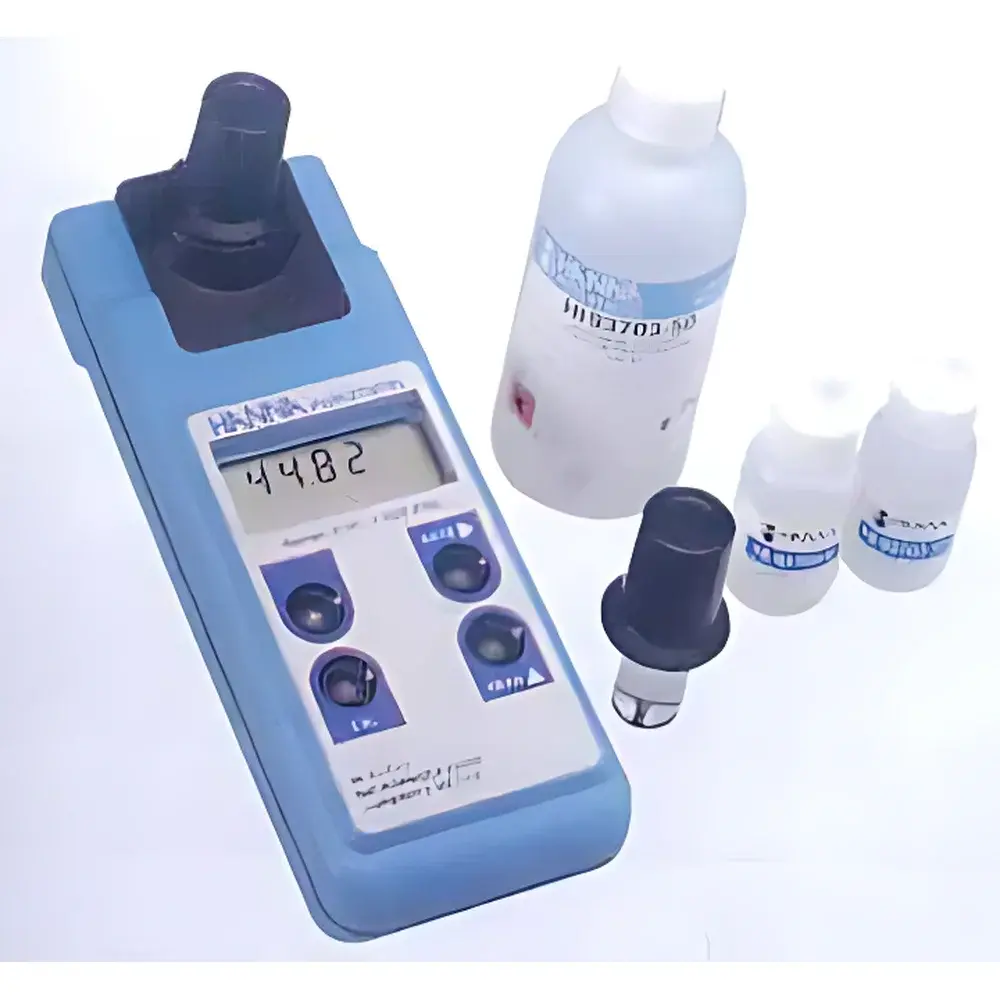
Hanna Instruments HI 93703-11 Portable Turbidimeter
| Brand | Hanna Instruments |
|---|---|
| Origin | Italy |
| Model | HI 93703-11 |
| Type | Portable Turbidimeter |
| Measurement Range | 0.00–50.00 FTU (NTU) and 50–1000 FTU (NTU) |
| Resolution | 0.01 FTU (NTU) |
| Accuracy | ±5% of reading or ±0.5 FTU (NTU), whichever is greater |
| Light Source | 890 nm infrared LED |
| Operating Temperature | 0 to 50.0 °C |
| Relative Humidity | up to 95% RH |
| Dimensions | 220 × 82 × 66 mm |
| Weight | 510 g |
| Data Storage | 200 measurement records |
| Calibration | Automatic 3-point calibration (0, 10, 500 FTU) |
| GLP Compliance | Timestamped calibration history and real-time clock |
| Interface | RS232 serial port |
| Power Supply | 4 × 1.5 V AA batteries |
Overview
The Hanna Instruments HI 93703-11 Portable Turbidimeter is a precision optical instrument engineered for rapid, field-deployable turbidity measurements in water quality monitoring applications. It operates on the principle of nephelometry—measuring the intensity of light scattered at 90° by suspended particles in a liquid sample—using a stable 890 nm infrared LED light source. This wavelength minimizes interference from color and absorbance, ensuring high specificity for particulate scattering and improved accuracy across diverse sample matrices, including drinking water, wastewater effluent, and process streams. Designed for compliance with ISO 7027:2016 (optical properties of turbidimeters) and aligned with EPA Method 180.1 and Standard Methods 2130B, the HI 93703-11 delivers traceable, reproducible results without requiring complex optical alignment or warm-up time. Its dual-range capability (0.00–50.00 FTU and 50–1000 FTU) enables seamless transition between low-turbidity potable water analysis and higher-turbidity industrial or environmental samples—all within a single handheld platform.
Key Features
- Automatic dual-range selection: Switches between 0.00–50.00 FTU (NTU) and 50–1000 FTU (NTU) based on sample signal strength, eliminating manual range switching errors.
- Stable 890 nm infrared LED source: Provides consistent output over extended operational life (>100,000 hours), reducing drift and recalibration frequency.
- Integrated real-time clock and GLP-compliant data logging: Stores date/time stamps for each measurement and calibration event, supporting audit-ready documentation per ISO/IEC 17025 and FDA 21 CFR Part 11 requirements when paired with compliant software.
- Three-point automatic calibration: Uses certified formazin or AMCO-AE standards (0, 10, and 500 FTU) to establish linear response across the full dynamic range; calibration coefficients are retained in non-volatile memory.
- RS232 serial interface: Enables direct connection to laboratory PCs or LIMS systems for automated data export, batch reporting, and integration into QA/QC workflows.
- Rugged, ergonomic housing: IP67-rated enclosure (dust-tight and submersible to 1 m for 30 min), with dimensions of 220 × 82 × 66 mm and weight of 510 g, optimized for prolonged field use and transport in mobile labs.
Sample Compatibility & Compliance
The HI 93703-11 is validated for aqueous samples meeting standard turbidity measurement criteria—including clarified surface water, filtered groundwater, treated effluents, and beverage process water. It accommodates standard 25 mm round glass vials (included) and supports optional quartz cuvettes for UV-transparent applications. All optical path components are factory-aligned and sealed to prevent contamination or misalignment. The instrument conforms to ISO 7027:2016 for instrument performance specifications, and its calibration protocol satisfies US EPA guidance for field turbidimeters under Method 180.1. When used with traceable NIST-traceable standards and documented calibration procedures, it meets GLP and GMP data integrity expectations for regulated laboratories.
Software & Data Management
Data acquisition and management are supported via Hanna’s proprietary HI 92000 Windows-based software (sold separately), which provides secure, timestamped import of all 200 stored readings. The software generates customizable reports with embedded calibration logs, operator ID fields, and pass/fail thresholds. Audit trail functionality records user actions, parameter changes, and calibration events—enabling compliance with 21 CFR Part 11 requirements when configured with electronic signatures and access controls. Export options include CSV, PDF, and Excel formats for integration into enterprise LIMS or statistical process control (SPC) platforms.
Applications
- Drinking water treatment: Monitoring filtration efficiency and final disinfection clarity (target <0.3 NTU per WHO guidelines).
- Wastewater discharge compliance: Verifying effluent turbidity against local regulatory limits (e.g., EPA NPDES permits).
- Pharmaceutical water systems: Conducting routine checks on purified water (PW) and water for injection (WFI) distribution loops.
- Food & beverage QC: Assessing clarity of juices, syrups, and brewing wort post-filtration.
- Educational laboratories: Teaching fundamental principles of light scattering, calibration traceability, and environmental analytical methodology.
FAQ
What turbidity units does the HI 93703-11 report in?
It displays results in Formazin Turbidity Units (FTU), equivalent to Nephelometric Turbidity Units (NTU), as defined in ISO 7027.
Is the instrument suitable for measuring colored samples?
Yes—the 890 nm infrared source significantly reduces spectral interference from sample coloration, improving accuracy compared to visible-light turbidimeters.
How often should calibration be performed?
Daily calibration is recommended for critical applications; however, the built-in GLP clock and calibration memory allow verification of last calibration date and interval adherence during audits.
Can data be exported without proprietary software?
Raw RS232 output is ASCII-formatted and compatible with generic terminal emulators or custom Python/Node.js scripts for direct parsing and integration.
Does the device require warm-up time before measurement?
No—LED-based optics achieve stable output instantaneously; measurements can begin immediately after power-on.




