
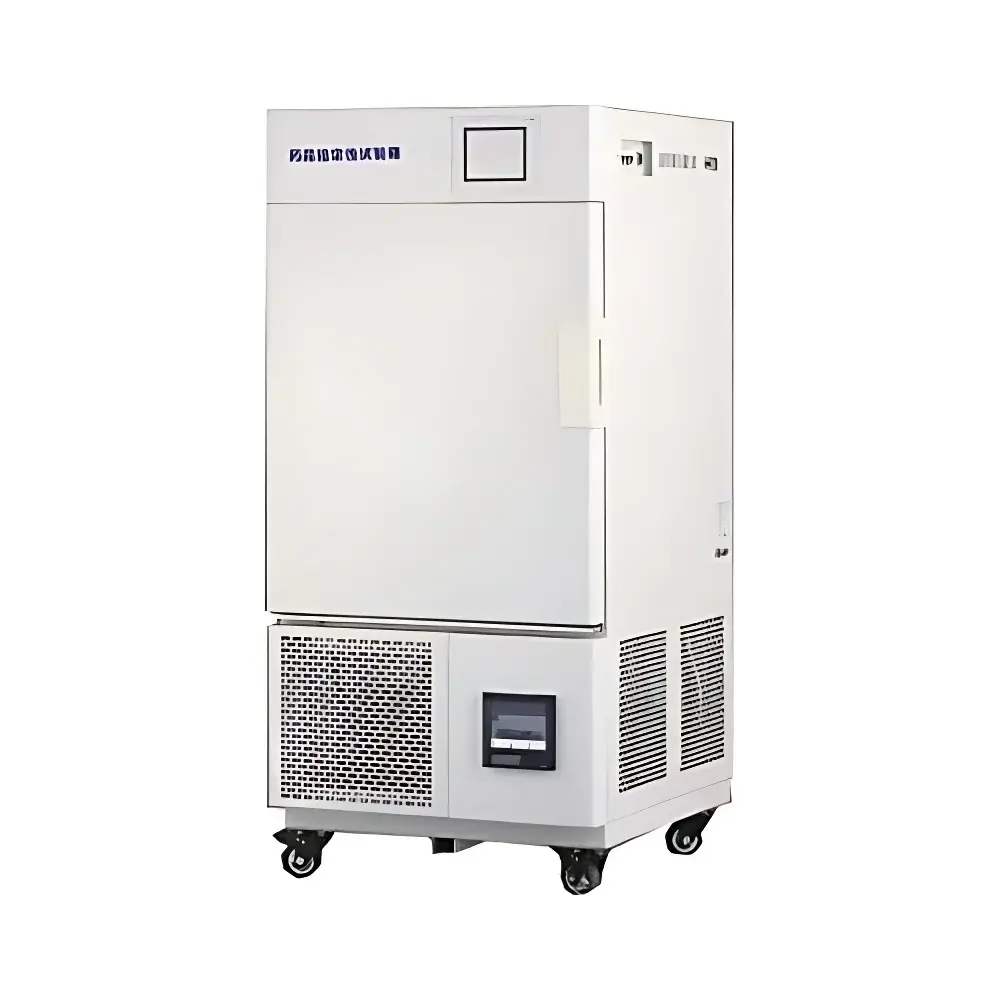
Truelab LHH-SS-I Multi-Chamber Drug Stability Testing Chamber
| Brand | Truelab |
|---|---|
| Origin | Shanghai, China |
| Model | LHH-SS-I |
| Temperature Range | 0–65 °C (10–65 °C with illumination) |
| Humidity Range | 40–95 %RH |
| Temperature Uniformity | ±2 °C |
| Temperature Fluctuation | ±0.4 °C |
| Humidity Deviation | ±2–3 %RH |
| Illuminance Control | 0–6000 lx (adjustable, error ≤ ±500 lx) |
| Chamber Configuration | Dual independent chambers (100 L + 100 L) |
| Refrigeration System | Dual imported hermetic compressors with auto-switching redundancy |
| Humidity Sensing | Imported capacitive humidity sensor |
| Interior Material | Electropolished stainless steel with radius-corner design |
| Controller | Graphical LCD touchscreen with real-time trend plotting |
| Compliance Support | IQ/OQ/PQ documentation and calibration services available |
| Optional Accessories | Wired/remote alarm systems, UV sterilization module, illuminance auto-regulation, paperless data loggers (e.g., Fuji PE-2), third-party metrology validation report (Shanghai Metrology Institute) |
Overview
The Truelab LHH-SS-I is a dual-chamber pharmaceutical stability testing chamber engineered to meet ICH Q1–Q5 guidelines for long-term, accelerated, and intermediate condition studies. It integrates temperature, humidity, and controlled illumination in a single compact footprint—enabling concurrent execution of multiple ICH-defined storage conditions (e.g., 25 °C/60 %RH, 30 °C/65 %RH, 40 °C/75 %RH, and photostability per ICH Q5C) within physically isolated, independently regulated compartments. Its core architecture employs Couette-flow air circulation with PID-controlled heating, refrigeration via dual redundant hermetic compressors, and dew-point-based humidification—all calibrated and validated to ensure traceable, reproducible environmental profiles over extended durations (≥180 days). Designed for GLP- and GMP-compliant laboratories, the system supports continuous operation under ambient conditions of 5–30 °C and maintains thermal/hygrometric stability even during power recovery or door opening events.
Key Features
- Independent dual-chamber configuration (2 × 100 L) with fully decoupled temperature, humidity, and illumination control—eliminating cross-condition interference and enabling parallel protocol execution.
- Zero-ozone, hydrocarbon-free refrigeration system using two imported hermetic compressors with automatic failover logic—ensuring uninterrupted operation for ≥7,200 hours without maintenance intervention.
- Capacitive humidity sensing technology (imported) replaces legacy wet-bulb/dry-bulb assemblies—removing consumable wick replacement cycles and reducing long-term RH drift to <0.8 %RH/year.
- Electropolished 316L stainless-steel interior with radius-corner geometry and seamless welds—complying with ISO 14644-1 Class 7 cleanroom surface requirements and facilitating residue-free cleaning validation per EU Annex 1.
- Graphical 7-inch resistive touchscreen controller with embedded trend visualization—displaying real-time chamber status, deviation alarms, and historical profiles (min/max/avg) for all monitored parameters.
- Intelligent airflow modulation: fan speed dynamically adjusted via feedback from chamber load sensors—preventing sample desiccation or condensation due to excessive air velocity.
Sample Compatibility & Compliance
The LHH-SS-I accommodates standard ICH-compliant packaging formats—including blister packs, HDPE bottles, glass vials, and aluminum pouches—on adjustable stainless-steel shelves (2 included per chamber). Each chamber meets ASTM E2809-22 for stability chamber qualification and supports full 3Q validation (IQ/OQ/PQ) aligned with FDA 21 CFR Part 11, EU GMP Annex 15, and WHO TRS 992. Optional third-party certification by the Shanghai Institute of Measurement and Testing Technology provides NIST-traceable calibration reports for temperature (±0.15 °C), humidity (±1.2 %RH), and illuminance (±25 lx), satisfying audit requirements for regulatory submissions.
Software & Data Management
The embedded controller logs timestamped environmental data at user-configurable intervals (1–60 minutes) to internal flash memory (≥1 year retention). Data export is supported via USB 2.0 to FAT32-formatted drives in CSV format—compatible with LIMS, ELN, and statistical process control platforms. Optional Fuji PE-2 high-precision recorder (IP65-rated, RS-232/RS-485 interface) adds redundant archiving with audit trail, electronic signature, and 21 CFR Part 11 compliance. All firmware updates are signed and verified; configuration changes generate immutable log entries with operator ID and timestamp.
Applications
- ICH Q1A(R2) long-term stability studies (25 °C/60 %RH) and accelerated testing (40 °C/75 %RH).
- ICH Q5C photostability assessment under Option 1 (near-UV/visible light) and Option 2 (cool white fluorescent + near-UV lamps).
- Bracketing and matrixing protocols for multi-strength/multi-package configurations.
- Excipient compatibility screening under stressed humidity (92.5 %RH) and thermal cycling (−20 °C to 60 °C).
- Reference standard storage verification per USP and Ph. Eur. 5.1.3.
FAQ
Does the LHH-SS-I support ICH Q1B photostability testing?
Yes—the illumination chamber (Chamber 1) delivers 0–6000 lx with spectral output compliant with ICH Q1B Option 1, using calibrated cool-white fluorescent and near-UV lamps.
Can humidity be maintained at 95 %RH continuously at 40 °C?
Yes—the system achieves and sustains 95 %RH at 40 °C with <±2.5 %RH deviation over 72-hour validation runs, verified per ISO 16770 Annex B.
Is remote monitoring available without on-site IT infrastructure?
Yes—optional GSM-based SMS alarm modules transmit fault codes (e.g., compressor failure, door ajar, RH out-of-spec) directly to up to five designated mobile numbers.
What validation documentation is included as standard?
Factory-installed calibration certificates for temperature (Pt100), humidity (capacitive sensor), and illuminance (silicon photodiode) are provided—traceable to national standards.
How often does the UV sterilization system require lamp replacement?
The 254 nm low-pressure mercury UV-C lamp has a rated service life of 8,000 hours; scheduled replacement is recommended annually or after 1,000 sterilization cycles.





