
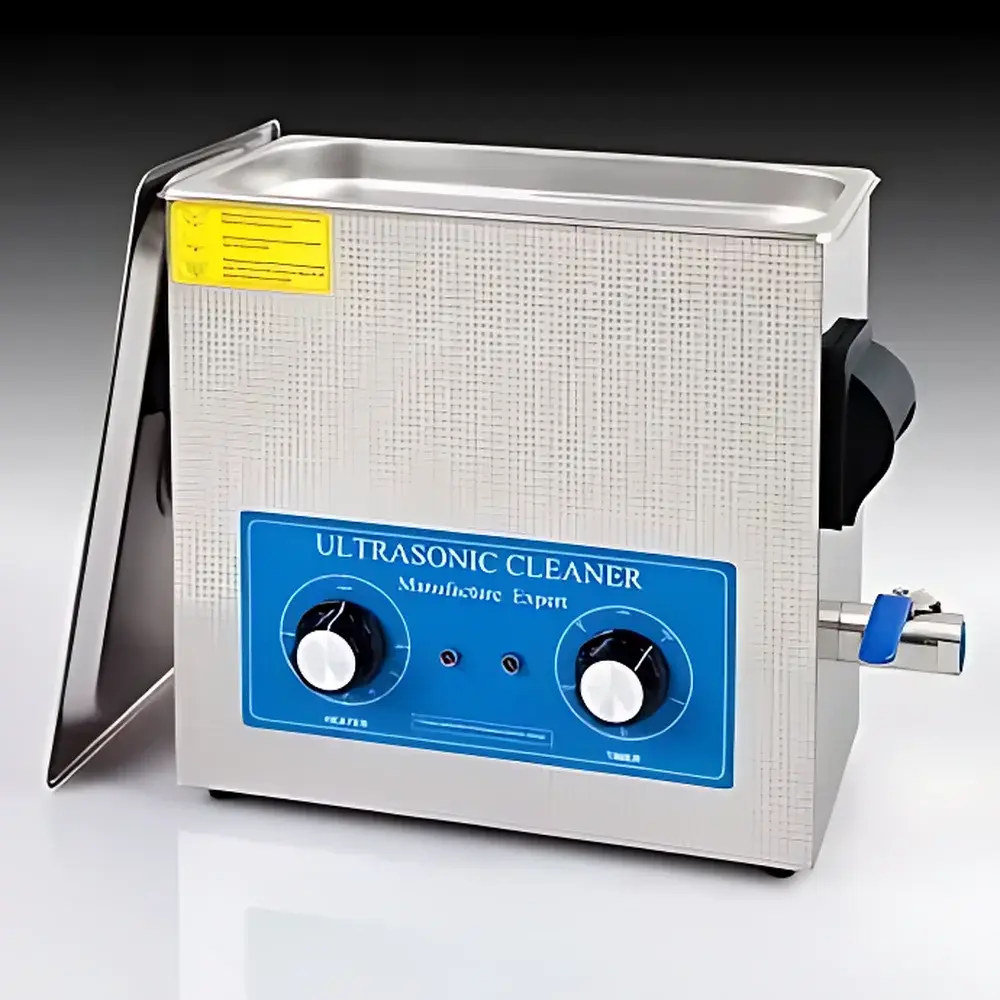
Truelab UC-T7 Benchtop Ultrasonic Cleaner
| Brand | Truelab |
|---|---|
| Origin | Shanghai, China |
| Model | UC-T7 |
| Type | General-purpose ultrasonic cleaner |
| Capacity | 7.0 L |
| Ultrasonic Frequency | 40 kHz |
| Ultrasonic Power Output | 150 W |
| Adjustable Power | Up to 300 W (heating only) |
| Temperature Control Range | 20–80 °C |
| Timer Range | 1–20 min |
| Sound-dampening Lid | Included |
| Drain Port | Yes |
| Tank Dimensions (L×W×H) | 300 × 155 × 150 mm |
| Overall Dimensions (L×W×H) | 330 × 180 × 310 mm |
| Net Weight | 5.45 kg |
| Construction | Full SUS304 stainless steel tank and housing |
| Stainless Steel Mesh Basket | Included |
Overview
The Truelab UC-T7 is a precision-engineered benchtop ultrasonic cleaner designed for consistent, repeatable cleaning performance in academic laboratories, quality control environments, and small-scale production settings. It operates on the principle of acoustic cavitation: a 40 kHz ultrasonic generator drives piezoelectric transducers bonded to the bottom of a monolithic SUS304 stainless steel tank, inducing high-frequency pressure waves in the cleaning medium. These waves generate transient microbubbles that collapse violently near submerged surfaces—producing localized shockwaves and microstreaming that dislodge particulate contaminants, organic residues, oils, oxides, and biofilms from complex geometries—including blind holes, crevices, and microchannels—without mechanical abrasion or surface damage.
Key Features
- Monobloc SUS304 stainless steel tank: Deep-drawn, seamless construction eliminates weld seams and potential leakage points—ensuring long-term corrosion resistance and compliance with ISO 15190:2020 laboratory safety standards.
- High-efficiency transducer array: Optimized for uniform energy distribution across the entire tank volume, delivering stable 150 W nominal ultrasonic output at 40 kHz with minimal frequency drift under load.
- Dual-function digital control panel: Independent adjustment of ultrasonic duration (1–20 min), heating setpoint (20–80 °C), and auxiliary heating power (up to 300 W)—enabling method-specific optimization for diverse sample types and cleaning chemistries.
- Integrated sound-dampening lid: Reduces airborne noise to ≤55 dB(A) at 1 m distance, meeting OSHA 29 CFR 1910.95 workplace noise exposure guidelines for continuous operation.
- Ergonomic design: Molded side handles and compact footprint (330 × 180 × 310 mm) facilitate safe repositioning on shared lab benches; drainage port enables rapid solvent exchange and residue removal between cycles.
- Stainless steel mesh basket: Precision-welded SUS304 frame with 2 mm aperture grid supports delicate components while permitting full acoustic coupling and solution circulation.
Sample Compatibility & Compliance
The UC-T7 accommodates a broad range of substrates—including metal alloys (stainless steel, aluminum, titanium), glassware (vials, cuvettes, capillary tubes), silicon wafers, printed circuit boards (PCBs), optical lenses, and biological fixtures (surgical instruments, endoscopic components). Its non-contact cleaning mechanism preserves dimensional integrity and surface finish. The unit complies with IEC 61010-1:2010 for electrical safety in laboratory equipment and meets CE marking requirements for electromagnetic compatibility (EMC Directive 2014/30/EU). When operated with aqueous alkaline or neutral detergents validated per ASTM D4893–22, it supports GLP-aligned cleaning validation protocols for residual analysis in pharmaceutical QC labs.
Software & Data Management
The UC-T7 operates via an embedded microcontroller with non-volatile memory—retaining user-defined time/temperature presets across power cycles. While it does not feature network connectivity or PC interface, its analog-digital hybrid control architecture ensures deterministic behavior and immunity to firmware-related failures. All parameter changes are logged internally with timestamp resolution (±1 s) for audit trail generation during internal process reviews. For regulated environments requiring electronic records, integration with external environmental monitoring systems (e.g., Vaisala viewLinc or DeltaTRAK) is supported via dry-contact relay outputs (optional accessory).
Applications
- Precision parts cleaning prior to metrology, coating, or soldering in electronics manufacturing.
- Removal of cutting fluids and polishing compounds from machined components in R&D prototyping labs.
- Pre-analytical preparation of HPLC vials, GC autosampler trays, and ICP-MS sample introduction hardware.
- Decontamination of reusable pipette tips, centrifuge rotors, and electrophoresis combs in molecular biology workflows.
- Extraction support for solid-phase microextraction (SPME) and accelerated solvent extraction (ASE) sample prep methods.
- Routine maintenance of optical components and MEMS devices where particle-free surfaces are critical.
FAQ
Is the UC-T7 suitable for cleaning delicate optical components without causing surface pitting?
Yes—when operated at 40 kHz with low-power settings (≤50% amplitude) and compatible low-surface-tension solvents (e.g., isopropanol/water mixtures), the UC-T7 delivers controlled cavitation intensity appropriate for coated lenses and fused silica substrates.
Does the unit support validation documentation for ISO 13485 or FDA 21 CFR Part 820 compliance?
The UC-T7 provides traceable operational parameters and stable thermal/ultrasonic performance—enabling users to develop IQ/OQ protocols using third-party calibration tools (e.g., hydrophone-based power mapping and RTD-verified temperature profiling).
Can the drain port be connected to a floor drain or waste collection system?
Yes—the standard 8 mm BSP-threaded outlet accepts flexible PVC tubing (ID 8 mm) and may be routed to passive or vacuum-assisted waste lines per local laboratory plumbing codes.
What maintenance is required to sustain optimal ultrasonic performance over time?
Routine inspection of transducer bonding integrity, periodic descaling of the tank interior using 5% citric acid solution, and verification of lid gasket compression force every 6 months are recommended to maintain acoustic coupling efficiency and thermal seal reliability.



