
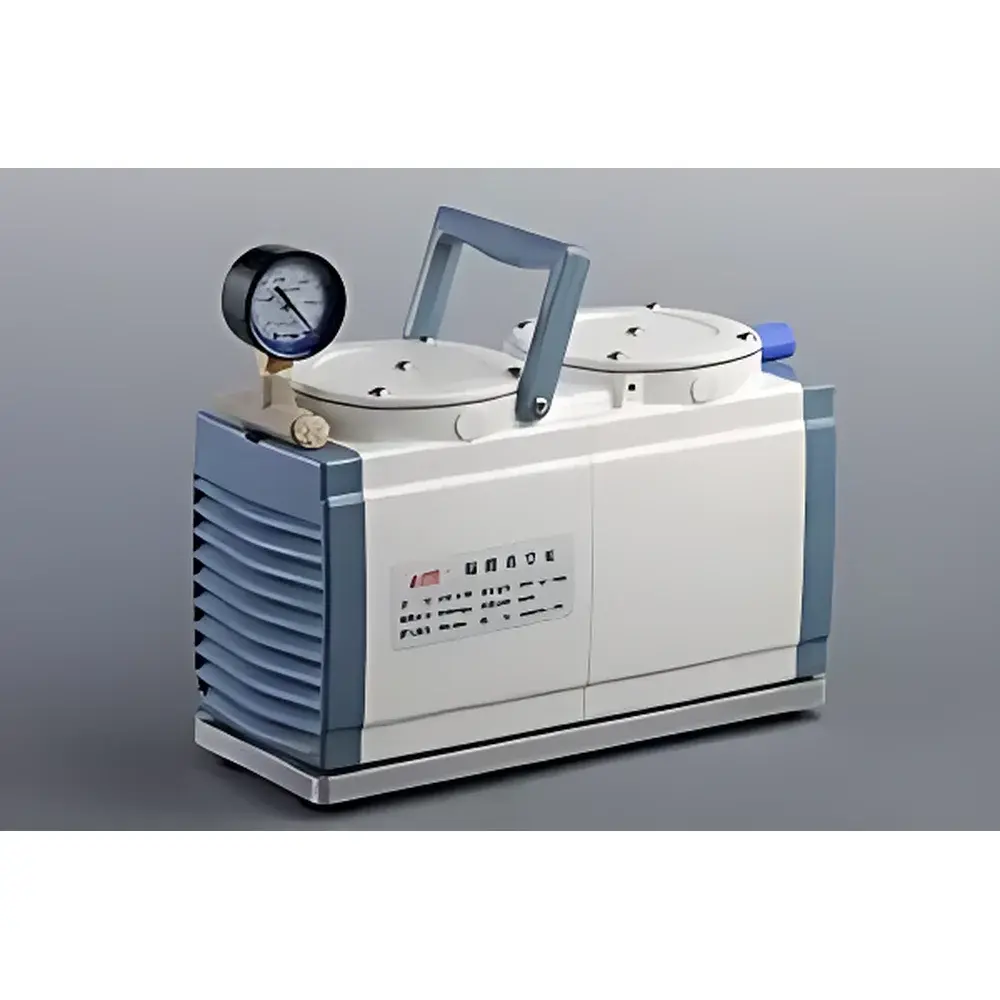
JINTENG GM-0.33B (GM-0.33III) Oil-Free Diaphragm Vacuum Pump
| Brand | JINTENG |
|---|---|
| Origin | Tianjin, China |
| Model | GM-0.33B (GM-0.33III) |
| Pump Type | Oil-Free Diaphragm Vacuum Pump |
| Ultimate Vacuum | ≤ −0.095 MPa (≤ 75 mbar absolute) |
| Air Displacement Rate | 20 L/min |
| Motor Power | 120 W (Single-Phase) |
| Dimensions (W×D×H) | 282 × 130 × 210 mm |
| Weight | 10 kg |
| Operating Temperature Range | 7–40 °C |
| Max. Surface Temperature | < 55 °C |
| Noise Level | < 50 dB(A) |
| Inlet Port Diameter | φ6 mm |
| Dual-Head Configuration | Positive/Negative Pressure Capable |
Overview
The JINTENG GM-0.33B (GM-0.33III) is an oil-free diaphragm vacuum pump engineered for precision laboratory applications requiring clean, contamination-free vacuum generation. Unlike rotary vane or piston pumps, it operates without lubricating oil—eliminating the risk of hydrocarbon backstreaming, oil vapor contamination, or sample degradation. Its core mechanism relies on reciprocating fluorocarbon-elastomer (FKM) diaphragms actuated by an eccentric cam drive, enabling positive displacement with zero internal friction or metal-to-metal contact. This design ensures stable vacuum output across extended duty cycles, making it suitable for integration with sensitive analytical instrumentation—including gas chromatographs (GC), HPLC degassers, vacuum ovens, and solvent filtration manifolds—where vacuum integrity and chemical compatibility are non-negotiable.
Key Features
- Oil-free operation: No lubricants required; eliminates oil mist, vapor carryover, and maintenance associated with oil-sealed systems.
- Chemically resistant construction: Aluminum alloy housing with corrosion-resistant coating; FKM diaphragms compatible with mild organic solvents, acids, and bases encountered in routine lab workflows.
- Dual-head configuration: Simultaneously supports both vacuum (negative pressure) and pressure (positive pressure) modes—ideal for applications such as vacuum-assisted filtration followed by pressure-driven sample transfer.
- Thermally managed design: Integrated passive cooling fins and optimized airflow routing maintain pump head temperature below 55 °C during continuous 24-hour operation.
- Adjustable vacuum regulation: Built-in pressure control knob allows fine-tuning of suction force to match application-specific requirements—from gentle cell harvesting to aggressive solvent removal.
- Low-noise performance: Acoustic enclosure and vibration-dampening mounting reduce operational noise to <50 dB(A), supporting use in shared laboratory environments without acoustic interference.
- Compact footprint & portability: Weighing only 10 kg with dimensions of 282 × 130 × 210 mm, it integrates seamlessly onto benchtops, fume hoods, or mobile carts.
Sample Compatibility & Compliance
The GM-0.33B is routinely deployed in regulated environments where material purity and process repeatability are critical. Its oil-free architecture aligns with ISO 8573-1 Class 0 air quality standards for contaminant-free gas handling—making it appropriate for use upstream of GC injectors, mass spectrometer inlets, or lyophilizer condensers. While not certified to specific FDA 21 CFR Part 11 or EU Annex 11 requirements as a standalone device, its stable performance, traceable operating parameters (e.g., pressure setpoint, runtime), and mechanical reliability support GLP/GMP-aligned documentation practices when integrated into validated workflows. The pump complies with IEC 61000-6-3 (EMC emission limits) and IEC 61000-6-2 (immunity to electrostatic discharge and RF fields), ensuring electromagnetic compatibility in instrument-dense laboratories.
Software & Data Management
As a standalone mechanical vacuum source, the GM-0.33B does not incorporate embedded firmware, digital interfaces, or data logging capabilities. It operates via manual on/off switch and analog pressure adjustment—designed for simplicity, reliability, and long-term serviceability without dependency on proprietary software or network connectivity. This architecture minimizes failure points and avoids obsolescence risks associated with firmware-dependent devices. For labs requiring audit-ready records, external pressure transducers (e.g., capacitance manometers) and programmable logic controllers (PLCs) may be interfaced via standard 0–10 V or 4–20 mA analog outputs to log vacuum profiles, runtime, and fault events within existing LIMS or SCADA frameworks.
Applications
- Solvent filtration: Paired with Büchner funnels or membrane filtration assemblies for rapid, particulate-free clarification of aqueous and organic solutions.
- Rotary evaporation: Provides consistent vacuum control for low-boiling-point solvent removal under reduced pressure, minimizing thermal stress on thermolabile compounds.
- Gas chromatography: Serves as a carrier gas purging or auxiliary vacuum source for detector exhaust lines and column oven venting.
- Sample preparation: Supports solid-phase extraction (SPE), vacuum concentration (e.g., centrifugal evaporators), and vacuum desiccation of hygroscopic materials.
- Biomedical workflows: Used in DNA/RNA purification kits, cell culture media sterilization, and forensic evidence drying—where absence of hydrocarbon residue is essential.
- Quality control labs: Deployed in pharmaceutical QC (USP , ) and food safety testing (AOAC methods) for vacuum-assisted extraction and filtration steps.
FAQ
Is the GM-0.33B compatible with aggressive solvents such as chloroform or acetone?
Yes—the FKM diaphragms and chemically treated aluminum housing provide resistance to common laboratory solvents; however, prolonged exposure to strong oxidizers (e.g., nitric acid fumes) or halogenated hydrocarbons at elevated temperatures should be avoided.
Can this pump be used continuously for 24/7 operation?
Yes—its self-cooling design and frictionless diaphragm motion enable uninterrupted duty cycles; ambient temperature must remain within 7–40 °C and adequate ventilation maintained.
Does the pump include vacuum gauging or automatic pressure feedback?
No—it is manually regulated; users must integrate an external vacuum gauge if real-time pressure monitoring or closed-loop control is required.
What is the expected service life of the diaphragm assembly?
Under typical laboratory usage (≤8 hrs/day, moderate load), FKM diaphragms typically exceed 10,000 hours of operational life; replacement kits are available and field-serviceable without specialized tools.
Is the GM-0.33B suitable for vacuum drying ovens?
Yes—its ultimate vacuum of ≤−0.095 MPa meets the requirements of most benchtop vacuum ovens used in polymer, ceramic, and pharmaceutical drying protocols.



