



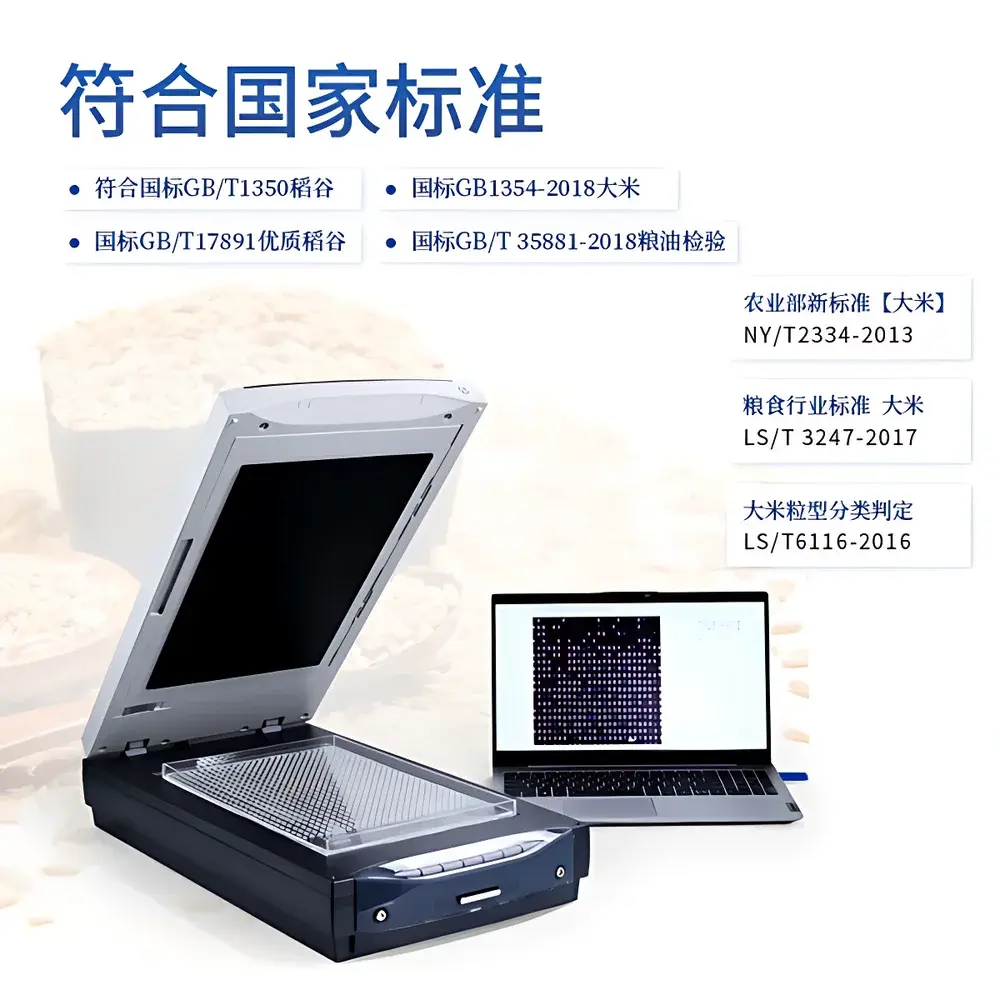

COMECAUSE IN~DM Rice Appearance Quality Analyzer
| Brand | COMECAUSE |
|---|---|
| Origin | Shandong, China |
| Manufacturer Type | Direct Manufacturer |
| Model | IN~DM |
| Price | USD 2,700 (approx.) |
| Optical Resolution | 4800 × 9600 dpi |
| Scan Area (Transmissive) | 30 cm × 20 cm |
| Minimum Pixel Size | 5.3 µm × 2.6 µm |
| Measurement Accuracy (Length) | ≤ ±0.05 mm |
| Length-to-Width Ratio Accuracy | ≤ ±0.05 |
| Repeatability Error (Morphometrics) | ≤ ±0.02 |
| Error for Head Rice Rate & Broken Rice Rate | ≤ ±1.0% |
| Repeatability for Rate Metrics | ≤ ±0.25% |
| Grain Counting Accuracy | ≥99% (≥100% with manual correction) |
| Compatible Grain Size Range | 0.25–20 mm |
| Compliance Standards | GB/T 1350, GB/T 17891, GB 1354–2018, NY/T 2334–2013, LS/T 6116–2016, LS/T 3247–2017, GB/T 35881–2018, NY/T 832–2004 |
Overview
The COMECAUSE IN~DM Rice Appearance Quality Analyzer is a high-precision, image-based analytical instrument engineered for objective, standardized assessment of rice grain morphology and visual quality attributes in accordance with national and industry standards. It employs high-resolution dual-illumination color scanning combined with advanced computer vision algorithms to acquire sub-millimeter spatial detail from individual grains—enabling quantitative measurement of geometric parameters (area, length, width, aspect ratio, diameter, roundness), optical properties (whiteness, yellowness index, transparency grade, chalkiness degree/rate), and compositional metrics (head rice rate, broken rice rate, small broken rice rate, yellow-grain count, black-grain percentage, immature grain count, fissure rate, germ ratio in brown rice, opaque grain rate in glutinous rice). Unlike subjective manual grading, the IN~DM system delivers traceable, auditable, and operator-independent results suitable for seed certification laboratories, grain quality control departments, breeding programs, and regulatory testing facilities operating under GLP or ISO/IEC 17025 frameworks.
Key Features
- High-fidelity imaging platform: A4+ extended dual-source color scanner with 4800 × 9600 dpi optical resolution and transmissive scan area of 300 mm × 200 mm ensures full-field capture of heterogeneous rice samples without cropping or stitching artifacts.
- Sub-pixel metrology engine: Achieves ≤ ±0.05 mm linear measurement accuracy and ≤ ±0.02 repeatability error for morphometric parameters; rate-based metrics (e.g., head rice, broken rice) maintain ≤ ±1.0% absolute error and ≤ ±0.25% repeatability across repeated runs.
- Multi-standard compliance mode: Built-in analytical templates map directly to GB/T 1350, GB/T 17891, GB 1354–2018, NY/T 2334–2013, LS/T 6116–2016, LS/T 3247–2017, GB/T 35881–2018, and NY/T 832–2004—automatically computing both mass-based and count-based ratios per standard requirements.
- Adaptive segmentation & classification: Proprietary clustering algorithms resolve adhered or overlapping grains with >99% initial separation accuracy; supervised learning modules support custom class labeling for atypical varieties or damaged kernels.
- Integrated hardware interface: RS232 port for direct integration with calibrated electronic balances; barcode reader support for sample traceability; optional cloud synchronization via encrypted HTTPS upload.
- Full-process documentation: Screen recording function captures real-time analysis workflow; annotated output images, distribution histograms (by length/width/area), ranked grain maps, and Excel-exportable datasets—including raw pixel coordinates and confidence scores for each measurement.
Sample Compatibility & Compliance
The IN~DM analyzer accommodates intact and fragmented rice kernels across all major types—polished rice, brown rice, glutinous rice, black rice, and specialty cultivars—with effective detection range spanning 0.25 mm to 20 mm in maximum dimension. Its validated performance meets the metrological requirements specified in GB/T 35881–2018 for image-based yellow-grain quantification and NY/T 832–2004 for black rice characterization. The system supports dual-mode reporting: count-based statistics (e.g., number of chalky grains per 100) and mass-weighted percentages (e.g., chalkiness area as % of total sample surface), ensuring alignment with both traditional inspection protocols and modern digital quality assurance systems. All measurements are performed under controlled ambient conditions (10–30°C, RH ≤85%, no direct glare), and mechanical stability is ensured by vibration-damped placement on level surfaces.
Software & Data Management
The proprietary Windows-based analysis suite includes a hardware-locked software key and operates on the included notebook PC. It features audit-trail logging compliant with basic data integrity principles—recording user ID, timestamp, parameter settings, and version-controlled algorithm flags for every analysis session. Export options include CSV and native Excel (.xlsx) formats containing raw grain-level data (ID, area, perimeter, centroid, bounding box, feature scores) alongside summary tables aligned with statutory reporting fields. Cloud storage integration enables remote access to historical datasets, cross-laboratory benchmarking, and long-term trend analysis. Raw image archives and processed overlays are stored in lossless TIFF format, preserving bit-depth fidelity for retrospective re-analysis or third-party verification.
Applications
- Grain procurement & trading: Objective verification of contractual quality specifications prior to bulk delivery.
- Rice breeding programs: High-throughput phenotyping of appearance traits (chalkiness, translucency, grain shape) across segregating populations.
- Food safety & authenticity labs: Detection of adulteration (e.g., mixed varietal content), contamination (foreign material, discolored grains), and processing defects (cracks, heat damage).
- Regulatory compliance testing: Generation of evidentiary reports for national grain grading certificates, export documentation, and conformity assessments against GB, NY/T, and LS/T standards.
- Research on post-harvest physiology: Quantitative tracking of moisture-induced fissuring, lipid oxidation-related yellowing, or enzymatic browning during storage.
FAQ
Does the IN~DM system require calibration with physical reference standards?
No routine calibration is required; however, periodic verification using certified reference rice samples (e.g., NIST-traceable chalkiness standards or ASTM E2915–22 reference sets) is recommended for ISO/IEC 17025 accreditation.
Can the software distinguish between naturally yellowed grains and those contaminated with ochratoxin A?
No—the system measures chromaticity (CIE L*a*b* values) and surface reflectance only; it does not perform chemical identification. Yellow-grain detection complies with GB/T 35881–2018’s visual definition but requires confirmatory HPLC or ELISA for mycotoxin validation.
Is FDA 21 CFR Part 11 compliance supported?
The current software version provides electronic signature capability and audit trail generation; full Part 11 compliance (including biometric authentication and system validation packages) is available under custom enterprise licensing.
What is the maximum throughput per hour?
Under standard operating conditions (sample prep + scan + analysis), the system processes 8–12 batches/hour, with each batch containing up to 200 g of milled rice (≈2,500–4,000 grains), depending on variety and kernel density.
Are firmware updates provided after purchase?
Yes—COMECAUSE offers free minor-version updates for two years post-delivery; major version upgrades (e.g., AI model enhancements or new standard integrations) are available under annual maintenance contracts.





