
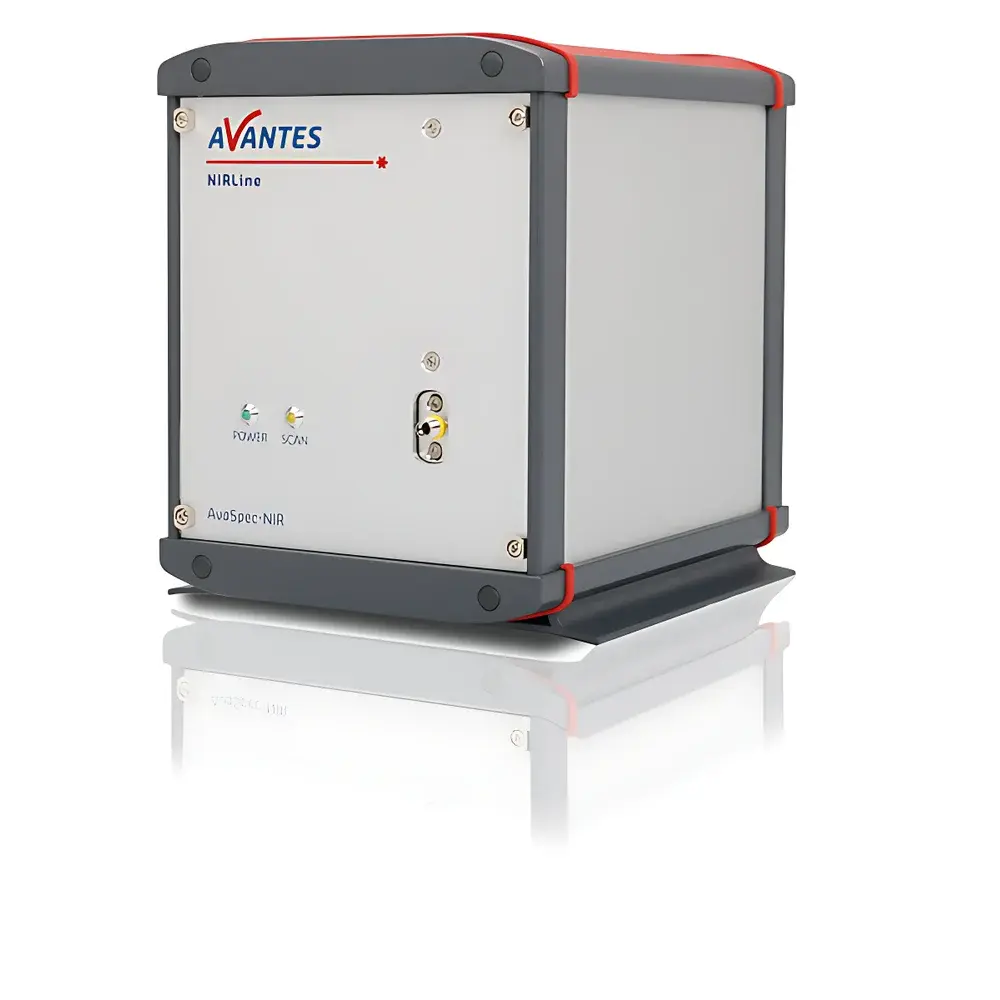
Avantes AvaSpec-NIR256-1.7-HSC-EVO Cooled Near-Infrared Spectrometer
| Brand | Avantes |
|---|---|
| Origin | Netherlands |
| Model | NIR256-1.7-HSC-EVO |
| Wavelength Range | 900–1750 nm |
| Scan Speed | 0.13 ms/scan |
| Data Sampling Interval | 0.4 ms/scan |
| Measurement Mode | Transmission/Reflection |
| Optical Design | Symmetrical Czerny-Turner, 100 mm focal length, 1-stage TE-cooled |
| Detector | TE-cooled InGaAs linear array (256 × 50 µm × 500 µm) |
| Interface | USB 3.0 (5 Gbps) and Gigabit Ethernet (1 Gbps) |
| AD Converter | 16-bit, 1.2 MHz |
| Integration Time (HS mode) | 20 µs – 500 ms |
| Integration Time (LN mode) | 20 µs – 20 s |
| Dynamic Range (HS/LN) | 4900:1 / 7600:1 |
| SNR (HS/LN) | 1900:1 / 5000:1 |
| Gain Modes | High Sensitivity (HS) and Low Noise (LN) |
| Grating Options | Four selectable, exchangeable gratings |
| Slit Options | Interchangeable slits (25–500 µm) |
| Digital I/O | HD-26 connector with 13 bidirectional digital I/O lines, 2 analog inputs/outputs, trigger/sync/gate/laser control |
| Operating Temperature | 0–40 °C |
| Cooling | ΔT = 24 °C below ambient |
| Dimensions & Weight | 185 × 160 × 184 mm, 3.6 kg |
| Software | AvaSoft suite with chemometrics support |
Overview
The Avantes AvaSpec-NIR256-1.7-HSC-EVO is a high-performance, thermoelectrically cooled near-infrared spectrometer engineered for demanding quantitative and qualitative analysis in research laboratories and industrial process environments. It operates on the principle of fixed-grating, non-scanning dispersive spectroscopy using a 256-pixel TE-cooled InGaAs linear array detector, enabling rapid spectral acquisition without mechanical movement. Its optical architecture employs a symmetrical Czerny-Turner design with a 100 mm focal length, optimized for throughput and stray-light suppression across the extended NIR range of 900–1750 nm — a critical window for overtone and combination band detection in organic molecules (e.g., C–H, O–H, N–H). The integrated EVO electronics platform delivers ultra-low-noise signal conditioning, supporting both high-sensitivity (HS) and low-noise (LN) operational modes to accommodate diverse sample types—from highly absorbing solids to low-concentration liquid solutions.
Key Features
- Single-stage thermoelectric cooling (ΔT = 24 °C below ambient) stabilizes detector dark current, ensuring long-term spectral reproducibility and baseline stability—essential for multivariate calibration transfer and GLP-compliant workflows.
- Dual gain architecture: HS mode maximizes photon collection efficiency for weak signals; LN mode extends dynamic range and improves precision for high-intensity or broadband sources.
- Sub-millisecond spectral acquisition: 0.13 ms/scan frame rate enables real-time monitoring of fast chemical processes, such as polymer curing kinetics or pharmaceutical blend uniformity assessment.
- Flexible optical configuration: Four interchangeable gratings and slit widths (25–500 µm) allow resolution tuning from 1.7 nm to 32 nm (FWHM), balancing spectral fidelity against sensitivity per application requirement.
- Robust synchronization capability: HD-26 digital I/O interface supports hardware triggering, external shutter control, pulsed source gating, and laser diode power modulation—critical for time-resolved reflectance or pump-probe configurations.
- Industrial-grade connectivity: Simultaneous USB 3.0 (5 Gbps) and Gigabit Ethernet interfaces ensure deterministic data streaming in embedded systems and networked lab environments, with full support for remote configuration and firmware updates.
Sample Compatibility & Compliance
The AvaSpec-NIR256-1.7-HSC-EVO accommodates transmission, diffuse reflection, and fiber-coupled probe-based measurements via standard SMA 905 connectors. Its extended 1.7 µm cutoff enables robust analysis of agricultural feedstocks (e.g., moisture, protein, starch), pharmaceutical tablets (API concentration, coating thickness), and petrochemical streams (hydrocarbon composition, octane rating). The instrument meets key regulatory expectations for analytical instrumentation: its digital I/O architecture supports audit-trail-capable triggering logic aligned with FDA 21 CFR Part 11 requirements when paired with compliant software environments; thermal stabilization and calibrated wavelength referencing facilitate ISO/IEC 17025 traceability in accredited testing labs; and its mechanical robustness (IP20-rated enclosure, shock-tested mounting points) ensures suitability for continuous operation in QC/QA settings under GLP or GMP frameworks.
Software & Data Management
Control and data acquisition are managed through the modular AvaSoft software suite, which provides native support for chemometric modeling—including PLS regression, PCA, and cluster analysis—directly within the acquisition environment. Raw spectra are stored in vendor-neutral formats (e.g., ASCII, CSV, HDF5) and include embedded metadata (wavelength calibration, integration time, gain setting, temperature log). The SDK (C/C++, .NET, Python) enables integration into custom LIMS or MES platforms and supports automated batch processing pipelines compliant with ASTM E1655-22 (standard practice for NIR quantitative analysis). All software modules undergo version-controlled release cycles with documented change logs, satisfying internal validation protocols required by regulated industries.
Applications
- Real-time quality assurance in continuous manufacturing: inline monitoring of granule moisture during fluid-bed drying or tablet hardness prediction via NIR reflectance mapping.
- Academic research in molecular spectroscopy: investigation of hydrogen-bonding dynamics in solvated biomolecules using time-resolved NIR absorption kinetics.
- Material science: quantification of polymer crystallinity, filler dispersion, and degradation products in composites exposed to thermal or UV stress.
- Food safety analytics: rapid screening of adulterants (e.g., melamine in milk powder) and authenticity verification (geographic origin of olive oil) using spectral fingerprinting.
- Environmental monitoring: field-deployable analysis of soil organic carbon content and nitrate concentrations in aqueous extracts via fiber-optic probe coupling.
FAQ
What is the maximum achievable optical resolution with this spectrometer?
Resolution is determined by grating line density and input slit width. With the 600 lines/mm grating and 25 µm slit, the theoretical FWHM is ~0.88 nm across 960–1700 nm—verified experimentally using low-pressure neon emission lines per ISO 14785.
Can the instrument operate unattended for extended periods in a production environment?
Yes. Its solid-state TE cooler requires no consumables or maintenance; thermal management is fully passive after initial stabilization. Continuous operation at 30 °C ambient has been validated over 720 hours with <0.05 nm wavelength drift and <1.2% intensity variation.
Is AvaSoft compatible with third-party chemometrics packages such as Unscrambler or MATLAB?
Raw spectral data exports support direct import into Unscrambler X (via .csv/.txt), MATLAB (via .mat or text readers), and Python (NumPy/Pandas). Calibration models built externally can be deployed via AvaSoft’s user-defined algorithm interface.
Does the spectrometer support NIST-traceable wavelength calibration?
Yes. Factory calibration uses certified rare-gas emission lamps (Ne, Ar); users may perform re-calibration in situ using optional calibration kits traceable to NIST SRM 2035 or equivalent national standards.
How is compliance with electromagnetic compatibility (EMC) ensured?
The unit conforms to EN 61326-1:2013 (industrial environment) and FCC Part 15 Subpart B Class A, with conducted and radiated emissions tested per CISPR 11. Shielded cabling and ferrite suppression are recommended for high-noise factory floors.




