
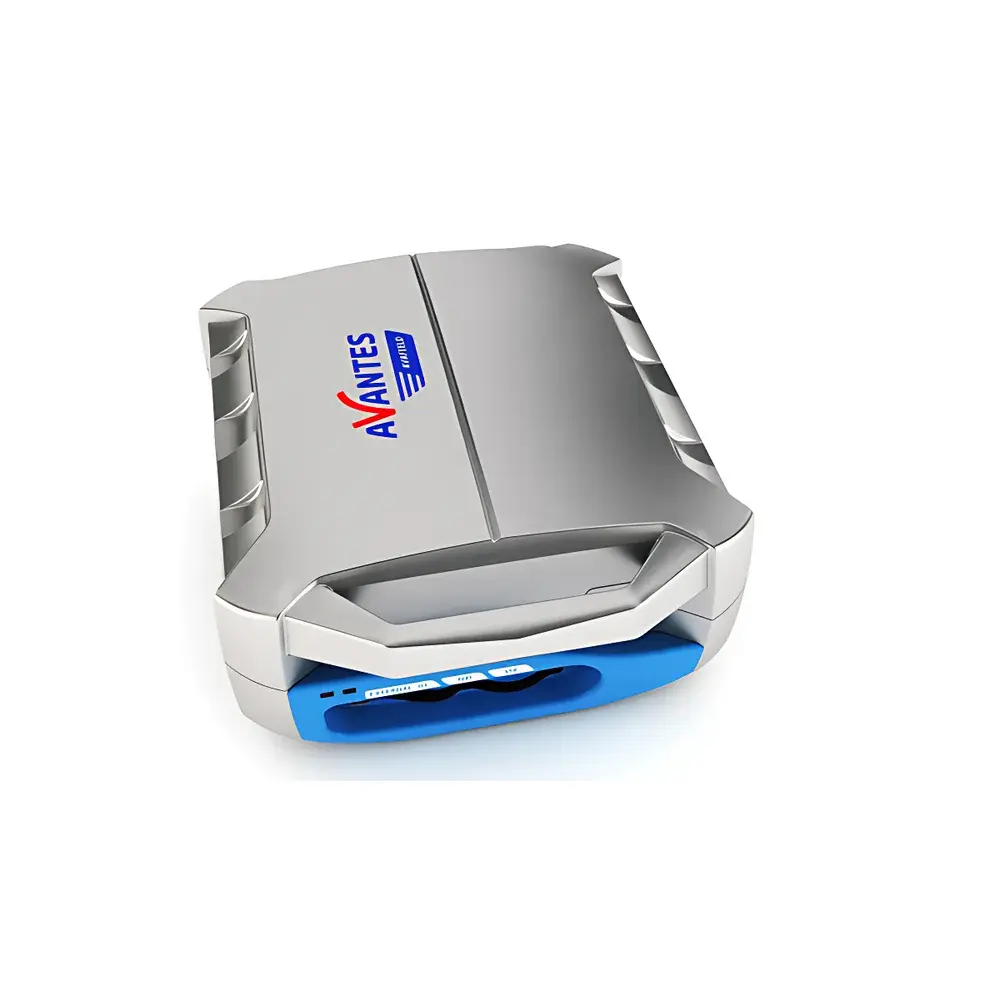
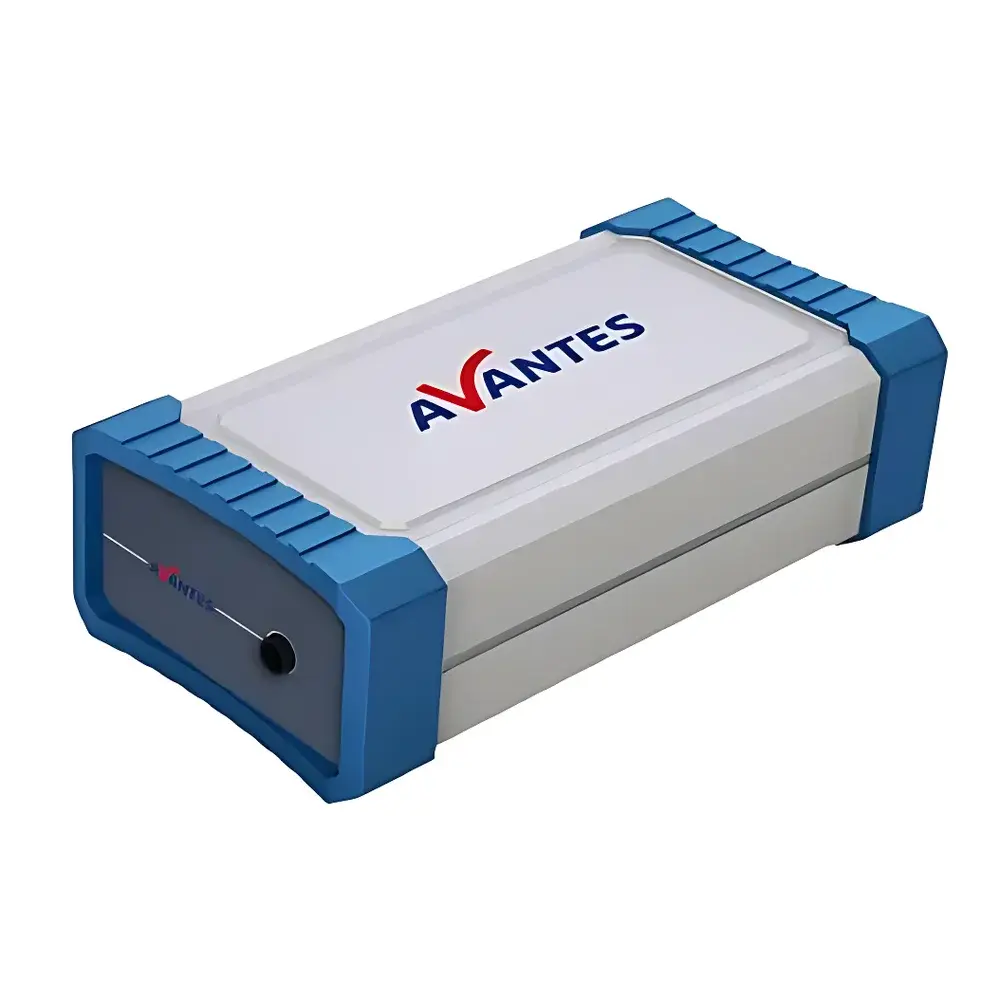
Avantes AvaField-1/2/3/EDU Portable Field Spectroradiometer
| Brand | Avantes |
|---|---|
| Origin | Netherlands |
| Detector Type | CCD (AvaField-1/2/EDU), InGaAs (AvaField-3) |
| Spectral Range | 300–1100 nm (AvaField-1), 350–1050 nm (AvaField-EDU), 300–1700 nm (AvaField-2), 300–2500 nm (AvaField-3) |
| Spectral Resolution | 1.4–15.0 nm (model-dependent) |
| Spectral Sampling Interval | 0.6–6.0 nm |
| Wavelength Accuracy | ±0.3–±3.0 nm |
| Wavelength Repeatability | ±0.1 nm |
| Detector | Back-thinned CCD (2048 px, 14×500 µm), CMOS (2048 px, 14×200 µm), or TE-cooled InGaAs array (256 px) |
| Linearity | >99% |
| Integration Time | ~10 ms per spectrum |
| Dynamic Range | 3800:1 |
| Signal-to-Noise Ratio | 500:1 |
| Stray Light | <0.1% |
| Operating Temperature | 0–40 °C |
| Dimensions & Weight | 275×140×85 mm / 2.0 kg (AvaField-1), 170×120×60 mm / 0.8 kg (EDU), 310×270×135 mm / 5.2–5.8 kg (AvaField-2/3) |
Overview
The Avantes AvaField-1/2/3/EDU series comprises rugged, portable field spectroradiometers engineered for high-fidelity spectral measurements in natural and semi-controlled environments. Based on grating-based optical dispersion and solid-state detector technology, these instruments operate on the principle of wavelength-resolved radiance detection—capturing absolute or relative spectral irradiance, radiance, reflectance, transmittance, and luminance across ultraviolet, visible, and near-infrared (VNIR) to short-wave infrared (SWIR) regions. Designed specifically for geoscience and environmental remote sensing applications, the AvaField platform integrates calibrated optical throughput, thermal stability mechanisms, and field-hardened mechanical architecture to ensure measurement integrity under variable ambient conditions—including solar loading, temperature drift, and mechanical vibration. Each model is factory-calibrated traceable to NIST standards, with spectral responsivity characterized using standard lamps (e.g., FEL-type) and reference panels (e.g., Spectralon®). The system supports both contact and non-contact measurement modalities via interchangeable fiber-optic probes, enabling flexible deployment in terrestrial, airborne (UAV-integrated), and aquatic settings.
Key Features
- Multi-spectral coverage options: AvaField-1 (300–1100 nm), AvaField-EDU (350–1050 nm), AvaField-2 (300–1700 nm), and AvaField-3 (300–2500 nm) — optimized for vegetation indices, mineral absorption features, and atmospheric water vapor bands.
- High optical fidelity: Stray light suppression 99% ensure robust inter-comparison across campaigns and instruments.
- Field-oriented ergonomics: Integrated inclinometer for probe angle reporting, Class II laser pointer for spatial targeting, IP54-rated enclosure for dust and moisture resistance, and built-in optical shutter for dark-current referencing without manual cover manipulation.
- Real-time acquisition capability: Sub-10 ms spectral integration enables rapid scanning of dynamic scenes—critical for UAV-mounted hyperspectral surveys and time-series monitoring of phenological or hydrological processes.
- Modular probe interface: SMA 905-compatible fiber input accepts cosine correctors, collimating lenses, integrating spheres, and bidirectional reflectance distribution function (BRDF) goniometers per ASTM E275 and ISO 13406-2.
Sample Compatibility & Compliance
The AvaField series accommodates diverse sample geometries and optical properties—from diffuse reflectance of soil and foliage to directional radiance of water bodies and urban surfaces. Its spectral calibration accounts for angular response non-uniformity and polarization sensitivity, meeting requirements for ground-truth validation of satellite and airborne sensors (e.g., Sentinel-2, Landsat-9, PRISMA). Instrument design complies with IEC 61000-6-2 (EMC immunity) and IEC 60529 (IP54 ingress protection). Data acquisition workflows support GLP-aligned metadata tagging—including GPS coordinates, timestamp (UTC), ambient temperature/humidity, solar zenith angle, and operator ID—enabling traceability in regulatory-grade environmental monitoring (e.g., EPA Method IO-3.3, ISO 17025-accredited labs).
Software & Data Management
Bundled AvaSoft-Full software provides real-time spectral visualization, batch processing, and export in interoperable formats (CSV, ENVI BIL, HDF5). It includes embedded algorithms for BRDF correction, atmospheric compensation (using MODTRAN-derived lookup tables), and vegetation index computation (NDVI, EVI, PRI, MCARI). Raw data files retain full audit trail metadata compliant with FDA 21 CFR Part 11 requirements when configured with electronic signature and user access control. Third-party integration is supported via DLL, .NET, and Python APIs—facilitating automation in custom UAV telemetry pipelines or IoT-enabled sensor networks.
Applications
- Agricultural monitoring: Quantification of chlorophyll content, nitrogen status, water stress, and crop health via narrow-band indices derived from 300–2500 nm spectra.
- Forestry and ecology: Species classification, canopy structure analysis, and post-disturbance recovery assessment using spectral unmixing and machine learning classifiers.
- Geological surveying: Identification of clay minerals, iron oxides, carbonates, and hydrocarbons based on diagnostic absorption features in SWIR (1000–2500 nm).
- Hydrological and coastal studies: Retrieval of chlorophyll-a, suspended sediment concentration, and CDOM (colored dissolved organic matter) from in situ water-leaving radiance.
- Atmospheric and urban remote sensing: Detection of NO₂, SO₂, and aerosol optical depth through differential optical absorption spectroscopy (DOAS)-compatible spectral fitting.
FAQ
Is the AvaField series suitable for UAV integration?
Yes—compact models (AvaField-1 and EDU) are routinely integrated into multirotor and fixed-wing UAV platforms with real-time telemetry and geo-referenced spectral stitching capabilities.
What calibration standards are applied during manufacturing?
Each unit undergoes absolute radiometric calibration using NIST-traceable tungsten-halogen and deuterium lamps, with spectral responsivity validated against calibrated reference panels across the full operational range.
Can the instrument perform absolute radiance measurements?
Yes—when coupled with a calibrated cosine corrector and appropriate geometric setup, AvaField systems deliver SI-traceable radiance (W·sr⁻¹·m⁻²·nm⁻¹) and irradiance (W·m⁻²·nm⁻¹) values.
How is thermal drift managed during extended field deployments?
AvaField-2 and AvaField-3 incorporate thermoelectric (TE) cooling for InGaAs detectors; all models feature internal temperature monitoring and wavelength stabilization algorithms that compensate for thermal expansion of optical components.
Does the system support compliance with ISO/IEC 17025 or FDA 21 CFR Part 11?
Yes—when deployed with AvaSoft-Full’s audit trail module, role-based access control, and electronic signature functionality, the system meets documentation and data integrity requirements for accredited testing laboratories and regulated environmental monitoring programs.






